
What Is Financial Astrology? The Strange, Old, Surprisingly Persistent Tradition Explained
The history, the evidence, and why this practice has survived centuries of skepticism to find a new audience among retail investors.
If you’ve spent any time on FinTwit lately, you’ve probably seen someone post a chart of the S&P with planetary symbols on it. Maybe they call themselves a financial astrologer. Maybe they’re an anonymous account who posts cryptic Mercury retrograde warnings to a surprisingly large following. Maybe they’re a serious-looking analyst whose newsletter has charts you don’t recognize.
Welcome to financial astrology — a tradition with deeper roots than most people realize, currently having a small renaissance among investors hunting for any edge they can find. Here’s what its practitioners claim, why so many traders are paying attention again, and how you might think about adding this lens to whatever you’re already doing.
The Short Version
Financial astrology is the practice — described and defined by astrologers themselves — of mapping astronomical cycles (the positions and apparent motions of the Sun, Moon, and planets) to financial markets. Practitioners use these cycles to identify timing windows, sector themes, and contextual frameworks for trading and investing. Many believe these signals give them a meaningful edge. Skeptics disagree. The tradition has persisted for thousands of years either way.
It is not a system for predicting specific prices, and serious practitioners don’t claim it is. Anyone who says astrology will tell you exactly when to buy Apple is selling something — and that something is probably a course.
A History More Interesting Than You’d Expect
Astrology and money have been entangled since long before anyone called it a stock market. Babylonian astronomers were correlating planetary cycles with grain prices and military campaigns more than two thousand years ago. Medieval and Renaissance merchants consulted astrologers about voyage timing and harvest yields. By the time recognizable financial markets emerged in the 17th and 18th centuries, looking up before making a trade had a long tradition behind it.
The figure most associated with modern financial astrology is W.D. Gann, a stock and commodities trader active in the early 20th century. Gann claimed to have predicted major market turns using a combination of geometric analysis, numerology, and astrology. He published widely-read books, attracted a devoted following, and is still studied today by traders who specialize in cycle analysis. Whether his real edge was actually astrological or just disciplined pattern recognition with cosmic scaffolding is a debate that’s been running for a century. The fact that he made significant money is documented; the methodology behind it remains contested.
Less famous but more documented is Evangeline Adams, the most prominent astrologer in early 20th-century New York. Her clientele reportedly included JP Morgan, Charles Schwab, and other titans of the era. She was prosecuted for fortune-telling in 1914, defended herself by demonstrating her technique on the judge’s son, and was acquitted — a moment that helped legitimize astrology as a profession in the United States.
The most-circulated quote in this corner of finance — “Millionaires don’t use astrologers, billionaires do” — is usually attributed to JP Morgan. Whether he actually said it is contested. That doesn’t seem to slow its circulation.
The 20th century saw a quieter continuation. Donald Bradley developed a “siderograph” model in the 1940s that combined planetary positions into a single time-series indicator, still used by some practitioners. Bill Meridian and others built professional advisory practices. Most worked discreetly — Wall Street has never been a particularly tolerant culture for approaches that can’t be defended on a CFA exam.
The current renaissance is driven by two factors: astrology’s mainstream resurgence (post-2015, partly meme-fueled, partly Co-Star) and the commoditization of obvious quantitative edges, which has made traders more open to looking for unusual analytical frames.
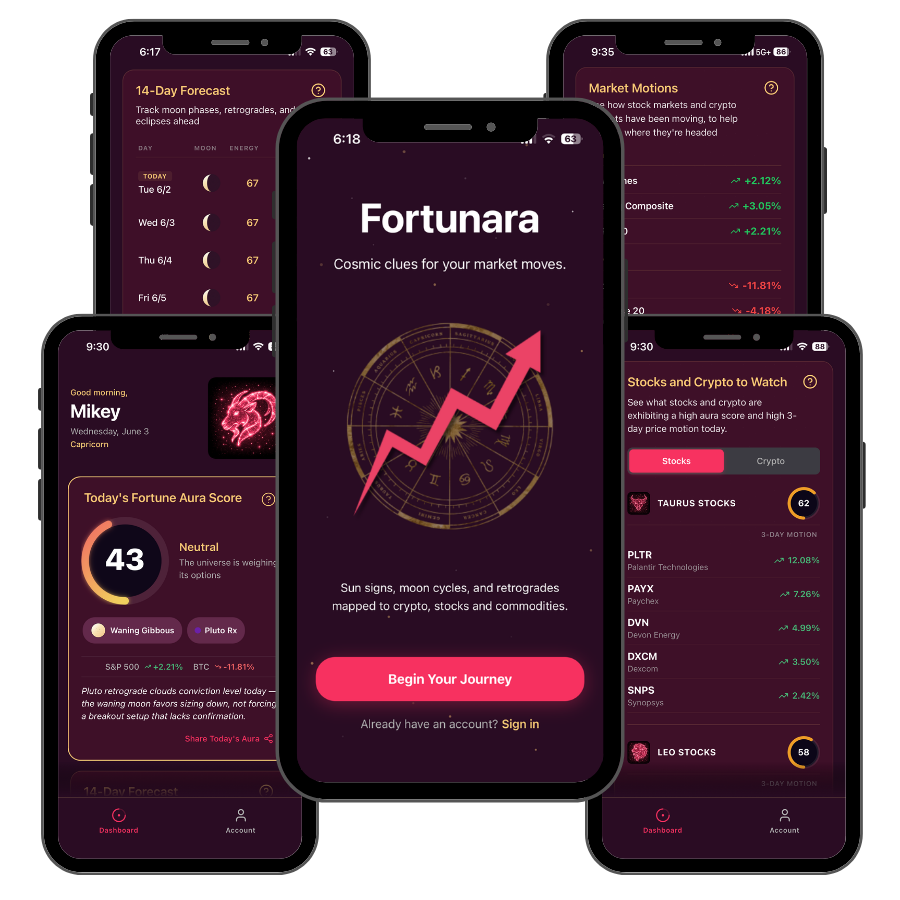
Get cosmic clues for your market moves.
Daily planetary signals mapped to your watchlist. Personalized to your sign.
Get Early AccessFor entertainment only. Not financial advice.
What Financial Astrologers Actually Watch
A common misconception is that financial astrology is “your horoscope, but for stocks.” It really isn’t. The practice uses the same astronomical raw material as any astrology, but interprets it through a different lens — one focused on collective economic behavior rather than individual psychology.
The three layers most-watched by practitioners:
Lunar cycles. The Moon completes a full cycle every 29.5 days, moving through all twelve signs. Each Full Moon falls in a different sign, carrying that sign’s thematic content. Lunar cycles are the most frequently watched layer because they’re frequent and specific.
Planetary aspects. When two planets form a geometric angle from Earth’s perspective — a conjunction (0°), opposition (180°), square (90°), trine (120°), or sextile (60°) — astrologers consider the combination significant. Aspects between the slow-moving outer planets (Jupiter, Saturn, Uranus, Neptune, Pluto) get particular attention in financial work because they last longer and correlate with broader cycles.
Outer planet ingresses. When a slow-moving planet changes signs, astrologers describe it as a generational shift. These are rare and treated as major framework changes — financial astrology’s equivalent of a regime change in macroeconomic terms.
There are also more technical layers — eclipses, retrograde cycles, “out of bounds” planets — that practitioners use depending on their approach.
How Real Astrology Differs from Your Horoscope App
Newspaper and Co-Star horoscopes apply the position of the Sun on your birthday to roughly 8% of the global population. They are not, strictly speaking, what astrologers do. They’re a popular shorthand.
Real astrology — financial or otherwise — uses the full birth chart: the position of every planet at the exact time and location of your birth, the geometric angles between them, and the houses (twelve life-domain divisions calculated from your time and place). A serious reading takes that full chart and overlays the current planetary positions (“transits”) to identify what’s active right now.
Financial astrology applies the same machinery to two different subjects. A practitioner can cast a chart for a market index, a company (using its IPO date), or a country (using its founding date) and read transits against that chart. The output looks like a horoscope. The technique is closer to macro analysis with a different set of inputs.
The Evidence Question
The practitioner tradition points to centuries of documented observation, practitioners with audited multi-decade track records, and a growing body of academic work. The most widely cited study — Dichev and Janes (2003) in the Journal of Finance — found annualized return differentials of 8.3 percentage points between new moon and full moon periods across 25 countries. That result was peer-reviewed, held across multiple time periods, and has not been refuted.
Skeptics will tell you the patterns are post-hoc fits. Practitioners will tell you the patterns have been refined over thousands of years of observation and that anyone who dismisses the field without seriously examining it has made a methodological error. Look at the 1929 crash, the dot-com peak, the 2008 collapse — serious practitioners will show you what they were tracking at each of those turns and why.
The most useful framing for a working investor: track a few cycles yourself. Personal pattern recognition, built on your own trading history overlaid with a planetary calendar, is worth more than any secondhand debate.
Who Actually Uses This
The active users fall into roughly four groups, and you might be surprised by who’s in them.
Professional financial astrologers. A small number — maybe a few dozen with public profiles — make their living advising traders, fund managers, and retail investors. They publish newsletters, host paid Discord communities, run subscription services. The work is more rigorous than outsiders assume.
Traders who use it as one input among many. A much larger group of working traders incorporate astrological technique into their broader process. Most don’t advertise the practice. You’d be surprised who does.
Curious retail investors hunting for an edge. Probably the largest group, and the audience Fortunara is built for. People who already read charts, follow earnings, and watch sentiment indicators — and figure that adding one more lens to their stack costs almost nothing if it points to even one trade they would have otherwise missed.
Investors who started as skeptics. A growing group who came in through the behavioral finance door — tracking planetary events because tens of millions of other investors follow them — and found, over time, that the practitioner framing was harder to dismiss than they expected. Many report that the longer they track the cycles, the more the traditional framework starts to feel explanatory rather than merely descriptive.
Where Fortunara Fits In
Fortunara is the first mobile app built specifically for retail use of financial astrology. We track the same layers serious practitioners watch — lunar cycles, planetary aspects, outer planet ingresses, retrograde periods — and personalize the read to your sign, the instruments you watch, and the sectors you care about. Each morning you get a daily aura score, a personalized horoscope, a watchlist of cosmically aligned stocks and crypto, and curated astro-finance news.
We don’t predict markets. We bring you the signals astrologers say matter, mapped to your chart and your watchlist. You decide what to do with them and how to combine them with the strategy you already have.
Fortunara tracks the planetary cycles and lunar phases that financial astrologers have watched for decades.
Daily aura score. Personalized Fortunarascope. 14-Day Astro Forecast. Free to start.
For entertainment only. Not financial advice.