
How to Use Astrology for Investing
Quick Answer
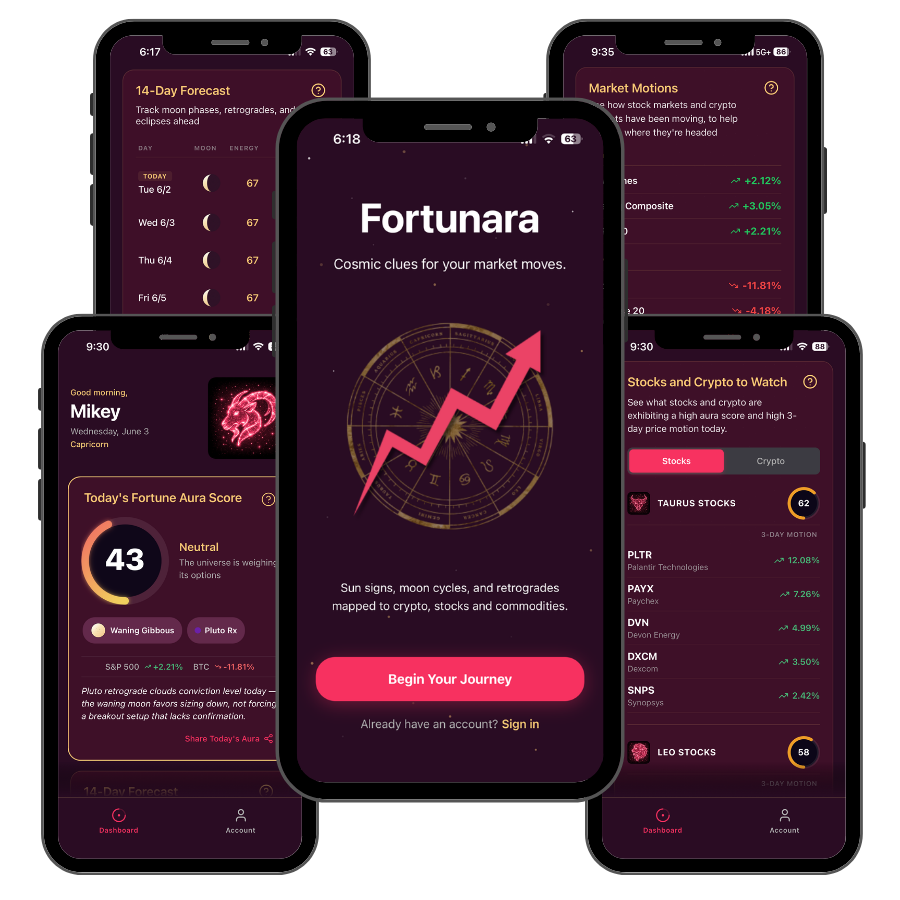
Get cosmic clues for your market moves.
Daily planetary signals mapped to your watchlist. Personalized to your sign.
Get Early AccessFor entertainment only. Not financial advice.
Step 1: Know the events worth tracking
Not every planetary event matters equally for investors. The high-signal events are:
Mercury retrograde (3x per year): The most widely-followed astrological event among retail investors. Associated with communication errors, tech volatility, and decision reversals. Many investors delay major decisions during retrograde periods. Measurable sentiment effect.
Full moon and new moon (monthly): The Dichev-Janes (2003) Journal of Finance study found consistent return differentials across 25 countries between new moon and full moon periods. New moons historically associated with expansion; full moons with completion and release.
Jupiter and Saturn transits: Slower-moving planets that signal multi-month trend shifts. Jupiter (expansion, growth) entering a new sign often coincides with sector rotations. Saturn (contraction, discipline) can signal consolidation phases.
Eclipse seasons (2x per year): Eclipse periods are associated with volatility and unexpected reversals. Two eclipse seasons per year, each lasting 4–6 weeks.
Step 2: Integrate, don’t replace
The most common mistake is treating financial astrology as a standalone system. It works better as a lens overlaid on your existing approach.
If you’re a technical analyst: check whether major planetary events align with key support/resistance levels or trend changes. When a Mercury retrograde coincides with a bearish technical setup, you have two independent signals pointing the same direction.
If you’re a fundamentals investor: use astrological timing to think about entry and exit windows, not about what to buy. Your thesis is fundamental. Your timing can incorporate planetary context.
If you’re a crypto trader: lunar cycles have a notable following in crypto communities. New moon periods have historically seen elevated buy-side sentiment in BTC and ETH. See the crypto astrology guide →
Step 3: Use your birth chart for personal timing
Beyond planetary events that affect everyone, your personal birth chart adds a layer of individual timing. When Jupiter transits your natal 2nd house (the house of money), traditional astrology associates that with financial expansion. When Saturn crosses your natal chart’s sensitive points, it often signals a period of reassessment.
Fortunara uses your birth date, time, and location to personalize the daily Fortune Aura score to your chart. This is more specific than a generic “Mercury retrograde affects everyone equally” — it accounts for how the current sky interacts with your individual planetary placements.
Step 4: Track, don’t predict
The most useful discipline is retrospective tracking before prospective acting. Go back through your trading history and overlay it with a planetary calendar. Do you notice patterns? Did you make worse decisions during Mercury retrograde periods? Did certain Jupiter transits coincide with winning trades?
This kind of personal pattern recognition — building your own evidence base — is more valuable than any generic rule.
Common Questions
Do I need to believe in astrology to use it for investing?
How much weight should I give astrological signals?
What's the best planetary event to start with?
Fortunara is for entertainment only. Nothing on this page constitutes financial advice.
Fortunara handles the planetary calendar for you.
Daily aura score, retrograde alerts, lunar phase tracking — and a personalized read for your sign every morning.
For entertainment only. Not financial advice.