
Moon Phases & the Stock Market
The moon and the market: what the data actually shows.
Quick Answer
The relationship between lunar cycles and stock market returns is one of the few astrological claims with peer-reviewed academic support. Dichev and Janes, in a 2003 paper published in the Journal of Finance, analyzed stock returns across 24 countries over 30 years and found that returns in the days around new moons ran approximately 8.3% higher annualized than returns around full moons — a statistically significant difference that held across markets.
The researchers proposed a behavioral mechanism — mood and risk appetite fluctuating with the lunar cycle in ways that influence investment decisions. Financial astrologers point to a deeper tradition: lunar cycles have shaped human behavior, agriculture, and commerce for thousands of years, and their correlation with market patterns reflects something more fundamental than coincidence. Both perspectives converge on the same practical signal: the lunar cycle is a real market timing input with documented evidence behind it. Fortunara tracks it daily alongside your personal chart.
In 2003, two finance professors published a paper in the Journal of Finance that most financial media ignored completely. Ilia Dichev of the University of Michigan and Troy Janes found that global stock returns in the days around new moons ran approximately 8.3% higher annualized than returns around full moons. The effect held across 24 countries and three decades of data. It replicated.
Financial astrologers had been describing this pattern for centuries. The Dichev and Janes study gave it peer-reviewed academic validation in one of the most prestigious finance journals in the world. The mechanism the researchers proposed was behavioral — mood cycles influencing risk appetite. The astrological tradition offers a deeper explanation. Either way, the pattern exists.
What are the moon phases and when do they occur?
The lunar cycle runs approximately 29.5 days from new moon to new moon. Four primary phases mark the cycle:
New moon: Moon is between Earth and the Sun, invisible from Earth. Traditionally associated with beginnings, new intentions, and in astrological tradition, increased optimism and willingness to initiate.
Waxing moon (new to full): The moon grows from invisible to fully illuminated over roughly two weeks. Astrologers associate this period with building, expanding, and momentum.
Full moon: Moon is opposite the Sun, fully illuminated. Traditionally associated with culmination, revelation, and heightened emotion. In the Dichev and Janes research, returns in the days around full moons were measurably lower than the new moon period.
Waning moon (full to new): The moon diminishes from full back to invisible over roughly two weeks. Astrologers associate this period with consolidation, release, and review — themes that align with the investment caution traditionally advised in this window.
The cycle repeats 12–13 times per year, making it one of the most frequently occurring and trackable astrological signals available.
What does the research actually say?
The Dichev and Janes 2003 paper is the most cited academic work on lunar cycles and financial markets. Key findings:
Returns in the 15 days around new moons were approximately 8.3% per year higher annualized than returns in the 15 days around full moons. The effect was consistent across the US, UK, Germany, Japan, and 20 additional markets. It persisted across the full 30-year period studied. The researchers attributed the effect to mood variation across the lunar cycle affecting investor risk appetite. Financial astrologers describe the same effect in terms of the moon’s influence on collective energy and decision-making — a tradition that predates the academic literature by millennia.
Subsequent research has probed the finding from different angles. Yuan, Zheng, and Zhu (2006) extended the analysis and found the lunar effect stronger in markets with less institutional dominance — consistent with a behavioral mechanism driven by individual investor sentiment rather than algorithmic or institutional trading. Bracha and Brown (2012) found evidence of lunar cycle effects on risk preference in experimental settings, adding a psychological dimension to the market data.
The full moon effect has not been without skeptics. Some researchers argue it’s a statistical artifact or that it disappears after transaction costs. The honest position is that the evidence exists, it has survived multiple replication attempts, and its proposed mechanism — mood-influenced risk appetite — is consistent with well-documented behavioral finance findings about how emotion affects financial decision-making.
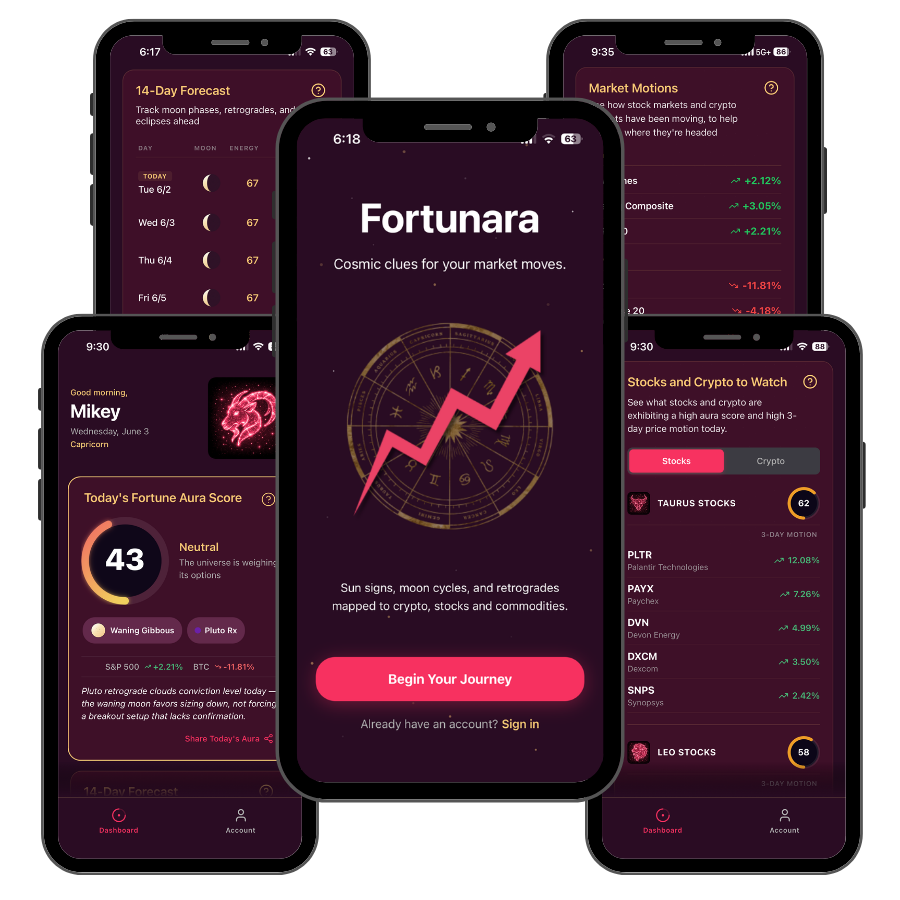
Every lunar phase. Every market signal. Delivered to your sign each morning.
Daily planetary signals mapped to your watchlist. Personalized to your sign.
Get Early AccessFor entertainment only. Not financial advice.
New moon vs. full moon: what financial astrologers say
The academic finding aligns reasonably well with the astrological tradition, which is one reason financial astrologers find the Dichev and Janes paper so compelling. The tradition has always associated the new moon with initiation and optimism, and the full moon with heightened emotion and potential volatility.
New moon: Financial astrologers describe new moons as favorable windows for initiating new positions, starting new financial cycles, and setting intentions around wealth and investment. The new moon in each sign carries that sign’s thematic flavor — a new moon in Taurus favors tangible asset decisions, a new moon in Gemini favors information-driven moves.
Waxing phase: The two weeks from new to full moon are traditionally associated with building and expansion. Astrologers generally describe this as a more favorable backdrop for growth-oriented positions than the waning phase.
Full moon: Emotionally amplified. Astrologers advise awareness rather than avoidance — the full moon can bring clarity and culmination, but reactive decisions made in the heat of a full moon’s emotional amplification are a recurring theme in the cautionary literature. For investors, the practical advice is to notice if a financial decision feels unusually urgent or emotionally charged during a full moon window.
Waning phase: The two weeks from full moon back to new moon are traditionally associated with consolidation, release, and review. Not unfavorable for investing, but astrologers generally describe this as a better window for reviewing and trimming than for initiating new positions.
The lunar calendar for investors: 2026 key dates
The new moons in 2026 each carry distinct astrological flavors based on the sign they occur in. Financial astrologers use these as monthly inflection points.
June 2026 — New Moon in Gemini (June 17): Mercury rules Gemini, making this new moon particularly sensitive to information and communication themes. A favorable window for research-driven decisions. Coincides with the current Mercury retrograde in Gemini — astrologers note that a new moon during a Mercury retrograde is a more complex signal, favoring review over initiation.
July 2026 — New Moon in Cancer (July 17): Cancer governs security, real assets, and domestic markets. Astrologers describe this new moon as favorable for decisions around real estate, income security, and defensive portfolio positioning.
August 2026 — New Moon in Leo (August 15): Leo governs gold, luxury, and high-conviction plays. The Sun is strong in Leo (it rules this sign), making this new moon one of the brighter initiation windows of the year per the tradition.
September 2026 — New Moon in Virgo (September 14): Virgo governs analytical precision. This new moon coincides with Mercury’s final retrograde of the year still in its shadow period — astrologers recommend double-checking analysis before acting on the Virgo new moon’s precise instincts.
Lunar cycles and crypto: a special case
The lunar-crypto relationship has attracted more attention than lunar-equity correlations in recent years, and with some reason. Crypto markets operate 24/7, attract a higher proportion of retail participants relative to institutional ones, and skew younger — a demographic with higher astrology app penetration than the general population.
Several analyses of Bitcoin price behavior relative to lunar phases have found suggestive patterns. The 2021–2022 crypto cycle showed a number of price peaks near full moons and consolidation phases near new moons — consistent with the behavioral mechanism proposed by Dichev and Janes, applied to a market with even higher retail sentiment sensitivity.
Correlation is not causation, and crypto’s volatility makes any pattern analysis noisy. But the behavioral logic is sound: if retail sentiment drives crypto more than equities, and lunar cycles influence retail mood, the lunar effect should be more pronounced in crypto. The data is consistent with that hypothesis even if it doesn’t prove it.
How to use moon phases in your investing practice
Financial astrologers and Fortunara don’t recommend replacing fundamental analysis with a lunar calendar. The framework is additive: use lunar phase awareness as a timing overlay on decisions you’d make anyway based on your regular investment process.
A practical approach:
Note the lunar phase before making significant decisions. If you’re considering a major new entry near a full moon, ask whether the urgency is analytical or emotional. Full moon periods are documented to amplify both excitement and anxiety — both of which are poor bases for financial decisions.
Use new moons as a review trigger. The monthly new moon is a natural reset point. Many investors find it useful to conduct a portfolio review at each new moon — not to make changes necessarily, but to reassess whether existing positions still reflect their current thesis.
Track your decisions against the lunar calendar over time. This is the exercise financial astrologers most commonly recommend for any investor new to the framework. Keep a decision journal. Note the lunar phase at the time of each significant investment decision. Review it after six months. The patterns that emerge are often more consistent than expected.
Consider the sign of the new moon. New moons in earth signs (Taurus, Virgo, Capricorn) are traditionally associated with practical, value-oriented financial decisions. New moons in fire signs (Aries, Leo, Sagittarius) with bold, high-conviction moves. New moons in air signs (Gemini, Libra, Aquarius) with information-driven decisions. New moons in water signs (Cancer, Scorpio, Pisces) with emotionally-informed and intuitive choices.
Common questions about moon phases and investing
Did a study really find moon phases affect stock returns?
Yes. Dichev and Janes (2003), published in the Journal of Finance, found that returns in the 15 days around new moons ran approximately 8.3% higher annualized than returns around full moons. The finding held across 24 countries and 30 years of data.
Is the lunar effect on stocks proven?
The finding has survived multiple replication attempts but isn't universally accepted. Some researchers argue it disappears after transaction costs or is a statistical artifact. The honest position: the data exists, the proposed behavioral mechanism is plausible, and the finding is more robust than most people expect.
Which moon phase is best for buying stocks?
Financial astrologers and the Dichev and Janes research both point toward the new moon period as the more favorable window for initiating positions. The full moon period correlates with elevated emotion and historically lower returns in the academic data.
Does the moon phase affect crypto more than stocks?
The behavioral argument suggests yes — crypto markets have higher retail participation and operate 24/7, making them more sensitive to mood-driven trading. Observational analysis of Bitcoin price behavior relative to lunar phases is consistent with this hypothesis.
Fortunara is for entertainment only. Nothing on this page constitutes financial advice.
Track the lunar cycle alongside your portfolio — free in the app.
Daily reads. Your sign. Your watchlist. Free to start.
For entertainment only. Not financial advice.