
Financial Astrology for Investors
How investors actually use financial astrology.
Quick Answer
Financial astrology for investors is the practice of using planetary cycles, lunar phases, and zodiac-based patterns as timing and guidance signals. Practitioners within the tradition use it as a direct framework for understanding when to act and when to wait. Investors approaching it through the behavioral finance lens use it as an overlay on conventional analysis — a timing layer that tracks collective market psychology.
The practitioners who use it most seriously include professionals with multi-decade track records: Ray Merriman’s MMA Cycles has issued institutional-grade planetary cycle research to fund managers since the 1980s. Arch Crawford’s Crawford Perspectives newsletter has tracked planetary cycles against market data for over 40 years. The Astrologers Fund, managed by Henry Weingarten in New York since 1988, has operated as a registered investment vehicle incorporating astrological analysis.
The core premise is timing: financial astrology doesn’t tell you what the market will do, it describes the energetic climate — periods of expansion or contraction, clarity or confusion, initiation or review. Used as a timing and temperament framework layered on top of your existing investment process, it offers a lens that no mainstream financial tool provides.
There are two valid ways to approach financial astrology as an investor. The first is from within the tradition — treating planetary cycles as meaningful direct signals about timing, energy, and the quality of the moment for financial action. Thousands of practitioners worldwide work this way, including those with documented multi-decade track records.
The second is through the behavioral finance lens — recognizing that astrology app users collectively modify their market behavior around planetary events, and that this collective modification is itself a tradeable signal. You don’t need to share the belief to track its market effects. Either way, the planetary calendar is worth understanding.
What is financial astrology?
Financial astrology is the application of astrological principles — planetary cycles, lunar phases, zodiac sign associations, and chart analysis — to financial markets and investment decisions. It’s been practiced in some form since the ancient world, where traders tracked celestial cycles alongside trade winds and agricultural seasons.
Its modern form emerged most clearly in the early 20th century. W.D. Gann, one of the most successful commodity traders in American history, embedded astrological cycles deeply into his market analysis. His geometric methods — the Gann wheel, Gann angles, and the Square of Nine — are rooted in planetary arc mathematics, though Gann rarely said so explicitly. Evangeline Adams, the most famous American astrologer of the 1920s, counted J.P. Morgan among her clients and advised him on financial timing. The Morgan quote most often attributed to financial astrology — “millionaires don’t use astrology, billionaires do” — has uncertain provenance but reflects genuine historical practice.
The contemporary field is anchored by a small number of serious practitioners with documented track records. Their approaches range from cycle analysis (Ray Merriman) to event-based forecasting (Bill Meridian) to natal chart analysis of market entities (Arch Crawford). What they share is a systematic, evidence-aware framework — not mysticism.
The planetary cycles that matter most for investors
Financial astrologers work with a hierarchy of planetary cycles based on their speed and sphere of influence. Faster planets create short-term signals; slower ones shape the macro backdrop for years or decades.
Mercury (88-day cycle): The fastest inner planet governs short-term communication, information flow, and contract timing. Mercury retrograde — three to four times per year — is the single most discussed astrological market timing signal. Its practical application: elevated caution around new commitments and information received during the three-week retrograde window.
Venus (225-day cycle): Venus governs value, sentiment, and the emotional experience of financial decisions. Venus retrograde, every 18 months, is traditionally associated with confusion around valuation and pauses in consumer sentiment. The sectors most sensitive: luxury, beauty, financial services, and anything tied to the perception of value.
Mars (2-year cycle): Mars governs energy, initiative, and risk appetite. When Mars is well-aspected to a birth chart or market entity, financial astrologers describe elevated drive and decisiveness. Mars retrograde — every 26 months — traditionally flags impulsive risk-taking as elevated-risk behavior.
Jupiter (12-year cycle): Jupiter is the primary expansion planet in the financial astrology framework. Its current sign shapes what sectors and styles of growth are favored by the cosmic backdrop. Jupiter in earth signs favors tangible value; in fire signs, growth and vision; in air signs, ideas and technology. Jupiter’s transit through a sign lasts roughly a year, making it a medium-term sector rotation signal for practitioners who track it.
Saturn (29-year cycle): Saturn is the primary discipline and consolidation planet. Its transit shapes the structural backdrop of markets over multi-year periods. Saturn-Jupiter conjunctions — occurring roughly every 20 years — are among the most significant macro timing signals in the financial astrology calendar, historically associated with major economic inflection points. The 2020 Saturn-Jupiter conjunction in Aquarius, occurring at the same degree they conjoined in 1980, was flagged years in advance by financial astrologers as a generational economic shift marker.
Uranus (84-year cycle): Uranus governs disruption and innovation. Its seven-year transits through each sign identify the domains of structural disruption in the economy. Uranus in Taurus (2018–2025) disrupted money and value. Uranus in Gemini (2025–2032) disrupts information and communication infrastructure.
Pluto (248-year cycle): Pluto governs transformation at the deepest structural level. Its multi-decade transits reshape entire economic systems. Pluto’s move from Capricorn (institutional structure, 2008–2024) to Aquarius (networks and collective systems, 2024–2043) is the single biggest macro astrological signal of the current era.
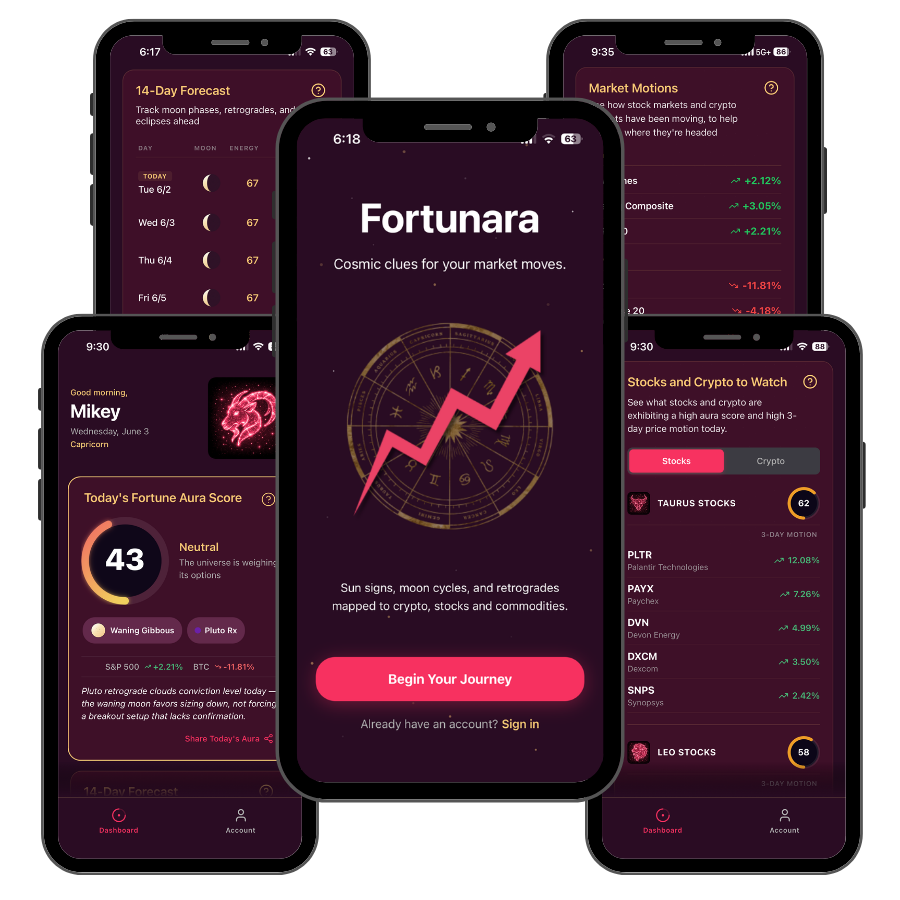
Your personalized cosmic edge, delivered every morning.
Daily planetary signals mapped to your watchlist. Personalized to your sign.
Get Early AccessFor entertainment only. Not financial advice.
How professional financial astrologers work
Understanding how the serious practitioners actually operate demystifies the field considerably.
Ray Merriman — MMA Cycles: Merriman’s methodology is primarily cycle-based — identifying recurring time intervals in market data and correlating them with planetary cycles. His annual forecast volumes, read by fund managers and sophisticated investors since the 1980s, identify key “critical reversal dates” based on planetary geocentric and heliocentric positions. He publishes weekly market analyses that blend technical and astrological timing. His approach is empirical: he tracks his forecasts against outcomes and publishes the accuracy rates.
Bill Meridian: Meridian’s work focuses on natal chart analysis of market entities — companies, indices, and commodities — and the transits of outer planets to those natal positions. His research identified correlations between Pluto transits to a company’s natal chart and significant stock price inflections. His book Planetary Stock Trading, now in multiple editions, is one of the most referenced works in the field.
Arch Crawford — Crawford Perspectives: Crawford has published a market timing newsletter since 1977, making it one of the longest-running in financial astrology. His approach combines technical analysis with planetary cycle analysis. Timer Digest has ranked Crawford among the top market timers in the US multiple times. His most famous call: identifying August 1987 as a high-risk period based on planetary alignments, made months before the October 1987 crash.
The Astrologers Fund: Henry Weingarten’s New York-based fund has operated since 1988, using astrological analysis as part of its investment process. It has filed with the SEC and operated as a registered investment vehicle — which means its astrological approach has been visible to regulators without triggering concern about its legitimacy as a methodology.
Applying financial astrology to your investment process
The practical application of financial astrology doesn’t require becoming a practitioner. The most accessible entry point is the timing and temperament framework — using the major planetary signals as a backdrop awareness tool layered on top of whatever investment process you already use.
Step 1: Know the current retrograde calendar. Mercury retrograde periods are the highest-frequency, highest-awareness signal in the financial astrology calendar. Knowing when they occur — and applying slightly more caution to new commitments during those windows — is the most accessible application of financial astrology for a non-practitioner. Fortunara’s app surfaces this automatically.
Step 2: Track the lunar cycle. The Dichev and Janes research establishes a peer-reviewed basis for lunar cycle awareness in investing. A simple practice: note the lunar phase before making significant investment decisions. If a major decision feels unusually urgent near a full moon, that’s worth pausing on. If you’re more enthusiastic than your analysis warrants near a new moon, that’s worth noticing too.
Step 3: Know the macro planetary backdrop. What sign is Jupiter in? What is Saturn doing? Where is Pluto? These slow-moving planets shape the multi-year backdrop for market sectors. Financial astrologers treat Pluto’s transit through Aquarius as a direct signal about structural economic transformation — and the behavioral finance case adds that the astrological community’s focus on this transit influences collective investor sentiment regardless of the underlying metaphysics. Either way, it’s relevant macro context.
Step 4: Know your natal chart’s financial indicators. Your natal Jupiter (expansion), Saturn (discipline), Venus (value), and Mercury (information) placements shape your investment temperament in ways that are worth understanding. Knowing that you have natal Saturn square Venus, for example, might explain a chronic tendency toward excessive financial caution. Fortunara calculates this from your birth data and incorporates it into your daily Fortune Aura score.
The behavioral finance dimension
For investors approaching financial astrology through an analytical rather than traditional framework, behavioral finance provides a rigorous grounding.
Behavioral finance is built on the observation that markets aren’t efficient in the textbook sense because human beings aren’t rational actors. Emotions, cognitive biases, and social dynamics systematically distort financial decisions. The field — which earned its founders multiple Nobel Prizes — has documented hundreds of specific ways that human psychology creates predictable, exploitable patterns in market prices.
Financial astrology, viewed through this lens, is a behavioral sentiment tracking system. Widely shared beliefs about planetary events create coordinated behavior, and coordinated behavior creates price patterns. The mechanism is the same one that makes quarterly earnings surprises, Federal Reserve meeting dates, and index rebalancing windows into predictable market events: a sufficient number of participants acting on a shared expectation creates the pattern the expectation predicted.
Richard Peterson, CEO of MarketPsych — which licenses sentiment analytics to major financial institutions — has made this argument explicitly: “At MarketPsych, we measure how narratives and collective beliefs move asset prices. In that framework, astrology functions like any other belief-driven narrative: if enough traders act on it, coordinated behavior can generate real price patterns — not because of celestial mechanics, but because of human herd psychology.”
That’s the serious investor’s case for financial astrology. Not that Mercury causes anything. That the astrology app community that believes Mercury causes things is a sentiment signal worth tracking.
How serious practitioners use financial astrology
The practitioners with the best track records use financial astrology as a primary timing and cycle framework — not a supplement to conventional analysis, but a discipline in its own right, refined over decades.
Ray Merriman’s MMA Cycles methodology identifies critical reversal dates using geocentric and heliocentric planetary positions, then confirms them against technical signals. The planetary cycle is the primary signal; the technical chart is confirmation. His Cycles Research portfolio returned 19.9% annually over 17 years per Timer Digest.
Bill Meridian’s natal chart analysis identifies inflection points in a company’s trajectory based on outer planet transits to its first-trade chart. His book Planetary Stock Trading, now in multiple editions, is the field’s most referenced systematic work. Timer Digest ranked him number one in stock market timing three times.
What they share: a systematic, evidence-tracked approach, decades of refining the methodology against real outcomes, and a willingness to publish forecasts in advance rather than explain them in retrospect. That is what serious financial astrology looks like in practice.
Common questions about financial astrology for investors
Do professional investors actually use astrology?
Yes, some do. The Astrologers Fund has operated as a registered investment vehicle in New York since 1988. Ray Merriman's MMA Cycles institutional research is subscribed to by fund managers. Arch Crawford's newsletter has ranked among the top market timers in Timer Digest multiple times. The practice is niche but not fringe.
Does financial astrology work?
The documented evidence includes: lunar cycle return differentials (Dichev and Janes 2003, Journal of Finance), audited track records from practitioners with decades of published forecasts, and the behavioral finance case for collective astrological sentiment creating real price patterns. Whether planetary cycles directly cause anything is a separate question from whether tracking them has value. The practitioner track records suggest it does.
Where do I start with financial astrology as an investor?
The most accessible entry point is the retrograde calendar and lunar cycle awareness. Know when Mercury is retrograde and apply slightly more caution to new commitments during those windows. Note the lunar phase before significant decisions. These are low-friction practices with documented behavioral logic behind them. From there, your natal chart's financial indicators are the natural next step — and that's exactly what Fortunara calculates.
What's the difference between financial astrology and regular astrology?
Regular astrology applies planetary cycles to personal life themes — relationships, career, personal growth. Financial astrology applies the same cycles specifically to markets, investment decisions, wealth patterns, and financial timing. The tools are identical; the application domain is different. Financial astrology also incorporates mundane astrology — the analysis of entities (companies, indices, currencies) as if they had birth charts — which has no direct equivalent in personal astrology.
Fortunara is for entertainment only. Nothing on this page constitutes financial advice.
Your natal chart meets today's market signals — see yours free.
Daily reads. Your sign. Your watchlist. Free to start.
For entertainment only. Not financial advice.