
Astrology & Crypto Investing
Bitcoin has a birth chart. Here’s what financial astrologers do with it.
Quick Answer
Crypto markets and financial astrology share more structural overlap than most people expect. Both operate on the premise that human belief shapes outcomes — crypto’s value is entirely a function of collective agreement, which makes it unusually sensitive to sentiment signals, including astrological ones.
Financial astrologers approach crypto in two ways. The first is mundane: applying standard planetary cycle analysis to crypto as an asset class, the same way they’d analyze equities. Uranus, the planet of disruption and technological innovation, is widely associated with crypto’s emergence and volatility patterns. The second is natal: Bitcoin has a documented “birth chart” — the timestamp of the genesis block on January 3, 2009 at 18:15:05 UTC — and practitioners analyze transits to this chart the way they’d analyze any natal chart.
Financial astrologers approach crypto through the same lens they apply to any market: planetary cycles as direct timing signals, with natal chart analysis applied to the asset itself. The behavioral dimension is particularly strong here — retail sentiment drives crypto more than any other major asset class, and astrology app users are disproportionately young, retail, and active in crypto markets. When major planetary events create collective caution or optimism among this audience, the market impact is more direct than in institutionally-dominated equity markets.
Crypto is the asset class most aligned with astrological analysis. It’s the most sentiment-driven major market in the world. It runs 24/7. Its participant base skews young, retail, and high in astrology app usage. And it emerged during one of the most astrologically significant planetary alignments of the decade.
If you’re going to find the lunar and planetary effects described in financial astrology anywhere, crypto is the most likely place to find them.
Why crypto and astrology are structurally related
Every asset class has a mechanism that drives price. Equities are ultimately tied to earnings, cash flow, and the present value of future profits — fundamentals that anchor price even when sentiment pulls it far from fair value. Bonds have yield, duration, and credit quality. Commodities have supply and demand in the physical world.
Crypto’s value is almost entirely a function of collective belief. Bitcoin produces no cash flow. It has no physical utility in the way gold does. Its value is what a sufficient number of people agree it is — and their agreement is driven by narrative, sentiment, and collective psychology. That makes crypto uniquely susceptible to exactly the kind of belief-driven, sentiment-amplified dynamics that astrological analysis is designed to track.
Financial astrologers didn’t invent this argument. George Soros’s theory of reflexivity — that market participants’ beliefs shape the reality they’re trying to predict — is well established in academic finance. Crypto is just the purest expression of it.
Bitcoin’s birth chart
Every event that can be assigned a precise time and place has an astrological birth chart in the Western tradition. Bitcoin is no exception.
The Bitcoin genesis block was mined on January 3, 2009, at 18:15:05 UTC. The location is typically set to the geographic coordinates of the internet’s infrastructure — or more practically, financial astrologers often use 0°0’N, 0°0’E (the null island coordinate) or a specific server location estimate. The exact coordinates matter less than the date and time, which are documented in the blockchain itself.
Bitcoin’s natal chart places the Sun in Capricorn — the sign associated with institutional structure, long-term value, and disciplined accumulation. Saturn, Capricorn’s ruler, was in Virgo at the time of the genesis block — astrologers describe this as grounding Bitcoin’s Capricorn ambition in analytical precision and systemic rigor. Uranus was in Pisces, which practitioners associate with the dissolution of existing financial boundaries and the imaginative leap required to conceive of a decentralized monetary system.
The Uranus-Pisces placement at Bitcoin’s birth is particularly noted. Uranus governs disruption, technological innovation, and the breaking of established systems. Pisces governs the dissolution of boundaries and the collective imagination. Together, financial astrologers describe this as a natal signature consistent with an asset that dissolves the boundary between currency and belief — which is precisely what Bitcoin did.
See which crypto aligns with your cosmic cycle today.
Daily planetary signals mapped to your watchlist. Personalized to your sign.
Get Early AccessFor entertainment only. Not financial advice.
Uranus and the crypto cycle
Uranus is the planet most consistently associated with cryptocurrency in the financial astrology community, and the historical correlation is striking enough to deserve attention even from skeptics.
Uranus entered Taurus in May 2018 and remained there through July 2025. Taurus governs value, money, tangible assets, and the material expression of wealth. Uranus’s transit through Taurus brought Uranian disruption directly into the domain of how humanity stores and transfers value.
The crypto market’s explosive growth, Bitcoin’s rise from roughly $6,000 at Uranus’s Taurus ingress to an all-time high above $100,000, the emergence of DeFi, stablecoins, CBDCs, and institutional crypto adoption — all occurred within the Uranus-in-Taurus window. Financial astrologers had been flagging this transit as a period of fundamental disruption to money and financial systems since at least 2016. Ray Merriman’s annual forecasts described the 2018–2025 Uranus-Taurus transit explicitly as a period of transformation in what humanity uses as currency.
Uranus moved into Gemini in July 2025, beginning a seven-year transit. Gemini governs information, communication, and the movement of ideas and data. Financial astrologers describe the Uranus-Gemini era as one where disruption moves from the storage of value (Taurus) to the transmission of value — the infrastructure through which financial information and digital assets flow. This has implications for blockchain technology, AI-integrated financial systems, and the tokenization of information assets.
The lunar cycle and crypto
The behavioral mechanism connecting lunar cycles to financial markets — documented by Dichev and Janes in their 2003 Journal of Finance study — should be more pronounced in crypto than equities for one straightforward reason: retail sentiment drives crypto more directly.
Observational analysis of Bitcoin price behavior relative to lunar phases has produced results consistent with the Dichev and Janes model. The pattern most frequently cited: consolidation and accumulation near new moons, volatility and potential reversals near full moons. This isn’t a reliable trading signal — crypto’s baseline volatility swamps lunar effects in short windows. But as a longer-term pattern across multiple cycles, it’s more consistent than random.
The strongest lunar signal in crypto appears around the full moon periods of Bitcoin halvings and major altcoin cycle peaks. The May 2021 crypto peak, for example, aligned closely with a full moon in Scorpio — a placement financial astrologers specifically associate with debt, leverage, and the extremes of financial intensity. The subsequent crash accelerated sharply through the new moon window, consistent with the tradition’s description of new moons as reset points rather than continuation signals during bearish phases.
Mercury retrograde and crypto trading
Mercury retrograde’s association with communication errors, technology disruptions, and contract reversals maps directly onto crypto market behavior during retrograde periods.
Financial astrologers consistently flag Mercury retrograde windows as elevated-risk periods for crypto-specific decisions: exchange migrations, new wallet setups, DeFi contract interactions, and ICO or token launch participation. The practical concern is the classic Mercury retrograde pattern — incomplete information, technical errors, and agreements that require revisiting — applied to a domain where technical precision and contract clarity are literally encoded in the product.
The 2022 Mercury retrograde in Capricorn (January–February) coincided with a significant cluster of crypto exchange technical issues and protocol vulnerability disclosures. The 2021 Mercury retrograde in Libra (September–October) aligned with a period of unusual regulatory communication confusion across multiple jurisdictions. Whether the mechanism is direct planetary influence or collective behavioral response, the pattern is consistent enough that financial astrologers tracking crypto have incorporated Mercury retrograde windows as routine caution flags.
Ethereum, Solana, and sign-based analysis
Beyond Bitcoin, financial astrologers have constructed birth charts for other major protocols based on their launch dates and have applied sign-based analysis to crypto assets the same way they’d apply it to individual equities.
Ethereum’s mainnet launched on July 30, 2015, placing its Sun in Leo — the sign associated with creative vision, performance, and building platforms for others to express themselves on. Financial astrologers note that Ethereum’s Leo nature is reflected in its role as the foundation for the NFT and DeFi ecosystems — creative platforms built on a creative foundation.
Solana’s mainnet launched on March 16, 2020, with the Sun in Pisces — the sign associated with imagination, dissolution of boundaries, and the collective. Astrologers describe Solana’s Pisces signature as consistent with its speed-and-scale approach: a system designed to absorb everything, process everything, dissolve the friction between the user and the blockchain. The Pisces shadow — boundary dissolution sometimes means boundary confusion — shows up in Solana’s history of network outages.
This kind of analysis demonstrates the coherence of the framework when applied systematically — the chart signatures align with the protocols’ actual characters in ways that financial astrologers find meaningful, and that even skeptics find intellectually interesting.
How Fortunara tracks crypto with astrology
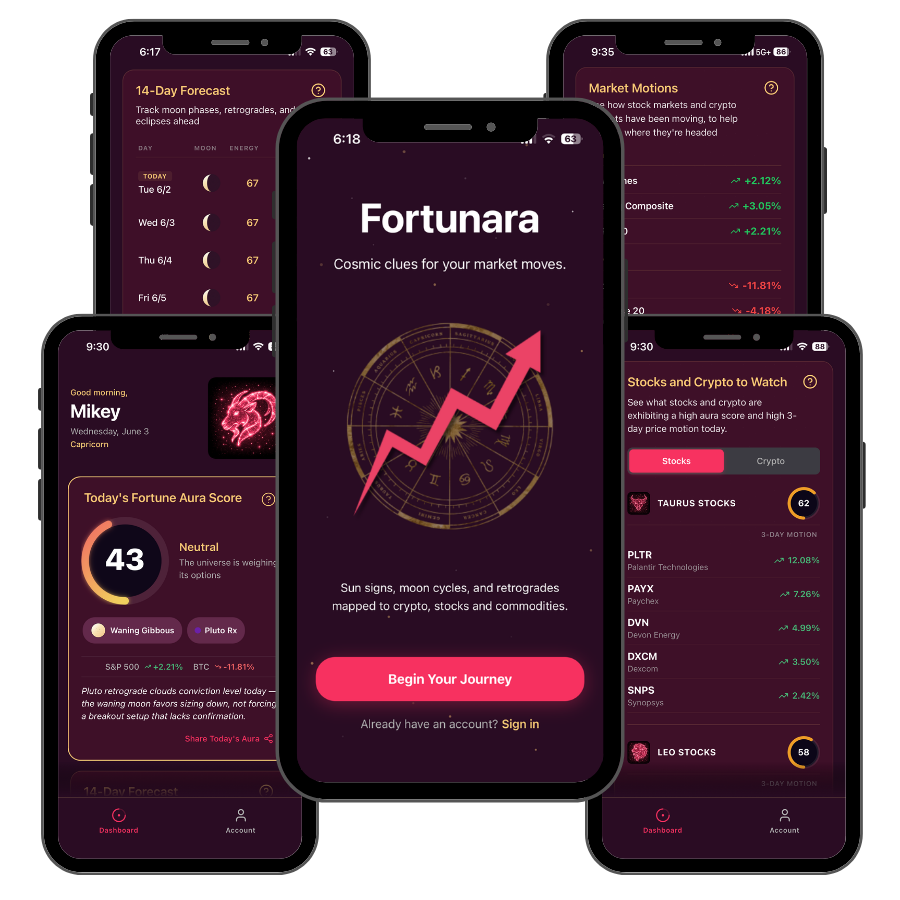
Fortunara’s Stock & Crypto to Watch section tracks crypto assets alongside equities, applying the same astrological signal framework to both. Each asset in the watchlist is associated with a zodiac sign based on its launch date, sector, or dominant characteristics, and scored daily against current planetary transits.
Bitcoin (Capricorn, Sun in genesis chart) shows elevated Stock & Crypto to Watch scores when Saturn and Capricorn-compatible transits are favorable. Ethereum (Leo) lights up when fire sign energy is running — Jupiter or Mars in Leo, Aries, or Sagittarius. Uranus transits to the crypto sector broadly are tracked as macro signals regardless of individual asset birth charts.
The Market Motions section tracks crypto majors — Bitcoin, Ethereum, Solana, and others — alongside equity indices, giving Fortunara users a single view of how their astrological signals map to the assets they actually hold.
Common questions about astrology and crypto
Does astrology work for crypto trading?
Financial astrologers use planetary cycles as direct timing signals — and some have documented track records doing so. The behavioral argument for astrological effects is particularly strong in crypto because retail sentiment drives prices more directly than in equities. Crypto's volatility is high enough that no single framework, astrological or otherwise, eliminates risk. But the lunar and planetary signals are more pronounced here than in any other major asset class.
Does Bitcoin have a birth chart?
Yes. The Bitcoin genesis block was mined on January 3, 2009 at 18:15:05 UTC. Financial astrologers use this as Bitcoin's natal chart and analyze current planetary transits against it the same way they'd analyze any natal chart.
What planet rules cryptocurrency?
Financial astrologers most commonly associate cryptocurrency with Uranus — the planet of disruption, technological innovation, and the breaking of established systems. Uranus's transit through Taurus (2018–2025) coincided with the full emergence of crypto as a mainstream asset class. Neptune (collective imagination, the dissolution of boundaries) is also cited, particularly for the speculative and narrative-driven aspects of crypto markets.
Is there academic research on lunar cycles and crypto?
The Dichev and Janes (2003) Journal of Finance study on lunar cycles and stock returns predates crypto markets. Subsequent observational analysis of Bitcoin price behavior relative to lunar phases has found patterns consistent with the Dichev and Janes model, though the crypto-specific data is less rigorously studied than the equity market research.
Fortunara is for entertainment only. Nothing on this page constitutes financial advice.
See today's astrological scores for Bitcoin, Ethereum, and more.
Daily reads. Your sign. Your watchlist. Free to start.
For entertainment only. Not financial advice.