
What is Financial Astrology?
Quick Answer
Financial astrology has been practiced for thousands of years. Its modern form includes dedicated practitioners who have published systematic research, managed institutional funds, and built documented track records applying planetary cycle analysis to markets. It also has a behavioral finance dimension: with astrology apps seeing significant mainstream adoption in the US, the collective behavior of astrologically-aware investors is a real market input regardless of whether planets cause anything.
This guide covers what financial astrology is, where it came from, what the evidence shows, who uses it today, and how Fortunara makes it accessible for retail investors.
The Definition
Financial astrology is the application of astrological principles specifically to financial markets, investment timing, and economic cycles.
Where traditional astrology interprets how planetary positions affect individual lives — relationships, health, career — financial astrology narrows the lens to the financial dimension:
- Which planetary cycles correlate with market expansions and contractions?
- What does Mercury retrograde historically signal for tech stocks?
- How do lunar phases affect short-term investor sentiment?
- What do outer-planet transits (Jupiter, Saturn, Uranus, Neptune, Pluto) suggest about decade-scale economic themes?
For practitioners, financial astrology answers the question: “what is the planetary backdrop right now — and what does that mean for timing, sector conditions, and the quality of the moment for action?” It is both a direct guidance system for those who work within the tradition, and a contextual timing layer for investors who approach it through the behavioral finance lens.
Either way, the goal is the same: an additional dimension of market awareness that most participants aren’t tracking. In a market where edge compounds over thousands of decisions, that additional dimension is worth understanding.
A Brief History
Financial astrology isn’t new. It has been practiced, in various forms, for as long as markets have existed.
Ancient roots
The Babylonians correlated planetary positions with commodity prices as far back as 2000 BCE. The connection between celestial cycles and harvest conditions — and therefore grain prices — was practical, not mystical. When Jupiter appeared in a certain position during planting season, prices historically moved in a particular direction. They tracked it because it worked often enough to be worth tracking.
Medieval European merchants used astrological almanacs to plan trading voyages and market days. The concept of “auspicious timing” for financial transactions appears across every major ancient culture.
The 20th-century tradition
The modern financial astrology tradition in the West has its clearest lineage through three figures:
Evangeline Adams (1868–1932) was America’s most famous astrologer and J.P. Morgan’s personal astrology consultant. She built a client list of the era’s most powerful financiers. Her 1914 trial for fortune-telling ended with a judge so impressed by her chart reading that he dismissed the charges. Morgan reportedly said: “Millionaires don’t use astrology. Billionaires do.” Full story →
W.D. Gann (1878–1955) was one of history’s most studied traders and the most systematic user of planetary timing in market analysis. His methods — Gann Angles, the Square of Nine, the Wheel of 24 — were explicitly built on astronomical geometry. He predicted the 1929 crash. His books remain in print and his tools remain in charting platforms a century later. Gann’s methods →
Bill Meridian is the leading modern quantitative practitioner, having published systematic studies on Saturn transits and sector performance, Jupiter-Saturn conjunctions and market regimes, and planetary aspects and S&P 500 cycles. His work updates the tradition with the rigor of modern data analysis. Bill Meridian’s work →
The India tradition
In India, financial astrology has a continuous unbroken tradition through Vedic astrology (Jyotish). Planetary transits and dasha periods (time lords) are used by thousands of practitioners to advise on business timing, investment decisions, and financial planning. India’s financial astrology market is growing at 49% annually — the fastest in the world.
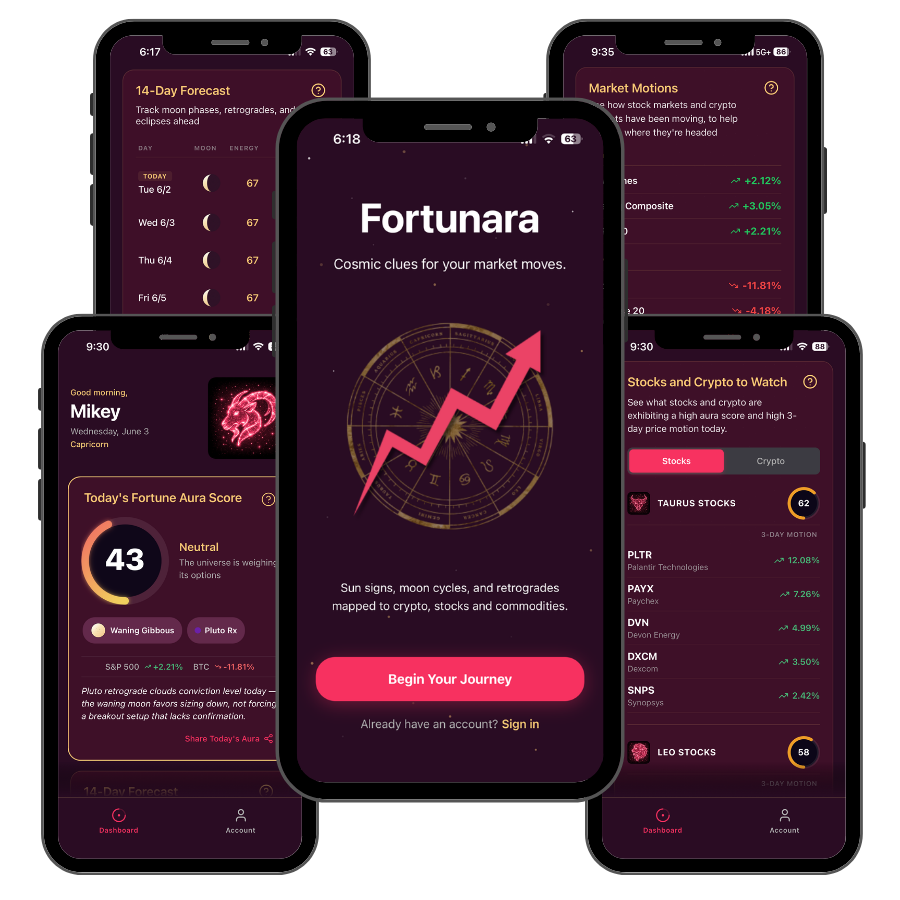
Get cosmic clues for your market moves.
Daily planetary signals mapped to your watchlist. Personalized to your sign.
Get Early AccessFor entertainment only. Not financial advice.
The Key Concepts
You don’t need to become an astrologer to use financial astrology. But understanding the core concepts makes the signals meaningful.
Planetary transits
A transit occurs when a planet in its current position in the sky forms a significant relationship to a point in a natal chart or to another planet. The key planets in financial astrology:
Mercury governs communication, contracts, technology, and information flow. Mercury retrograde — three times per year — is associated with delays, errors, and revisiting past decisions. In markets, it correlates with tech volatility and deal complications. Mercury retrograde guide →
Venus governs value, aesthetics, and relationships. Venus transits affect the luxury goods sector, art markets, and general market sentiment. Venus retrograde periods see reversals in these areas.
Mars governs energy, action, and aggression. Mars transits affect the energy sector, defense stocks, and overall market momentum. Mars retrograde tends to slow market advances.
Jupiter is the expansion planet, governing growth, optimism, and abundance. Jupiter transiting a new sign or making favorable aspects tends to correlate with bullish sentiment and sector rotations toward growth themes.
Saturn is the contraction planet, governing discipline, restriction, and long-term structure. Saturn transits tend to coincide with consolidation, regulatory scrutiny, and bear market conditions.
Outer planets (Uranus, Neptune, Pluto) move slowly and govern generational themes. Pluto’s current transit through Aquarius (2024–2043) — its first time there since the American and French revolutions — correlates with technology disruption of established power structures. In markets, this maps to the AI revolution and the decentralization of finance.
Lunar phases
The moon completes one cycle every 29.5 days. The key phases in financial astrology:
New moon: Beginning of the cycle. Associated with fresh starts, new positions, and bullish energy. Academic research (Dichev & Janes, 2003, Journal of Finance) found stock returns in new moon periods were 8.3 percentage points higher annualized than full moon periods across 25 countries. Moon phase investing →
Waxing moon (new to full): Building phase. Traditional association with expansion, accumulation, and increasing momentum.
Full moon: Peak of the cycle. Associated with revelation, completion, and emotional intensity. Historically correlates with short-term market tops and sentiment extremes.
Waning moon (full to new): Releasing phase. Traditional association with selling, distribution, and decreasing momentum.
Retrograde periods
A planet appears “retrograde” when Earth passes it in orbit, creating the optical illusion that it’s moving backward. The planet isn’t actually reversing — but from Earth, it appears to. In astrological tradition, retrograde periods are associated with reversal, review, and reassessment.
Mercury retrograde is the most-followed retrograde in financial astrology — it occurs three times a year and has a measurable collective behavioral effect because of its cultural ubiquity. When the astrology app community is simultaneously cautious, that caution shows up in market sentiment data.
Eclipse seasons
Twice a year, a series of solar and lunar eclipses occurs over a 4–6 week window. Eclipse seasons are associated in financial astrology with unexpected reversals, sudden news, and volatility spikes. They mark points where concealed information tends to surface.
The Evidence
What does the research actually say?
The Dichev-Janes study
The most rigorous study of astrology and markets was published in the Journal of Finance in 2003. Ilia Dichev and Troy Janes analyzed stock returns around lunar phases across 25 countries over several decades. Their finding: returns near new moons were about 8.3 percentage points higher annualized than returns near full moons. The effect held after controlling for known calendar anomalies and was consistent across markets.
The mechanism they proposed was behavioral: lunar phases affect mood and risk appetite across large populations, which aggregates into measurable market effects. Full details →
The behavioral finance framework
Richard Peterson, CEO of MarketPsych and one of the leading researchers in sentiment-driven market analysis, has framed it in terms that resonate with practitioners across the spectrum: coordinated belief, he’s argued, can generate real price patterns — not because of celestial mechanics, but because of human herd psychology. It’s the same reflexivity that George Soros built a career on.
This is the behavioral finance case for financial astrology. It doesn’t require believing planets exert any physical force. It requires only accepting that millions of people follow astrological signals and modify their behavior accordingly — and that collective behavioral modification affects markets. That logic is identical to tracking sentiment indicators, social media mood, or the VIX. Financial astrology becomes, in this framing, one more signal about collective human behavior. And collective human behavior moves markets.
What the research shows
The behavioral evidence is the strongest and most replicable. The Dichev-Janes finding has held up across multiple independent analyses. The practitioner tradition has produced documented, audited track records — Bill Meridian’s Cycles Research portfolio returned 19.9% annually versus the S&P’s 5.6% over 17 years per Timer Digest. Arch Crawford was ranked the top US market timer in 1987, 1994, and 2008.
Who Uses Financial Astrology
Financial astrology is more mainstream than it appears.
Retail investors
Millions of retail investors track Mercury retrograde, follow lunar phase calendars, and check astrology apps before making investment decisions. This isn’t fringe behavior — it’s a significant and growing segment of the retail market. The total US astrology app market exceeds $1.4 billion annually.
Serious practitioners
A community of dedicated financial astrology practitioners — some with decades of research behind them — applies systematic methods to market analysis. Bill Meridian, Ray Merriman, and Christeen Skinner are among the most prominent. They publish forecasts, research studies, and newsletters followed by thousands of traders.
Pattern and sentiment followers
A growing segment of financial astrology users approaches it through the behavioral finance lens: they use financial astrology as a crowd sentiment indicator — a way to anticipate when collective caution or optimism will peak.
This is the same logic applied to tracking the AAII Sentiment Survey or monitoring Reddit’s WallStreetBets. The signal has value whether or not you share the underlying belief.
How Fortunara Delivers Financial Astrology
Fortunara was built for retail investors who want financial astrology in a format that respects both the tradition and their intelligence.
What you get daily
Fortune Aura Score: A personalized daily score reflecting the quality of financial timing for your sign, based on current planetary positions and your birth chart.
Fortunarascope: A full daily horoscope focused on the financial dimension — timing, energy, caution signals, and opportunity signals — written for your sign.
Cosmic Forecast: Moon phases, retrograde periods, eclipse flags, and daily aura scores for the coming two weeks. See what’s coming.
Stock & Crypto to Watch: Stocks and crypto assets with elevated aura scores and 3-day price momentum — grouped by zodiac sign for context.
Signal Feed: Curated astro-finance news and market commentary, updated daily.
What makes it different
Most astrology apps give you generic horoscopes. Fortunara was built specifically for the financial intersection — real planetary transits, market-relevant signals, and sign-specific investment context. It’s the only product of its kind built for retail investors.
Getting Started
You don’t need any prior astrology knowledge to use financial astrology effectively.
Know your sun sign (the zodiac sign determined by your birth date). This is the minimum needed for generic daily context.
Know your birth time and location. This enables a full birth chart and personalized timing — the difference between "Mercury retrograde affects everyone" and "Mercury retrograde is crossing your natal 2nd house of money this week."
Track a few events first. Mercury retrograde (three times per year), full moons, and new moons are the highest-signal, most-followed events. Use them as a timing overlay on your existing analysis.
Build your own evidence base. Keep a simple log. Note what the sky is doing when you make investment decisions. Over six to twelve months, you'll have your own data on whether and how astrological cycles correlate with your outcomes.
Use Fortunara. Let the app handle the planetary calendar, the daily read, and the signal tracking. You focus on applying it to your strategy.
Common Questions
What is the difference between financial astrology and regular astrology?
Financial astrology narrows the astrological lens specifically to money, markets, and investment timing. It focuses on the financial houses in the birth chart (2nd, 5th, 8th, 11th), market-relevant planetary transits, and the timing signals most applicable to investment decisions. Regular astrology covers all life areas. Financial astrology is a specialized application.
Is financial astrology the same as trading on astrology?
Not necessarily. Most financial astrology practitioners use it as a timing context layer alongside fundamental or technical analysis — not as a standalone trading system. Very few serious practitioners make buy/sell decisions based solely on planetary signals. Fortunara treats it as one signal in your investment toolkit, not a replacement for the rest.
Do I need to believe in astrology to use financial astrology?
No. Many practitioners work entirely within the tradition and find direct value in the planetary guidance. Others approach it through the behavioral finance lens — tracking what millions of other investors are watching, not because they share the belief, but because the collective behavior creates real patterns. Fortunara is built to serve both.
What's the most important planet for financial astrology?
Mercury, for short-term timing — retrograde periods are the most widely-followed events with the clearest collective behavioral effect. Jupiter and Saturn for medium-term sector and trend analysis. Pluto for decade-scale economic themes.
Is financial astrology legal?
Yes. Tracking and publishing astrological signals is not regulated financial advice, provided no specific investment recommendations are made. Fortunara is for entertainment and educational purposes only and does not constitute financial advice.
Fortunara is for entertainment only. Nothing on this page constitutes financial advice.
Fortunara delivers financial astrology built for investors.
Daily aura score. Personalized Fortunarascope. Cosmic Forecast. Retrograde alerts. Free to start.
For entertainment only. Not financial advice.