
Lunar Cycles & Crypto: The Connection
Quick Answer
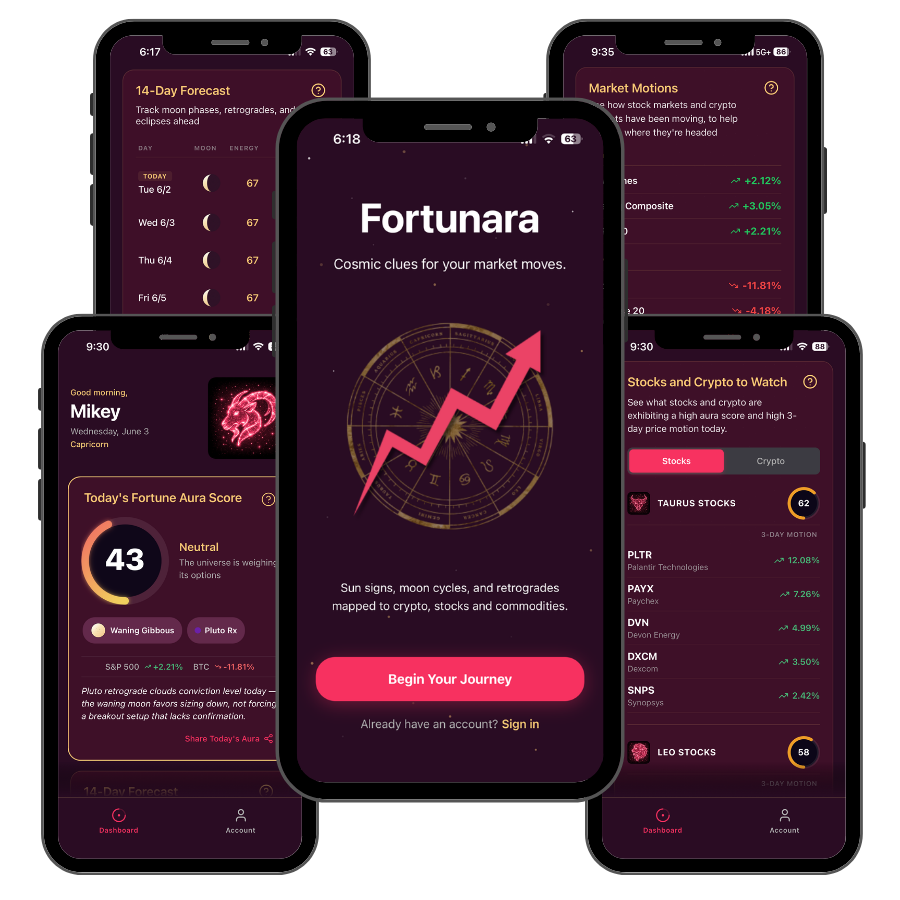
Get cosmic clues for your market moves.
Daily planetary signals mapped to your watchlist. Personalized to your sign.
Get Early AccessFor entertainment only. Not financial advice.
Why Crypto Is Different
The Dichev and Janes (2003) study that documented lunar cycle effects in stock markets was conducted on traditional equity markets — the kinds with institutional market-makers, circuit breakers, options markets, and fund managers with quantitative risk models.
Crypto markets have none of those institutional dampeners in the same degree. They trade continuously, 24 hours a day, every day of the year, including weekends. The investor base is more retail-dominated than any major equity market. Sentiment shifts propagate faster and with less institutional resistance. When the collective mood of crypto participants changes, prices respond more immediately and more dramatically.
For lunar cycle analysis, this means the behavioral mechanism that Dichev and Janes proposed — lunar cycles affecting collective mood and risk appetite — should have a larger effect in crypto than in equities. And practitioner observation across the years since major crypto markets became liquid suggests that it does.
The Community Effect
There’s a second factor that amplifies lunar cycle effects in crypto specifically: the demographic and cultural overlap between astrology-following communities and crypto-native communities.
Both communities skew younger, are native to social media, are more comfortable with alternative frameworks for understanding complex systems, and are more willing to act on non-traditional signals. The result is a meaningful proportion of crypto market participants who actively track lunar phases and modify their behavior accordingly.
This creates a partial self-fulfilling dynamic that traditional equity markets don’t have in the same degree. When a significant portion of a market’s active participants is simultaneously cautious (full moon) or expansive (new moon), the collective behavior shows up in price action regardless of whether the underlying astrological mechanism is the cause.
For an investor who doesn’t follow astrology at all, this community effect is still worth understanding. If enough participants in a market you trade are modifying their behavior around lunar phases, those modifications create real patterns in the market’s microstructure. That’s information worth having.
New Moon Patterns in Bitcoin and Ethereum
Independent analysis of Bitcoin and Ethereum price behavior overlaid with lunar phases has been conducted by multiple researchers and practitioners since approximately 2015, when crypto markets became liquid enough to analyze meaningfully.
The consistent observation: Bitcoin has tended to see elevated buying activity and net positive price action in the days around new moons, and elevated selling pressure and distribution activity in the days around full moons. The effect isn’t present in every cycle and isn’t large enough in any individual instance to constitute a reliable trading signal on its own. Across a large sample of cycles, it’s consistent with the equity market pattern documented by Dichev and Janes.
Ethereum has shown similar but slightly more volatile patterns, which is consistent with Ethereum’s higher beta to sentiment shifts generally.
These observations come primarily from practitioner research and community analysis rather than peer-reviewed academic studies — the crypto market history is simply too short for rigorous long-run statistical work. They should be weighted accordingly: consistent with the theoretical framework and equity market evidence, but not independently verified to the same standard.
Mercury Retrograde and Crypto
Beyond lunar cycles, Mercury retrograde has a specific and well-observed relationship with crypto markets. Multiple significant crypto drawdowns have begun or accelerated during Mercury retrograde windows. The tech/communication domain that Mercury governs maps directly onto what crypto is: a technology-and-communication-based asset class.
The 2022 crypto winter saw major drawdowns initiate or accelerate during multiple Mercury retrograde windows that year. The 2018 crypto bear market began during a Mercury retrograde period. These observations are consistent with Mercury retrograde’s traditional association with technology sector complications.
For crypto investors, Mercury retrograde windows merit the same elevated caution that tech equity investors give them — with the understanding that crypto’s higher volatility means the effects can be more dramatic. Full Mercury retrograde guide →
Eclipse Seasons and Crypto Volatility
Eclipse seasons — the two windows per year, each lasting 4–6 weeks, when solar and lunar eclipses occur — have historically produced some of crypto’s most dramatic price moves.
The mechanism fits the eclipse framework: eclipse seasons are associated with revelations, sudden shifts in fundamental narratives, and the surfacing of information that changes the market’s understanding of an asset. Crypto, as a narrative-intensive asset class where news events can dramatically shift the story around a coin or protocol, is particularly sensitive to eclipse-type dynamics.
Regulatory announcements, exchange collapses, protocol upgrades, and major adoption news have a disproportionate tendency to land during eclipse seasons. Whether this is the eclipse creating the conditions or simply the tendency to notice eclipse-season events more carefully is a question practitioners debate. The practical implication is the same: eclipse seasons are elevated-attention windows for crypto portfolio management.
A Practical Framework for Crypto Investors
Synthesizing the lunar and Mercury signals into a practical crypto investment framework:
New moon (especially in growth-oriented signs): Preferred accumulation window. Dollar-cost averaging or opening new positions in established crypto assets. Watch for confluence with other favorable signals.
Waxing phase (new moon to full moon): Generally constructive for existing positions. Momentum tends to build in the second half of the waxing phase.
Full moon: Natural review and potential distribution window. Tighten stops. Assess whether positions have reached targets or are showing warning signs. More cautious about new initiations.
Mercury retrograde: Elevated caution across all crypto positions. Higher incidence of unexpected negative events. Not a mandate to sell, but a period for tighter risk management and skepticism about rapid moves in either direction.
Eclipse seasons: Maximum attention periods. Significant news events more likely. Positions should be sized for volatility rather than for normal conditions.
Common Questions
Is there academic research specifically on lunar cycles and crypto?
Do altcoins respond differently to lunar cycles than Bitcoin?
Does Fortunara cover crypto in its market analysis?
Fortunara is for entertainment only. Nothing on this page constitutes financial advice.
Fortunara's Stock & Crypto to Watch covers crypto assets alongside equities, with the same lunar phase and planetary timing context applied to both.
One platform for the full picture.
For entertainment only. Not financial advice.