
Did J.P. Morgan Use an Astrologer?
Quick Answer
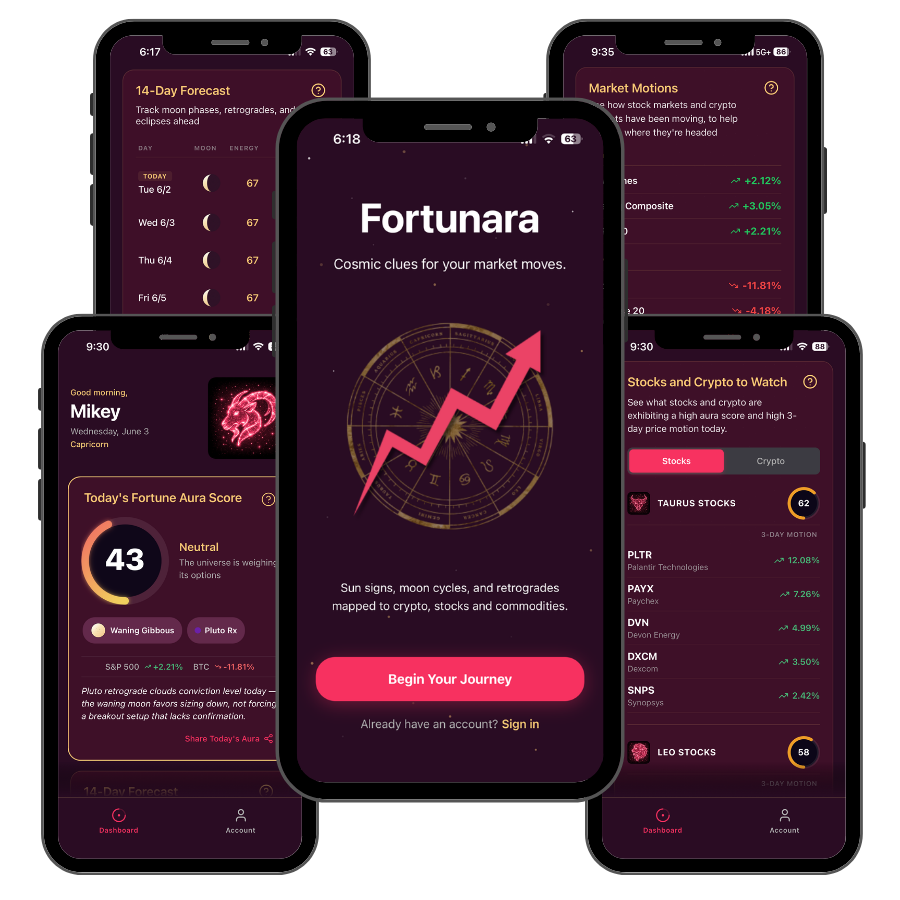
Get cosmic clues for your market moves.
Daily planetary signals mapped to your watchlist. Personalized to your sign.
Get Early AccessFor entertainment only. Not financial advice.
Who was Evangeline Adams
Evangeline Adams (1868–1932) was the most famous astrologer in America during her lifetime. She operated from Carnegie Hall in New York, had a client list that included royalty, heads of state, and Wall Street figures, and in 1914 successfully defended astrology in a New York court by demonstrating her system to the judge — who reportedly said her work "raised astrology to the dignity of an exact science."
Adams published several books on astrology, ran a highly successful radio program in the 1930s, and reportedly had a waiting list of clients several months long. She was not a fringe figure. She was a prominent professional operating at the center of New York society.
Her client roster included King Edward VII of England, the actress Mary Pickford, and — most famously — J.P. Morgan.
The Morgan connection
John Pierpont Morgan was the dominant force in American finance from the 1880s through his death in 1913. He organized the bailout of the US Treasury in 1895. He created US Steel, the first billion-dollar corporation. During the Panic of 1907, he personally orchestrated the rescue of the American financial system when the government could not.
Morgan retained Evangeline Adams as a personal astrologer. By multiple accounts, he consulted her regularly on timing — when to act, when to wait. The relationship was professional and sustained, not a one-time curiosity.
The quote most frequently attributed to Morgan — "Millionaires don’t use astrology. Billionaires do" — has become one of the most-cited lines in financial astrology circles. Its attribution is disputed; no verified primary source connects it to Morgan directly. But the sentiment it captures — that sophisticated actors pay attention to information that their competitors dismiss — is consistent with how Morgan operated in every other domain.
What is not disputed: Morgan was a man of considerable intellectual breadth who took seriously many systems that mainstream academia dismissed. His library contained extensive collections on esoteric traditions. His approach to markets was deeply psychological — he understood before behavioral finance existed that sentiment, belief, and collective psychology were market forces as real as fundamentals.
Why this story matters
The Morgan-Adams relationship is significant both as evidence that one of history’s most analytically rigorous financiers found real value in astrological counsel, and as an illustration of how elite financial actors have always sought non-consensus information sources.
Morgan didn’t use astrology because he was credulous. He was one of the most analytically rigorous financial minds of his era. He used it, presumably, because he found value in it — whether as a genuine predictive system, as a structured framework for thinking about timing, or as a disciplinary mechanism that forced reflection before major decisions.
The lesson for modern investors isn’t "Morgan did it, so it works." It’s more subtle: sophisticated actors have always used non-consensus information sources. The fact that something sits outside mainstream financial theory doesn’t make it useless. Morgan knew that better than most.
Other historical practitioners
Morgan was not alone. The overlap between serious financial practitioners and astrological systems is older and wider than most people realize.
W.D. Gann built planetary timing into his entire trading methodology. He incorporated astrological cycles into the Gann Square and the Square of Nine. He reportedly predicted the 1929 crash using these methods. Read the full Gann story →
Bill Meridian has published quantitative studies on planetary cycles and S&P 500 sector performance over decades. His work on Saturn transits and market behavior is the most systematic attempt to back-test financial astrology claims.
These figures span different eras and different approaches. What they share is a willingness to look for pattern and signal in places that mainstream finance ignores — and a track record serious enough that their methods are still studied today.
Common Questions
Is the "Millionaires don't use astrology" quote actually from J.P. Morgan?
Did Morgan make investment decisions based on astrology?
Are there other famous investors who used astrology?
Fortunara is for entertainment only. Nothing on this page constitutes financial advice.
The tradition Morgan started is now available to everyone.
Daily planetary signals and personalized financial horoscopes. Free to start.
For entertainment only. Not financial advice.