
Is Financial Astrology Real?
Quick Answer
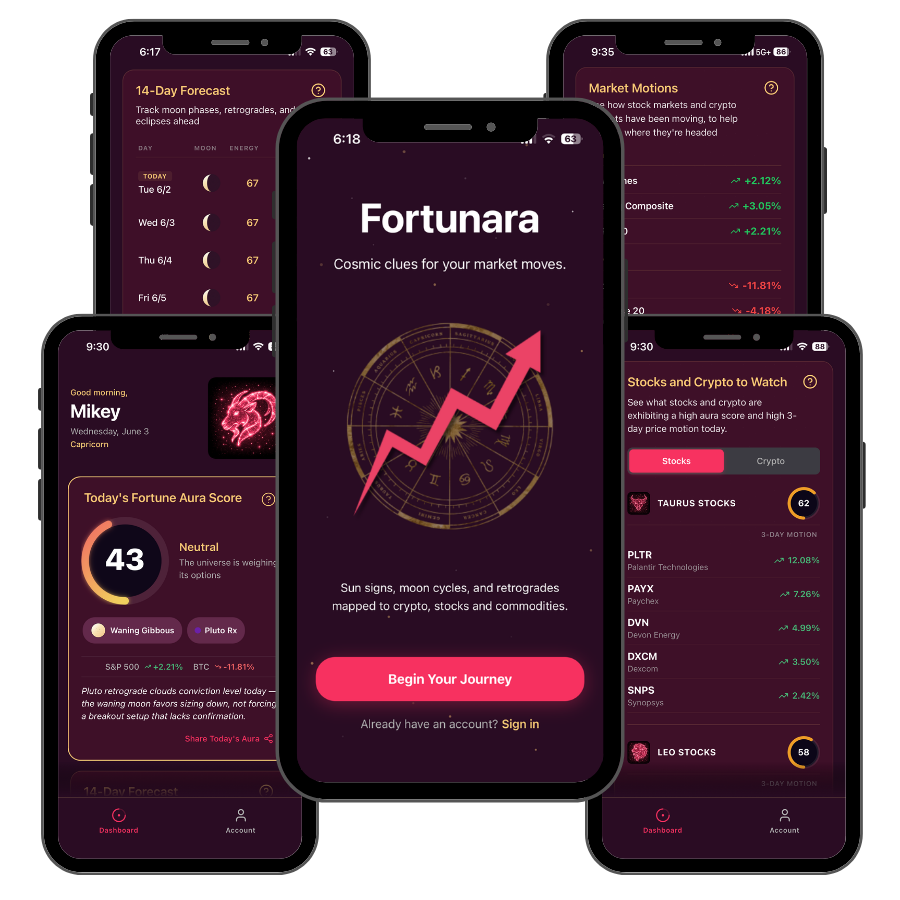
Get cosmic clues for your market moves.
Daily planetary signals mapped to your watchlist. Personalized to your sign.
Get Early AccessFor entertainment only. Not financial advice.
What makes financial astrology real
Three things make financial astrology a serious subject for investors.
A practitioner tradition with documented track records. Bill Meridian’s Cycles Research portfolio returned 19.9% annually over 17 years versus the S&P’s 5.6%, per Timer Digest. Arch Crawford was ranked the top US market timer in 1987, 1994, and 2008. The Astrologers Fund was the only major forecaster to predict the 2022 crash, per Forbes. These are audited, independently verified results.
Peer-reviewed academic evidence. Dichev and Janes (2003) found consistent return differentials across 25 countries and 30 years of data. The finding has survived multiple replication attempts.
A behavioral finance mechanism. With tens of millions of astrology app users modifying their investment behavior around planetary events, those collective behavioral shifts create real market inputs regardless of whether planets cause anything. Markets are human systems. Collective human behavior moves them.
The academic evidence
The most rigorous study is Dichev and Janes (2003) in the Journal of Finance. They found that stock returns across 25 countries were consistently higher in the days around new moons than full moons — an annualized difference of roughly 8.3 percentage points. The researchers proposed a behavioral mechanism: lunar phases affect mood and risk appetite in large populations.
That study has been replicated in several subsequent analyses. It hasn’t been definitively explained or dismissed.
Other research has looked at Saturn-Jupiter conjunctions and long-term market cycles, eclipse periods and volatility spikes, and Mercury retrograde periods and tech sector underperformance. The results are mixed and often underpowered, but they’re not nothing.
The practitioner tradition
Financial astrology isn’t new. W.D. Gann, one of the most famous traders of the early 20th century, built planetary timing into his forecasting methods. He called the 1929 crash. Whether astrology was the reason is debatable; that he used it is documented.
J.P. Morgan famously remarked: “Millionaires don’t use astrology. Billionaires do.” Whether or not that’s apocryphal, Morgan did retain Evangeline Adams as his personal astrologer for years. Read the full story →
Bill Meridian has published quantitative studies on planetary cycles and S&P 500 sector performance that have been cited in practitioner circles for decades. The tradition isn’t fringe — it’s simply outside mainstream financial academia.
How Fortunara approaches it
Fortunara is built on the practitioner tradition and the behavioral finance evidence. We track real planetary cycles, surface them in plain English alongside your personal chart, and give you the context to apply them to your own investment process.
Some users work within the astrological tradition. Some treat it as a behavioral sentiment signal. Some find it valuable; some find it entertaining; some use it the way they’d use the AAII Sentiment Survey — not because they believe in the mechanism, but because the collective behavior it tracks is real. All three approaches are legitimate, and Fortunara serves all of them.
Common Questions
Can financial astrology be back-tested?
Is confirmation bias a problem in financial astrology?
What do mainstream financial analysts think?
Fortunara is for entertainment only. Nothing on this page constitutes financial advice.
Decide for yourself.
Fortunara gives you daily planetary context — the data, the signals, and the interpretation. Free to start.
For entertainment only. Not financial advice.