
Can Astrology Predict the Stock Market?
Quick Answer
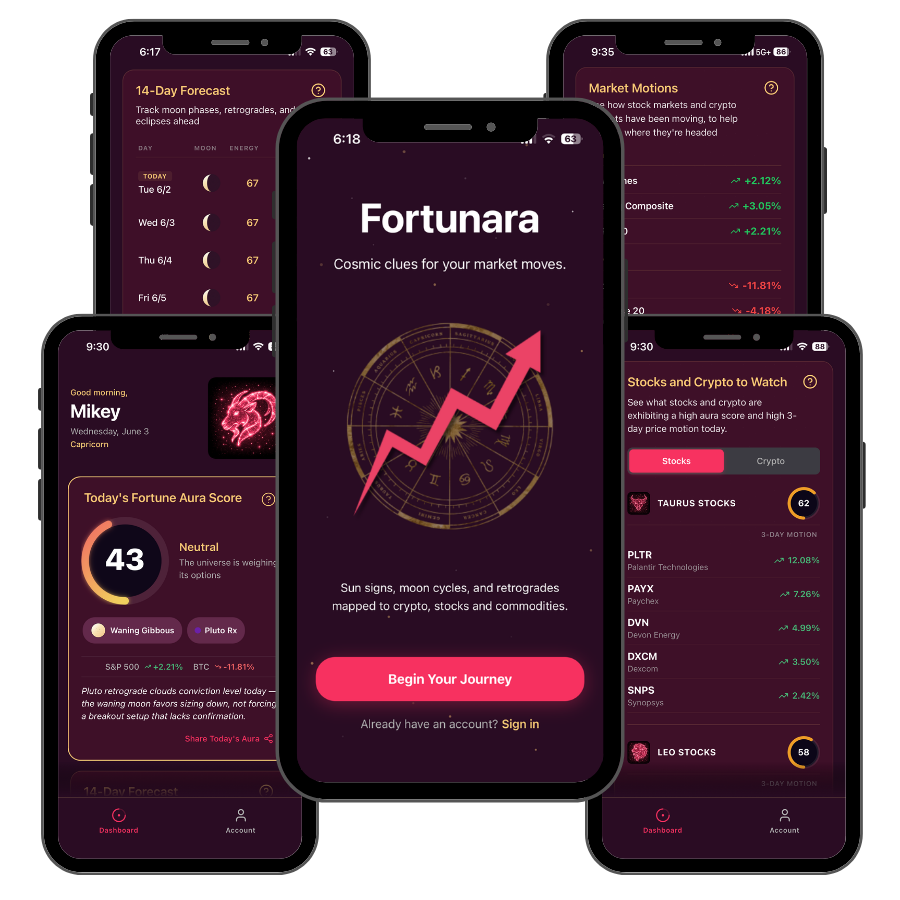
Get cosmic clues for your market moves.
Daily planetary signals mapped to your watchlist. Personalized to your sign.
Get Early AccessFor entertainment only. Not financial advice.
What financial astrology actually does
Financial astrology doesn’t predict specific stock movements at the ticker level. What it does is describe timing conditions, planetary cycles, and the energetic backdrop that practitioners have used for centuries to guide financial decisions. Some practitioners work directly within the tradition; others approach it through the behavioral finance lens.
The behavioral case: astrology apps have seen significant mainstream adoption in the US, and a meaningful share of those users modify their behavior around planetary events. They get cautious during Mercury retrograde. They feel expansive during Jupiter transits. When enough people act on the same signal at the same time, that collective behavior produces real price patterns. The mechanism is the same one that makes Federal Reserve meeting dates, quarterly earnings windows, and index rebalancing into predictable market events.
Richard Peterson, CEO of MarketPsych and one of the leading researchers in market sentiment analysis, has argued in similar terms: coordinated belief can generate real price patterns — not because of celestial mechanics, but because of human herd psychology.
This is the behavioral finance case for financial astrology. It doesn’t require believing the planets exert any force. It requires believing that crowd behavior moves markets — which is as well-established as any principle in modern finance.
What the academic research actually shows
The most-cited study on astrology and markets was published in the Journal of Finance in 2003 by Ilia Dichev and Troy Janes. They examined stock returns around lunar phases across 25 countries over several decades. Their finding: annualized stock returns in the days around new moons were roughly 8.3 percentage points higher than returns around full moons. The effect was consistent across markets and time periods.
The researchers were careful not to claim causation. The mechanism they proposed was behavioral — lunar cycles affecting mood and risk appetite in large populations. The result held even after controlling for known calendar effects.
Is 8.3 percentage points a trading signal? That depends on how you use it. For most investors, it’s a lens, not a system. For the researchers, it was enough to publish in the most prestigious finance journal in the world.
How to think about financial astrology as an investor
Fortunara tracks real planetary cycles and delivers them as context for your own analysis. Some users work within the astrological tradition and find direct value in the planetary guidance. Some approach it through the behavioral lens and use it as a sentiment signal. Some find it compelling. Some find it entertaining. All three are legitimate ways to engage with it.
What the evidence supports: the lunar cycle has documented return differentials across 25 countries. Practitioners with audited track records have outperformed broad market benchmarks over multi-decade periods. The collective behavior of millions of astrology app users creates real market inputs. That is enough to make financial astrology worth understanding — regardless of whether you believe in planetary causation.
Common Questions
Does Mercury retrograde actually affect stocks?
Has any serious research been done on astrology and markets?
Is financial astrology the same as technical analysis?
Fortunara is for entertainment only. Nothing on this page constitutes financial advice.
Fortunara delivers daily planetary signals, retrograde alerts, and sign-specific market context — built for investors who want every edge available.
Free to start.
For entertainment only. Not financial advice.