
How Do Moon Phases Affect the Stock Market?
Quick Answer
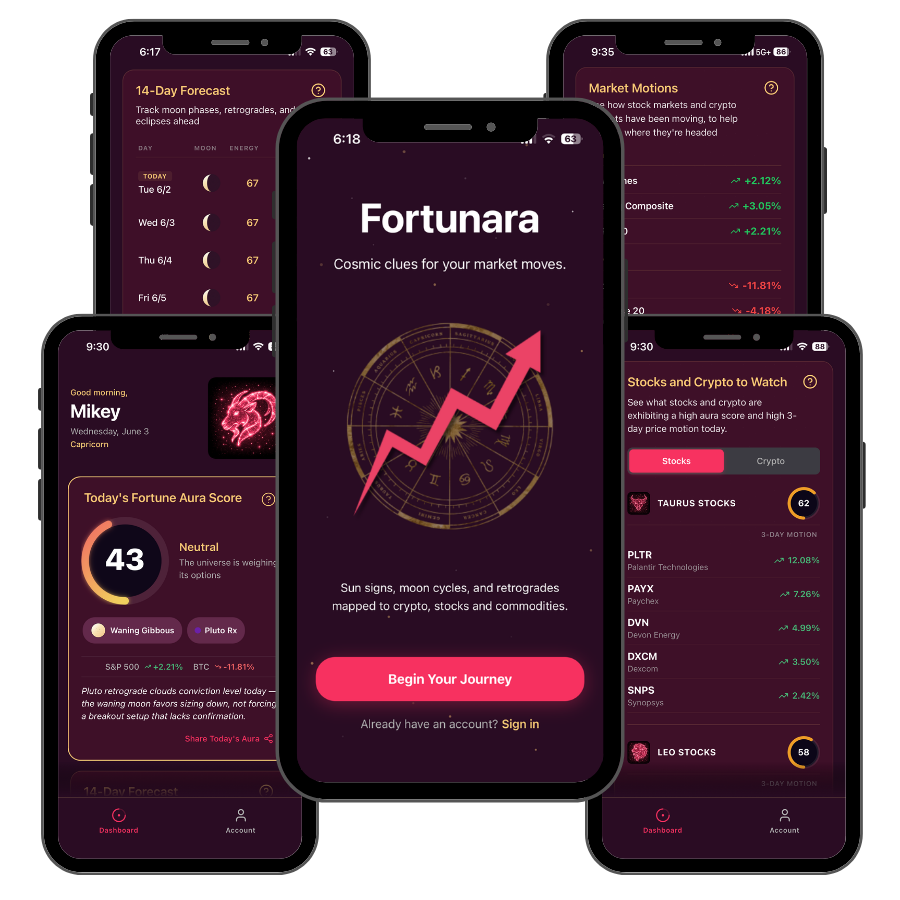
Get cosmic clues for your market moves.
Daily planetary signals mapped to your watchlist. Personalized to your sign.
Get Early AccessFor entertainment only. Not financial advice.
The research: Dichev and Janes (2003)
The foundational study on lunar phases and stock markets was published in the Journal of Finance in 2003 by Ilia Dichev and Troy Janes. It is one of the most rigorous analyses of a non-fundamental market variable ever published in mainstream financial academia.
The study examined stock market returns around lunar phases in 25 countries over multiple decades. The central finding: annualized stock returns in the 15 days around new moons were roughly 8.3 percentage points higher than returns in the 15 days around full moons. The effect was:
- Consistent across all 25 countries in the sample
- Persistent across different time periods tested
- Robust after controlling for known calendar effects (turn-of-month, day-of-week, etc.)
- Not explained by any known risk factor
The researchers did not claim that the moon causes anything. They proposed a behavioral mechanism: lunar phases are known to influence human mood and sleep patterns (the literature on this is separate and extensive), and changes in mood affect risk appetite. When large populations of investors simultaneously become more or less risk-averse, it shows up in aggregate market behavior.
The paper was peer-reviewed, published in the most prestigious finance journal in the world, and has been cited widely. It is not a fringe result.
Why the behavioral mechanism makes sense
The behavioral finance explanation for the lunar effect runs as follows:
Lunar cycles are among the oldest and most universal environmental rhythms that humans track. The evidence that lunar phases influence human mood and sleep quality is well-documented in the chronobiology literature. If lunar phases systematically shift the mood of large populations — even subtly — they shift the aggregate risk appetite of investors.
New moons are traditionally associated in many cultures with beginnings, optimism, and initiation. Full moons are associated with completion, culmination, and tension. If these associations are held by enough market participants, and if those associations influence their trading behavior in even small ways, the aggregate effect on prices is real — not because the moon did anything to the market, but because human belief and behavior constitute the market.
Astrology practitioners would say the lunar cycle has direct meaning — that the waxing and waning of the moon genuinely shapes the energetic conditions for financial decisions. The behavioral channel reinforces this: when enough investors act on the same signal at the same time, the effect on prices is real regardless of mechanism. The practitioner tradition and the academic evidence are pointing at the same calendar.
The new moon vs. full moon pattern
The Dichev-Janes finding is specifically about the contrast between new moon and full moon periods — not about absolute levels. Returns aren’t universally high around new moons or universally low around full moons; the differential between the two periods is what’s statistically significant.
In traditional astrology, the lunar cycle has clear financial associations:
New moon (dark moon): Traditionally a time of new beginnings, planting seeds, initiating projects. In financial astrology, associated with expansion, optimism, and the start of new cycles. The research evidence for elevated returns around new moons is the strongest empirical support for any astrological claim in mainstream financial literature.
Full moon: Traditionally a time of culmination, harvest, and release. In financial astrology, associated with tension, volatility, and the peak of cycles before reversal. The Dichev-Janes finding of relatively lower returns around full moons is consistent with this traditional association.
Waxing (new to full): The two-week period of growing lunar light, traditionally associated with building momentum and increasing energy. Generally considered favorable for initiating positions in financial astrology.
Waning (full to new): The two-week period of decreasing lunar light, traditionally associated with completion and release. Often considered a period for closing positions rather than opening new ones.
Crypto and lunar phases
The lunar effect, if it exists through behavioral mechanisms, should be strongest in markets with the highest retail participation and the most sentiment-driven pricing. Cryptocurrency markets fit that description more than almost any other asset class.
Several analyses of crypto markets have found lunar-phase correlations, particularly in Bitcoin and Ethereum. The mechanisms proposed are the same: the large retail base of crypto investors includes a significant proportion who follow astrological calendars, and their coordinated behavior around lunar events creates detectable price patterns.
The crypto community’s general openness to unconventional signals — compared to traditional equity markets — means lunar tracking is more openly discussed and acted upon in crypto circles. That collective openness may itself amplify the effect: if more participants are aware of and acting on lunar signals, the self-reinforcing dynamic is stronger. See the crypto astrology guide →
Common Questions
Has the Dichev-Janes finding been replicated?
Is the lunar effect large enough to trade on?
Do lunar phases affect all markets equally?
Fortunara is for entertainment only. Nothing on this page constitutes financial advice.
Track lunar phases alongside your investments.
Fortunara delivers daily lunar phase context, new moon and full moon alerts, and personalized chart readings. Free to start.
For entertainment only. Not financial advice.