
Does Astrology Affect the Stock Market?
Quick Answer
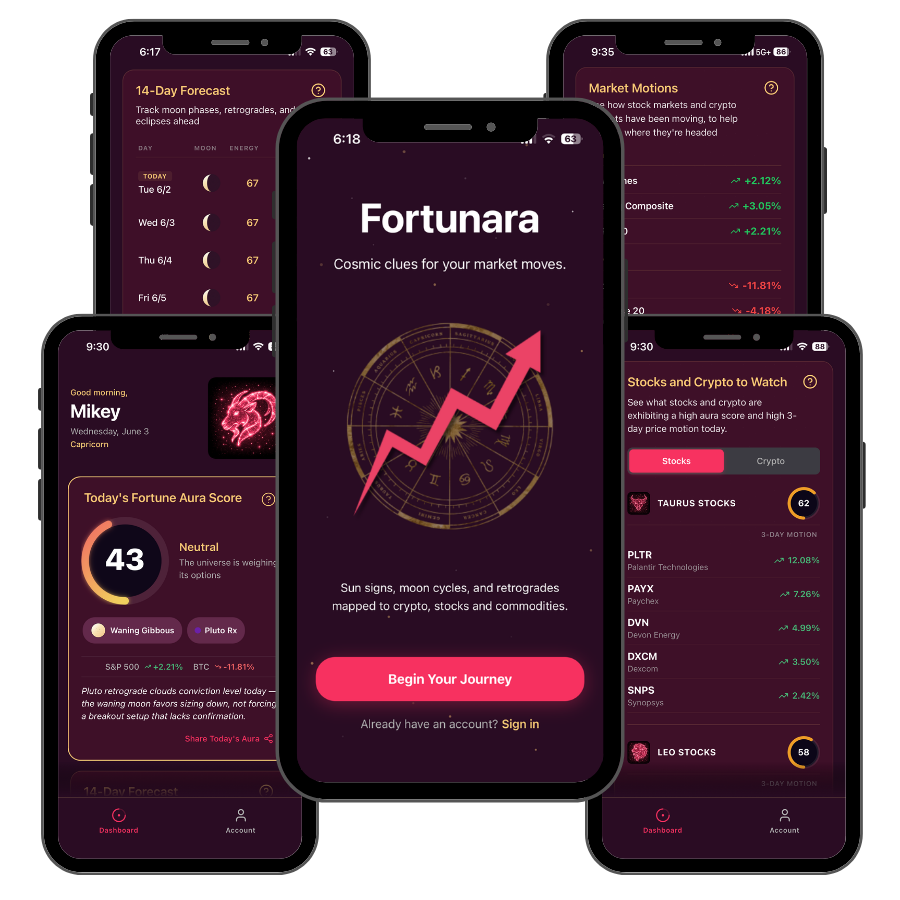
Get cosmic clues for your market moves.
Daily planetary signals mapped to your watchlist. Personalized to your sign.
Get Early AccessFor entertainment only. Not financial advice.
Two complementary channels
Financial astrology operates through two reinforcing channels that skeptics and practitioners often discuss separately — but which point toward the same practical conclusion.
The practitioner channel: Astrology practitioners hold that planetary cycles directly shape the conditions in which human decisions unfold — that Mercury retrograde genuinely affects communication and contracts, that Jupiter transits genuinely open windows of expansion. This tradition has been tested over centuries and has produced practitioners with documented multi-decade track records calling market events.
The behavioral channel: With astrology apps seeing significant mainstream adoption in the US, planetary events like Mercury retrograde have reached mainstream cultural awareness. George Soros built his investment career partly on the observation that market participants’ beliefs about the market become part of the market itself. When tens of millions of investors modify their behavior around the same signals at the same time, that coordinated behavior creates real, measurable market forces — regardless of mechanism.
These channels are compatible. The practitioner tradition and the behavioral finance lens both lead to the same calendar. Both are worth taking seriously.
The sentiment signal case
Richard Peterson at MarketPsych, which measures how narratives move asset prices, has validated this framing directly: financial astrology functions like any other belief-driven narrative. If enough traders act on it, coordinated behavior generates real price patterns.
You can see this in social data. Mercury retrograde searches spike three times a year. Finance Reddit communities see elevated caution-language during these periods. The question for an investor isn’t “is Mercury retrograde real?” It’s “is the collective behavioral response to Mercury retrograde large enough to be tradeable?” For some time windows, the evidence suggests it might be.
What Fortunara actually does
Fortunara is built on the view that planetary cycles carry real signal — both through the practitioner tradition that has tracked them for centuries, and through the collective behavior of the tens of millions of investors who follow them today. We track these cycles, deliver them in plain English, and give you the context to act on them.
Some users engage through the practitioner tradition. Some approach it through the behavioral lens. Most find that the longer they track the cycles, the harder the distinction is to maintain. What they have in common: they want to know what the sky is doing, because the sky is doing something worth knowing.
Common Questions
Do institutional investors use astrology?
Do astrological frameworks improve investment decision-making?
What's the difference between astrology and other market signals?
Fortunara is for entertainment only. Nothing on this page constitutes financial advice.
See what the sky is doing today — and what it might mean for the markets you're watching.
Daily planetary signals, retrograde alerts, and sign-specific context. Free to start.
For entertainment only. Not financial advice.