
New Moon Investing: What the Data Shows
Quick Answer
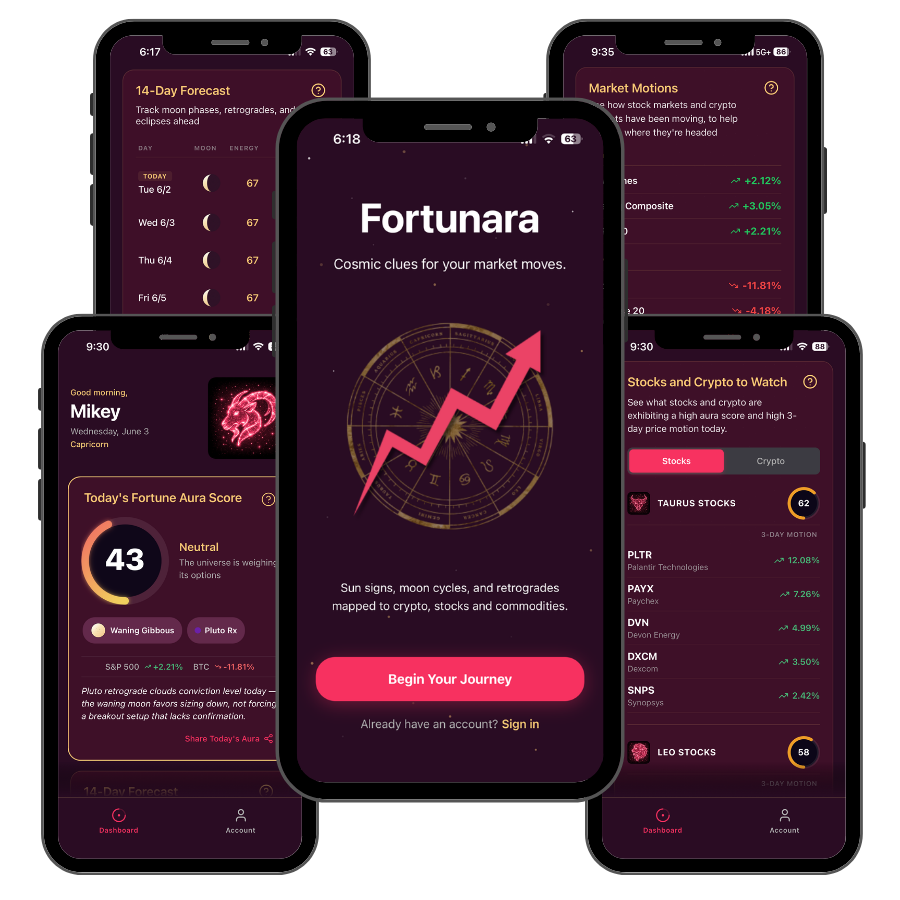
Get cosmic clues for your market moves.
Daily planetary signals mapped to your watchlist. Personalized to your sign.
Get Early AccessFor entertainment only. Not financial advice.
What the New Moon Represents
Every 29.5 days, the moon returns to its starting position — invisible against the Sun, ready to begin its cycle again. The new moon is the moment of reset, the dark before the light begins to build.
In the astrological tradition, new moons carry the quality of beginnings. Seeds planted at the new moon are said to grow with the building lunar light. Projects initiated at the new moon develop momentum as the waxing phase proceeds. The new moon is an opening, not an event.
Financial astrology applies this framework directly to investment activity. New moon periods are the preferred window for:
- Initiating new positions in assets that have been researched and are ready for entry
- Beginning due diligence processes on potential new investments
- Deploying capital that has been held in cash pending the right moment
- Setting new investment goals and portfolio targets for the month ahead
The Dichev and Janes data provides empirical support for this traditional framework. The 8.3 percentage point annualized return differential they found between new moon and full moon periods aligns precisely with what the tradition would predict. Full evidence overview →
The Sign Context Changes the Flavor
Every new moon occurs in a specific zodiac sign, because the moon moves through the full zodiac over its 29.5-day cycle. The sign context modifies what kind of initiation is most aligned with that particular new moon.
A new moon in Taurus — typically occurring in late April or May — carries Taurus themes: stability, tangible value, patient accumulation. It’s a favorable new moon for initiating positions in value-oriented equities, commodities, or real estate-adjacent assets. It’s less aligned with speculative, high-risk initiations.
A new moon in Aries — typically March or April — carries Aries themes: bold initiative, new ventures, risk appetite. This is a more aligned window for higher-risk initiations, new market entries, and aggressive positioning.
A new moon in Scorpio — typically October or November — carries Scorpio themes: deep research, transformation, and the surfacing of hidden value. Practitioners use Scorpio new moons as particularly favorable windows for deep-value investing and for positioning in sectors undergoing transformation.
The pattern repeats through all 12 signs over the course of a year, with each new moon carrying a distinct flavor that modulates how practitioners apply the general new moon initiation principle.
Solar Eclipses: The Amplified New Moon
Not all new moons are equal. Approximately twice a year, a new moon coincides with a solar eclipse — when the Earth, Moon, and Sun align precisely enough that the Moon’s shadow falls on Earth.
In financial astrology, a solar eclipse is treated as a supercharged new moon. The themes of the sign where the eclipse occurs are intensified dramatically. The initiation window is larger in scope and longer in duration. Eclipse new moons are associated with beginnings that matter — not just the start of a new month’s cycle, but the start of something with more lasting significance.
The practical application: when a new moon is also a solar eclipse, practitioners give it more weight as a timing signal. Initiations made at eclipse new moons are considered to have more momentum and staying power than standard new moon initiations.
Eclipse seasons occur twice a year, with each season typically producing one solar eclipse (new moon) and one lunar eclipse (full moon). Fortunara’s Cosmic Forecast flags eclipse events specifically, distinguishing them from standard lunar phase cycles.
Practical Application: Using New Moons Without Disrupting Your Strategy
The most common misreading of lunar phase investing is treating new moons as mandatory trade triggers. The discipline doesn’t work that way. Initiating a position at every new moon regardless of other conditions would quickly prove ineffective.
The correct application is additive, not prescriptive. If you’ve been researching a stock for three weeks, the fundamentals look right, the technical setup is reasonable, and the new moon is approaching — the lunar timing is a tiebreaker that adds weight to initiating now rather than waiting. If the fundamentals don’t support entry, the new moon doesn’t override that.
A simple framework that practitioners use:
Green light: Fundamentals support entry, technical setup is favorable, new moon within 5 days. All three factors aligned — proceed with full position.
Yellow light: Two of three factors positive, new moon within 5 days. Consider a partial position with intent to complete it during the waxing phase.
Red light: Fundamentals and technicals negative regardless of lunar phase. No position. The lunar calendar is a timing overlay, not a fundamental override.
The Monthly Portfolio Rhythm
Practitioners who use lunar phase investing often describe the most lasting benefit not as the specific performance difference between new and full moon periods, but as the monthly planning discipline the framework creates.
The new moon becomes a natural portfolio review moment: what positions am I ready to initiate this month? The full moon becomes a natural assessment moment: what positions am I reviewing, adjusting, or closing? This rhythm creates a structured cadence that many investors find valuable for maintaining discipline — independent of whether the astrological signal itself is the operative cause.
The 29.5-day lunar cycle maps onto a reasonable investment review cadence. Monthly portfolio reviews are a standard best practice in professional portfolio management. Using the lunar cycle to time those reviews is one way to make the cadence natural rather than arbitrary.
Common Questions
Should I always wait for the new moon to initiate positions?
What if I miss the new moon?
How does the new moon interact with Mercury retrograde?
Fortunara is for entertainment only. Nothing on this page constitutes financial advice.
Fortunara's Cosmic Forecast tells you not just when the next new moon is, but what sign it's in, whether it's an eclipse, and how it interacts with the current planetary configuration.
The context that makes lunar timing actually useful.
For entertainment only. Not financial advice.