
Planetary Aspects Explained for Investors
Quick Answer
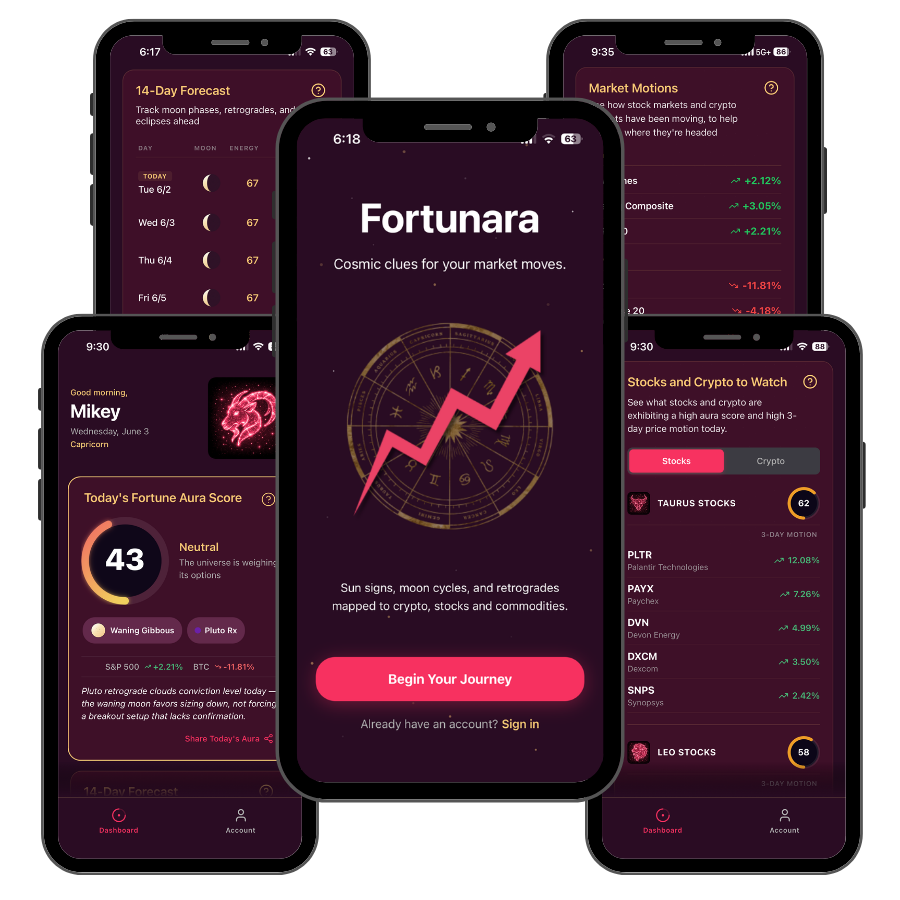
Get cosmic clues for your market moves.
Daily planetary signals mapped to your watchlist. Personalized to your sign.
Get Early AccessFor entertainment only. Not financial advice.
Why Aspects Matter More Than Single Planets
The most common mistake in learning financial astrology is treating planets in isolation. Reading that “Jupiter is in Gemini” and concluding “tech sector bullish” misses the critical second step: what is Jupiter doing in relation to other planets right now?
A Jupiter transit in favorable aspect to a given market chart can produce significant upward moves. Jupiter in a tense square to Saturn can produce the frustrating sideways markets where expansion impulses keep getting checked by structural resistance. The planet alone is the noun. The aspect is the verb.
Experienced practitioners describe it this way: knowing planetary positions without aspects is like knowing the weather instruments but not the current readings. The positions tell you what forces are at work. The aspects tell you what they’re actually doing to each other.
The Major Aspects and Their Market Signatures
Conjunction (0 degrees): Two planets at the same degree of the zodiac. Their energies combine intensely, for better or worse depending on which planets are involved. Jupiter conjunct Venus amplifies both expansion and value perception — historically positive for luxury and consumer sectors. Saturn conjunct Pluto (2020) combined contraction and transformation into a structural disruption signal that practitioners had been flagging for years. Conjunctions are among the most powerful timing markers in the discipline.
Trine (120 degrees): Two planets separated by 120 degrees. The trine is considered the most naturally harmonious aspect — energy flows easily between the two planets. Market conditions under strong trine configurations tend to advance smoothly, with momentum sustained and fewer obstacles. The risk is complacency: trines can produce conditions so favorable that participants over-extend. Jupiter trine Saturn is one of the most constructive market aspects, combining expansion with structural support.
Sextile (60 degrees): Two planets separated by 60 degrees. Slightly less powerful than the trine but similarly constructive. The sextile is often described as an opportunity that requires some effort to realize — the conditions are supportive but not effortless. Practically, sextile configurations between Jupiter and slower planets often mark good entry windows in their respective sectors.
Square (90 degrees): Two planets separated by 90 degrees. The square creates friction and challenge between the two planetary energies. Neither can easily express itself without the other getting in the way. Market conditions under strong square configurations tend to be contentious, volatile, and characterized by competing forces that prevent smooth directional movement. Jupiter square Saturn produces the “two steps forward, one step back” market that frustrates both bulls and bears. Saturn square Pluto is one of the more structurally challenging configurations in the discipline.
Opposition (180 degrees): Two planets at exactly opposite positions in the zodiac. The opposition represents maximum polarity — the full expression of both planetary energies in tension. Oppositions often coincide with market turning points, peaks, or confrontations between competing forces. The Saturn-Jupiter opposition, which occurs roughly every 10 years, marks a mid-cycle correction in the 20-year Jupiter-Saturn cycle.
The Orb: How Precise Do You Need to Be?
An important technical concept: aspects don’t only operate at exact degree. Practitioners apply an “orb” — a range of degrees on either side of the exact aspect within which the influence is active.
Tighter orbs (within 1–2 degrees) produce the strongest, most concentrated effects. Wider orbs (5–8 degrees) produce subtler background influences. Most experienced practitioners use orbs of approximately 5 degrees for major aspects between slow planets (Jupiter, Saturn, Uranus, Neptune, Pluto) and tighter orbs for fast planets (Sun, Moon, Mercury, Venus, Mars).
The practical implication: when a significant Saturn-Pluto square is within 2 degrees of exact, that’s a different intensity level than when it’s 6 degrees away. Understanding orb tightening and separating (whether the planets are moving toward exact or away from it) is part of reading the aspect’s timing.
Confluence: When Multiple Aspects Align
The most significant timing signals in financial astrology come not from a single aspect but from multiple aspects pointing in the same direction simultaneously.
A single Jupiter trine to a market chart point is encouraging but not necessarily actionable. Jupiter trine combined with Venus sextile and a favorable lunar phase all occurring in the same week creates a confluence that carries more weight.
Experienced practitioners look for confluence before treating an aspect as a high-conviction timing signal. One supporting aspect might be coincidence. Three independent aspects pointing the same direction at the same time is a pattern worth taking seriously.
The same principle applies in reverse: a Saturn square coinciding with a Mars retrograde station and a tense Pluto aspect creates a degree of structural pressure that any single aspect alone wouldn’t produce.
Applying Aspects to Current Markets
The practical application of aspect analysis for investors doesn’t require calculating every planetary position manually. It requires understanding:
First, which major slow-planet aspects are currently active (Saturn-Jupiter, Saturn-Pluto, Jupiter-Uranus, etc.). Second, whether those aspects are tightening (approaching exact) or separating (past exact). Third, what the combined planetary energies suggest about the current market regime. Fourth, where the fast planets (Sun, Mercury, Venus, Mars) are triggering the slow-planet configurations through their own aspects.
This is genuinely complex to track manually. A practitioner doing this rigorously maintains an ephemeris, tracks multiple planet positions daily, calculates orbs, and synthesizes across multiple timescales simultaneously. It’s exactly the kind of multi-variable synthesis that software handles more reliably than manual calculation.
Common Questions
Do I need to calculate aspects myself?
Which aspects are most important for short-term market timing?
What's the difference between a natal chart aspect and a transit aspect?
Fortunara is for entertainment only. Nothing on this page constitutes financial advice.
Understanding aspects manually requires tracking a dozen planetary positions simultaneously and calculating their relationships in real time.
Fortunara's Cosmic Forecast synthesizes all of this into a daily read — the aspects are doing their work in the background whether or not you're calculating them.
For entertainment only. Not financial advice.