
Saturn Transits & the Stock Market
Quick Answer
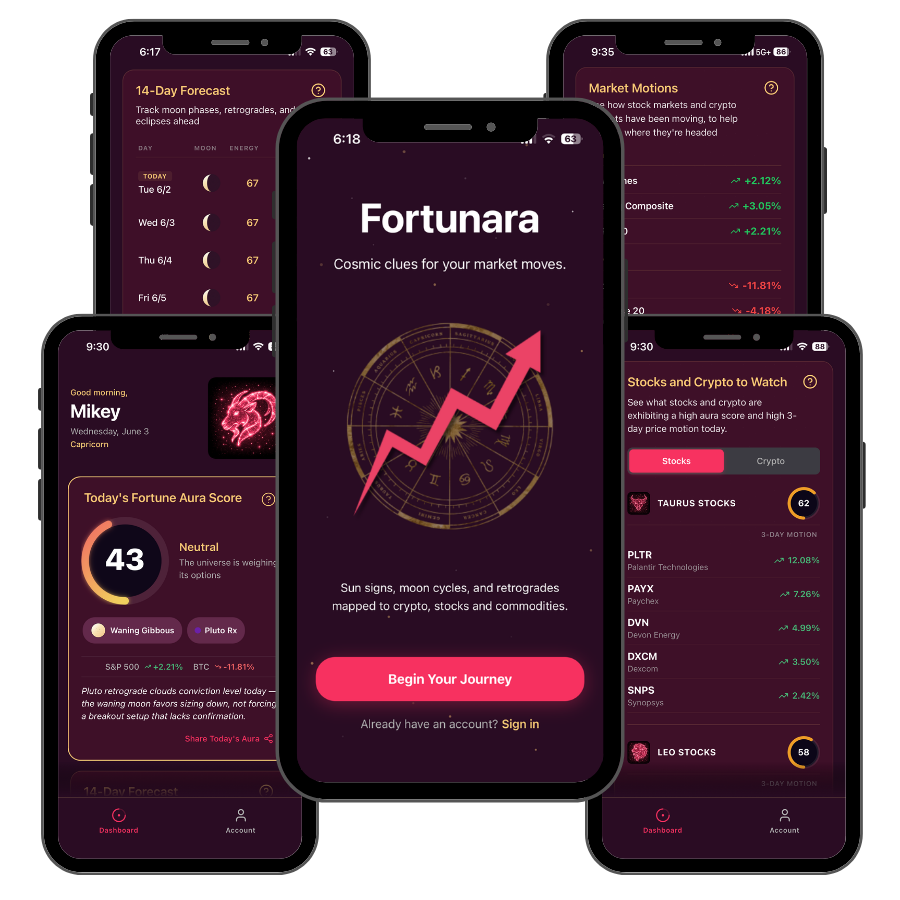
Get cosmic clues for your market moves.
Daily planetary signals mapped to your watchlist. Personalized to your sign.
Get Early AccessFor entertainment only. Not financial advice.
Saturn’s Market Identity
Every discipline needs a counterweight to its bullish indicators. In financial astrology, Saturn is it.
Where Jupiter describes what might grow, Saturn describes what must hold up under pressure. Markets that have expanded rapidly under Jupiter’s influence often face their reckoning when Saturn moves into a tense configuration. The sectors that benefited from easy money and optimistic forecasts find out, during Saturn transits, whether their fundamentals were real.
This isn’t pessimism built into the system — it’s realism. Saturn transits don’t cause bear markets. They correlate with the periods when the structural weaknesses that were always present get exposed.
The 29.5-Year Cycle
Saturn’s full orbit of around 29.5 years creates a long-cycle market pattern that financial astrologers have documented across several centuries of price data. The “Saturn return” — when Saturn returns to its natal position in a country’s founding chart, a company’s incorporation chart, or an exchange’s inception chart — tends to coincide with significant structural reckonings in those entities.
The New York Stock Exchange was incorporated in 1792. Practitioners track Saturn’s relationship to the NYSE’s natal chart as a macro signal for US equity markets broadly. Bill Meridian, whose quantitative work on planetary cycles and market behavior is cited in mainstream financial reference texts, has documented the Saturn return pattern in exchange charts across multiple cycles.
Saturn Through the Signs: Recent and Upcoming History
Understanding where Saturn has been and where it’s going provides the macro backdrop for current market positioning.
Saturn in Capricorn (2017–2020): Capricorn is Saturn’s home sign, where its themes of institutional authority and structural discipline are at their most intense. This period saw: the peak and initial unwind of the post-2008 expansion, tightening regulatory environments, increasing institutional scrutiny of speculative sectors, and — at its culmination in early 2020 — a conjunction with Pluto that practitioners identify as one of the most structurally disruptive configurations in modern market history.
Saturn in Aquarius (2020–2023): Aquarius rules networks, technology, and collective systems. Saturn’s transit here produced the tension between the explosive growth of tech-sector innovation (Aquarian theme) and the structural discipline Saturn brings — manifesting as the 2022 tech selloff and the unwinding of the most speculative growth valuations. Crypto’s 2022 implosion also fits this pattern, as crypto is an Aquarian technology facing Saturnian structural accountability.
Saturn in Pisces (2023–2026): Pisces rules energy, pharmaceuticals, speculative imagination, and the dissolution of boundaries. Saturn in Pisces tends to produce structural reckonings in these sectors. Energy markets have faced structural pressure. Pharmaceutical valuations have come under scrutiny. The speculative excess in AI-adjacent names is navigating Saturn’s demand for structural justification.
Saturn into Aries (2025–2028): Saturn entering Aries marks a significant shift. Aries rules initiative, aggression, and new market entrants. Saturn in Aries tends to produce a structural reckoning for the most aggressively-positioned players — the overextended, the undercapitalized, the companies that scaled before they were ready. This is not uniformly bearish, but it does tend to separate well-structured operations from poorly-structured ones in ways that markets eventually price.
The Saturn-Pluto Conjunction: The Rare Disruption Signal
The single most-discussed Saturn configuration in financial astrology is its conjunction with Pluto. This occurs approximately every 33–38 years and is associated, in the historical record, with major structural breakdowns.
The 2020 conjunction in Capricorn at 22 degrees preceded the COVID market crash by approximately eight weeks. The 1982 conjunction preceded the deepest recession of the post-WWII era. The 1914–1915 conjunction coincided with the outbreak of World War I and the closure of major global exchanges.
This is not a connection practitioners invented after the fact. Ray Merriman, whose MMA Cycles research has been published for decades, identified the 2020 Saturn-Pluto conjunction as a high-risk window well in advance. The next Saturn-Pluto conjunction is not until 2053. But Saturn’s aspects to Pluto — squares and oppositions — occur on shorter timescales and carry related themes at reduced intensity.
Integrating Saturn Into Investment Practice
The practical application of Saturn’s signal is primarily defensive and structural rather than directional.
Macro regime assessment. Understanding which sign Saturn currently occupies and what aspect it makes to key points in market charts helps identify whether the current environment is expansionary (Jupiter dominant) or reckoning-oriented (Saturn dominant). A tense Saturn configuration doesn’t mean sell everything. It means evaluate whether your positions are structurally sound enough to withstand pressure.
Sector positioning. Saturn in a given sign tends to pressure the sectors ruled by that sign while potentially favoring the sectors ruled by the opposite sign, which receives Saturn’s opposition and can respond constructively to the structural demands. Identifying the Saturn-pressured sectors and reducing overweight positions there is a standard practitioner technique.
Entry quality. Saturn transits, even difficult ones, create the market conditions that produce the best long-term entry points. The bottoms of Saturn-driven corrections often coincide with the best risk-reward entries for patient investors. Saturn ends. The sectors it pressured often recover substantially once Saturn moves on.
Saturn Is Not the Enemy
The practitioners who have studied Saturn’s market influence longest are the most pragmatic about it. Saturn isn’t a doom signal. It’s a quality test.
Markets built on genuine earnings, real cash flow, and defensible moats tend to hold up through Saturn transits. Markets built on speculative excess, narrative, and future promises tend to get repriced. Saturn doesn’t cause that repricing — it just provides the conditions under which the market does the repricing itself.
For investors who hold high-quality positions, Saturn periods can be excellent times to add at compressed valuations. For investors who are overexposed to speculative excess, Saturn periods are when the overexposure becomes expensive.
Common Questions
Does Saturn always signal a bear market?
What's the difference between Saturn and Jupiter signals?
How does Saturn affect individual stocks?
Fortunara is for entertainment only. Nothing on this page constitutes financial advice.
Fortunara's Cosmic Forecast tracks Saturn's current sign and upcoming aspect dates, framed for investors who want the macro backdrop.
Not just the horoscope.
For entertainment only. Not financial advice.