
Jupiter Transits & Investing
Quick Answer
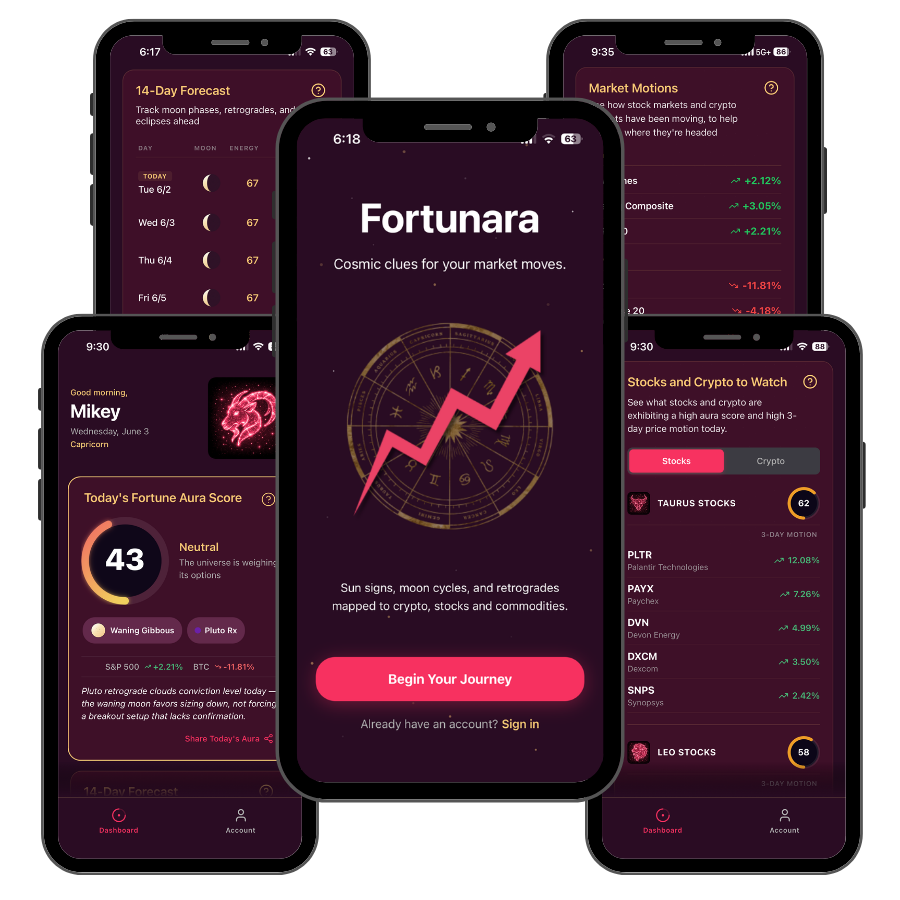
Get cosmic clues for your market moves.
Daily planetary signals mapped to your watchlist. Personalized to your sign.
Get Early AccessFor entertainment only. Not financial advice.
Jupiter’s Role in Financial Astrology
Of all the planetary indicators tracked by financial astrologers, Jupiter has the most consistently bullish reputation. It governs expansion, abundance, optimism, and the growth impulse. Its market signature is most visible in sector rotation: when Jupiter moves into a new zodiac sign, the sectors and themes associated with that sign tend to attract elevated attention, capital flows, and often elevated valuations.
This isn’t a short-term signal. Jupiter’s year-long stay in each sign is a macro backdrop, not a daily trade trigger. Practitioners use it the way macro investors use central bank posture or sector rotation models — as a directional bias that informs positioning without dictating individual trades.
The discipline’s approach to Jupiter is direct: understand which sector themes the current sign amplifies, watch for Jupiter’s ingress dates, and position sector exposure accordingly.
The 12-Year Cycle and Sector Rotation
Jupiter’s transit through the full zodiac takes approximately 12 years. That cycle maps loosely onto economic expansion cycles that economists have observed empirically. The connection isn’t coincidental, according to financial astrology — Jupiter’s position describes the collective psychological orientation toward growth, and that orientation has material market consequences.
Each sign Jupiter transits carries specific sector implications based on the sign’s traditional domains:
Aries rules new initiatives, risk appetite, and aggressive action. Jupiter in Aries tends to favor small-cap growth, venture-stage investments, and sectors associated with new market entrants challenging established players.
Taurus rules tangible assets, stability, and material value. Jupiter in Taurus tends to favor commodities, real estate, agriculture, and value-oriented equities over speculative growth.
Gemini rules information, communication, and the rapid exchange of ideas. Jupiter in Gemini historically benefits media, telecommunications, education technology, and short-term trading activity.
Cancer rules domestic security, consumer behavior, and the home. Jupiter in Cancer tends to favor consumer staples, housing, and defensive sectors associated with everyday household needs.
Leo rules entertainment, leadership, and the expression of confidence. Jupiter in Leo historically benefits entertainment, luxury goods, celebrity-driven brands, and risk-on sentiment broadly.
Virgo rules precision, health, and systematic improvement. Jupiter in Virgo tends to benefit healthcare, pharmaceutical research, data analytics, and productivity-focused technology.
Libra rules balance, partnerships, and aesthetic value. Jupiter in Libra historically benefits M&A activity, luxury brands, legal services, and deal-making environments broadly.
Scorpio rules transformation, shared resources, and penetrating analysis. Jupiter in Scorpio tends to benefit financial services, private equity, investigative industries, and deep-value investment approaches.
Sagittarius rules expansion, international reach, and philosophical breadth. Jupiter in its home sign tends to benefit global trade, legal and regulatory sectors, higher education, and international equities.
Capricorn rules institutional authority, discipline, and long-term structure. Jupiter in Capricorn tends to benefit traditional institutional sectors — banking, infrastructure, government contractors — though its natural expansiveness is somewhat constrained by Capricorn’s conservatism.
Aquarius rules technology networks, collective action, and systemic innovation. Jupiter in Aquarius historically benefits fintech, decentralized systems, social platforms, and technology disruption broadly.
Pisces rules intuition, dissolution of boundaries, and speculative imagination. Jupiter in Pisces tends to benefit energy, pharmaceuticals, creative industries, and speculative assets — including crypto.
The Jupiter-Saturn Conjunction: The 20-Year Reset
The most significant recurring Jupiter signal isn’t its annual ingress but its conjunction with Saturn, which occurs approximately every 20 years. Financial astrologers and some economic historians treat the Great Conjunction as a marker of major economic era transitions.
The 2020 conjunction occurred in Aquarius — the first time the conjunction happened in an air sign in approximately 200 years. Practitioners noted this as marking the beginning of a new era defined by information, networks, and technology rather than the earth sign themes (industry, material production, institutional power) that had dominated since the conjunction series of the 1800s.
In hindsight, the AI era, the acceleration of fintech, and the rise of retail investor networks (meme stocks, crypto communities, social trading) all fit the Aquarian framework. Whether that’s predictive methodology or pattern recognition applied retrospectively is a fair debate. What practitioners track is the conjunction dates and the sector themes of the conjunction sign as a 20-year macro backdrop.
Jupiter Retrograde
Jupiter spends approximately four months of each year in retrograde. The expansion themes associated with Jupiter’s current sign don’t reverse during retrograde, but they do internalize. Practitioners describe Jupiter retrograde as a consolidation of the gains made during direct motion — a period more suitable for reviewing and strengthening existing positions than for aggressive new expansion.
The pattern observed by practitioners: Jupiter retrograde periods tend to see the sectors favored by Jupiter’s current sign pause or consolidate rather than extend their advance. When Jupiter stations direct again, the advance often resumes.
This makes Jupiter retrograde a useful timing signal for entries. If Jupiter has been driving a particular sector higher and then stations retrograde, waiting for the direct station before initiating new positions in that sector is a practice recommended in the discipline.
Integrating Jupiter Into a Portfolio Framework
Jupiter’s influence operates on a timescale that suits strategic allocation decisions rather than active trading. The practical application:
Sector rotation. When Jupiter ingresses into a new sign, review the sector implications and consider whether your current allocation is aligned or misaligned with the Jupiter-favored themes for the coming year.
Entry timing. Jupiter direct stations are considered favorable entry windows for positions in Jupiter-favored sectors. Jupiter retrograde stations are considered less favorable for new initiations.
Long-cycle positioning. The Jupiter-Saturn conjunction cycle provides a 20-year framework for thinking about structural sector dominance. Understanding which era you’re in helps contextualize why certain sectors have multi-decade tailwinds.
This is not a replacement for fundamental analysis. It’s a directional macro overlay that practitioners layer on top of conventional approaches — the same way an investor might use economic cycle analysis or demographic trend research as a backdrop for sector allocation decisions.
Common Questions
Is Jupiter's market influence scientifically documented?
Where is Jupiter right now?
How does Jupiter interact with other planets?
Fortunara is for entertainment only. Nothing on this page constitutes financial advice.
Fortunara's Cosmic Forecast surfaces Jupiter's current position and upcoming ingress dates, framed in terms of what they mean for markets.
Not just what they mean in an astrology textbook.
For entertainment only. Not financial advice.