
Financial Astrology on Wall Street: The Complete History
From J.P. Morgan’s personal astrologer to a hedge fund that predicted the 2022 crash — the practice most investors don’t know exists.
The Practice Most Investors Don’t Know Exists
Most investors, if asked whether astrology has ever played a role on Wall Street, would say no. Most would be wrong.
The history of financial astrology — the practice of using planetary cycles as a framework for market timing and investment analysis — runs directly through the most consequential names in American financial history. It has been practiced, documented, and in several cases independently verified, for well over a century.
This is not a story about fringe believers and lucky guesses. It is a story about J.P. Morgan’s personal astrologer, W.D. Gann’s 1929 crash prediction published eleven months before Black Thursday, a Merrill Lynch analyst who called the exact top day of the 1987 crash, an NYU MBA whose model portfolio outperformed the S&P 500 by nearly four to one over seventeen years, an institutional fund that was the only major forecaster to predict the 2022 crash according to Forbes, and the world’s wealthiest person reportedly timing a $50 billion IPO to a planetary alignment.
What follows is the complete story, with links to the full account of each figure.
What Is Financial Astrology?
Financial astrology is the practice of using planetary positions, cycles, and configurations as analytical inputs for understanding market timing, investor sentiment, and economic patterns. Practitioners in the tradition treat planetary signals as direct guidance on timing and conditions. The behavioral finance dimension adds a second foundation: planetary cycles create collective narrative moments that influence investor behavior at scale.
Both perspectives are represented in the active practitioner community. As Richard Peterson, CEO of MarketPsych, has argued: coordinated belief can generate real price patterns — not because of celestial mechanics, but because of human herd psychology. The practitioners with the best documented track records combine both: deep knowledge of the astrological tradition, and rigorous tracking of how planetary signals correlate with market outcomes.
In this framing, financial astrology is a branch of behavioral finance — one that uses planetary event calendars as a proxy for collective sentiment cycles. When tens of millions of astrology app users become cautious during Mercury retrograde, that collective caution is a real market input regardless of whether Mercury causes anything. And when moon phases align with documented behavioral shifts in large populations, the resulting market patterns are measurable.
Fortunara’s complete guide to financial astrology covers the evidence, the methodology, and how to apply it.
At its most sophisticated level, financial astrology also involves tracking long-term planetary cycles — the 20-year Saturn-Jupiter conjunction, the 84-year Uranus cycle, the 248-year Pluto cycle — as frameworks for identifying generational economic transitions. These are the tools that Gann used to call the 1929 crash, that Crawford used to call 1987, and that Weingarten has used to advise institutional clients since 1988.
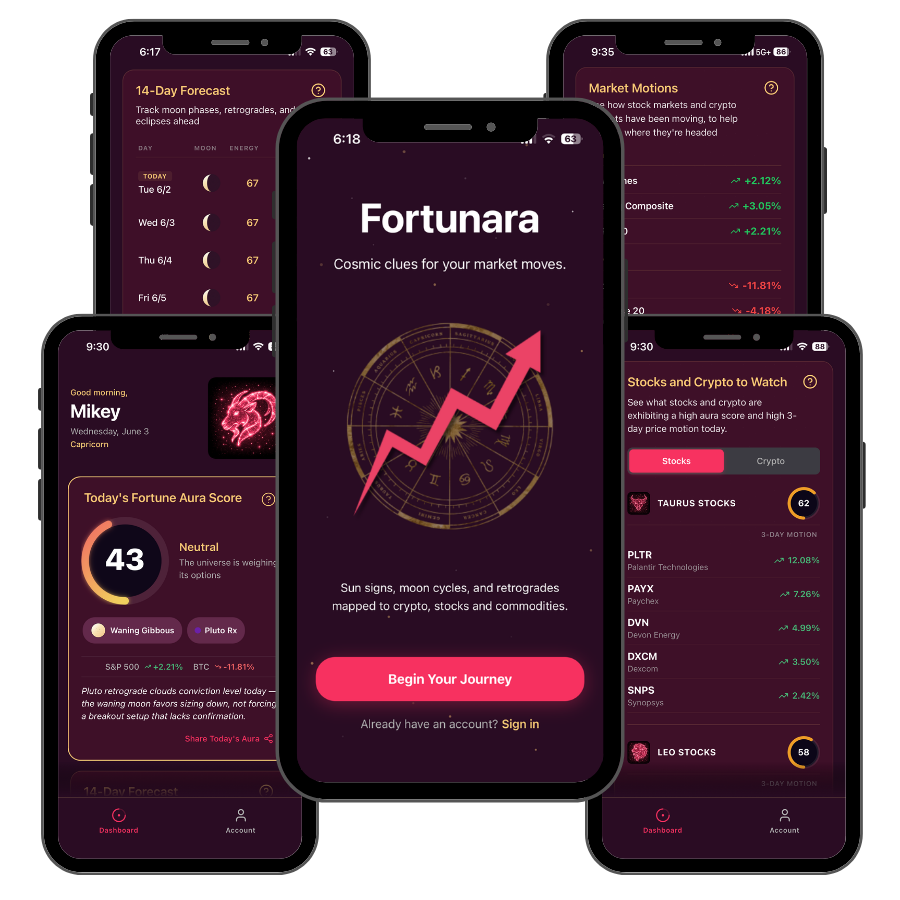
Get cosmic clues for your market moves.
Daily planetary signals mapped to your watchlist. Personalized to your sign.
Get Early AccessFor entertainment only. Not financial advice.
J.P. Morgan and Evangeline Adams: Where It Begins
The most famous figure associated with financial astrology in American history is also the most powerful banker the country has ever produced.
J.P. Morgan — founder of JPMorgan Chase, financier of U.S. Steel, orchestrator of the Panic of 1907 resolution — kept a personal astrologer. Her name was Evangeline Adams, and she was the most prominent astrologer in early twentieth-century America.
Adams documented her relationship with Morgan in her 1926 autobiography, The Bowl of Heaven. She provided him with regular advisory services during the final years of his life, consulting on business decisions and, by historical accounts, major financial timing.
The quote most associated with Morgan in financial astrology circles — “Millionaires don’t use astrology; billionaires do” — may or may not be his precise words. Researchers note that some versions of the quote are attributed to astrologer Sydney Omar rather than Morgan directly. What is not disputed is the documented relationship between Morgan and Adams, or the fact that the most powerful figure in American finance at the turn of the twentieth century had an astrologer in his circle of advisors.
The Morgan-Adams story established a template that would repeat across the next century: elite financial actors engaging with planetary analysis privately, while the practice remained publicly unacknowledged.
W.D. Gann: The Trader Who Predicted the Great Crash
The most rigorously documented case of financial astrology producing a verifiable market prediction belongs to William Delbert Gann — a self-taught trader from Lufkin, Texas who became the most studied figure in the history of technical analysis.
In November 1928, Gann published his annual market forecast for 1929. It predicted, unequivocally, a major market top and crash in the fall of 1929. The Dow Jones Industrial Average peaked on September 3, 1929. The crash began in October. The Great Depression followed.
Gann had called it eleven months in advance.
His methodology — which he called the Law of Vibration — combined planetary cycle analysis, sacred geometry, and time cycle research. He tracked Saturn and Jupiter as long-cycle market indicators, compared current transits to the NYSE’s natal chart, and used geometric angles derived from planetary relationships as price support and resistance lines.
His tools — Gann Angles, the Square of Nine, the Wheel of 24 — remain in active daily use by traders worldwide. Read the full story of W.D. Gann and the Law of Vibration.
Arch Crawford: Wall Street’s Best-Known Astrologer
Arch Crawford began his career as the first technical analyst assistant to Robert Farrell at Merrill Lynch — one of the most respected technical analysts in institutional finance history. He discovered financial astrology in 1963 and founded Crawford Perspectives in 1977, a monthly market timing newsletter he has published without interruption for nearly five decades.
His defining moment came in 1987. Crawford identified August 25, 1987 — the date of a rare multiple planetary conjunction — as the exact top of the bull market. He appeared on Financial News Network (now CNBC) the Friday before Black Monday and predicted a 150-point down day followed by a 200-point down day. The market fell 108 points that Friday and 508 points on Monday.
Barron’s named him “Wall Street’s best-known astrologer.” Independent tracker Timer Digest ranked him number one in stock market timing in 1987, 1994, and 2008. Robert Prechter of the Elliott Wave Theorist said Crawford “probably has the best 30-year record in the business.”
The full story of Arch Crawford’s 1987 crash prediction documents one of the most remarkable individual calls in the history of financial forecasting.
Bill Meridian: The NYU MBA With a Four-Decade Track Record
Bill Meridian received his MBA in finance from New York University in 1972 and began studying astrology the same year. The dual background shaped everything that followed: he approached planetary cycles not as a believer but as a financial analyst testing a hypothesis.
The results of four decades of research and institutional fund management are on the public record. According to Timer Digest, Meridian’s Cycles Research model portfolio returned 19.9% annually from 1996 through 2013, versus the S&P 500’s 5.6%. The portfolio outperformed the benchmark in 51 of 68 quarters.
In 1983 Meridian built the AstroAnalyst — believed to be the first software program designed specifically to analyze the relationship between planetary cycles and price series data. His work on first-trade charts and the 3.8-year planetary cycle is included in Robert Colby’s Encyclopedia of Technical Indicators, published by McGraw-Hill — a mainstream technical analysis reference that cited Meridian’s planetary research on its merits.
Bill Meridian’s four-decade track record is the most rigorously audited case study in the empirical validation of financial astrology.
The Astrologers Fund: Institutional Money, Planetary Methods
On May 2, 1988, Henry Weingarten founded the Astrologers Fund, Inc. — an institutional investment fund that uses astrology as its primary analytical tool to manage money for high-net-worth individuals and institutions, and to advise money managers worldwide. He has served as its Managing Director ever since.
Weingarten’s documented forecasting calls span multiple market cycles and asset classes: the 1990 Tokyo crash, the 1997 Asian financial crisis, the 2000 Nasdaq correction (his model portfolio was up 17% in a year when the Nasdaq fell 40%), and the 2022 market crash.
The 2022 call was cited by Forbes journalist Lawrence Carrel, who reviewed the global market outlooks produced by major investment banks and fund companies for that year. His conclusion: “The only organization that predicted the market crash was the Astrologers Fund.”
In a field of institutional forecasters with the resources of Goldman Sachs, JPMorgan, and hundreds of professional economists behind them, the Astrologers Fund stood alone in its accuracy. It did so using planetary cycles.
Elon Musk and the SpaceX IPO: The Modern Chapter
The most current entry in the history of financial astrology on Wall Street came in January 2026, when the Financial Times reported — confirmed by Bloomberg — that Elon Musk was considering timing the SpaceX IPO to coincide with a rare Jupiter-Venus conjunction on June 8–9, 2026.
The potential offering was expected to raise $50 billion and value SpaceX at approximately $1.5 trillion, which would make it the largest IPO in history. Musk’s reported consideration of planetary timing for this event brought financial astrology into the mainstream financial press in a way it had not been since the 1987 coverage of Crawford.
Jupiter and Venus are, in financial astrology, the two most consistently bullish planetary bodies. Their conjunction is traditionally considered one of the most favorable configurations for launching major financial ventures.
Whether or not the SpaceX IPO ultimately launches during the conjunction window, the fact of Musk’s reported consideration — reported by Bloomberg, confirmed by five sources familiar with the matter — adds a new and significant chapter to a very long story.
The Behavioral Finance Argument
There is a version of financial astrology that requires no belief in cosmic causation and no departure from mainstream analytical frameworks.
It goes like this: planetary events create collective narrative moments. Mercury retrograde, eclipses, major conjunctions — these are widely tracked by tens of millions of people who adjust their behavior in response. When the astrology app community becomes cautious during Mercury retrograde, that collective caution is a real market input. It shows up in reduced transaction volume, increased risk-off positioning, and measurable sentiment data.
If you can predict when those sentiment shifts are coming — because you track the planetary calendar — you have an informational edge that is entirely independent of any metaphysical claim about what the planets do.
This is the lens through which figures like Bill Meridian and the Astrologers Fund can be understood by skeptical investors: not as astrologers making mystical claims, but as behavioral cycle analysts using an unconventional but empirically grounded timing tool.
The returns, in their cases, suggest the tool works.
How Fortunara Fits Into This History
Fortunara was built on the premise that the tradition documented above deserves a modern platform — one that makes planetary cycle awareness accessible to everyday investors, not just institutional clients paying for private advisory services.
The planetary cycles that J.P. Morgan’s astrologer tracked in the early 1900s, that Gann formalized into a systematic methodology, that Crawford applied to call one of the most famous market crashes in history, that Meridian quantified into a four-decade outperforming track record, and that the Astrologers Fund has used to advise institutions for 35 years — these are the same cycles Fortunara tracks daily, updated in real time, presented in a format that doesn’t require a finance degree or forty years of astrological study to use.
The tradition is long. The methodology is credentialed. The platform is new.
Frequently Asked Questions
What is financial astrology?
Financial astrology is the practice of using planetary cycles, eclipses, and celestial alignments as a framework for understanding market timing, investor sentiment, and economic patterns. It has been practiced by professional investors and traders for over a century, including figures such as J.P. Morgan, W.D. Gann, Arch Crawford, Bill Meridian, and Henry Weingarten.
Did J.P. Morgan use astrology?
Yes. J.P. Morgan, widely considered the most powerful banker in American history, kept a personal astrologer. Evangeline Adams provided Morgan with regular advisory services during the final years of his life and documented the relationship in her 1926 autobiography, The Bowl of Heaven. The quote commonly attributed to Morgan — 'Millionaires don't use astrology; billionaires do' — reflects this association.
Who are famous investors who used astrology?
Notable figures in the history of financial astrology include J.P. Morgan (who had a personal astrologer), W.D. Gann (who predicted the 1929 crash using planetary cycles), Arch Crawford (who predicted the exact top day of the 1987 crash), Bill Meridian (ranked #1 stock market timer by Timer Digest three times), Henry Weingarten (whose Astrologers Fund was the only institution to predict the 2022 crash, per Forbes), and Elon Musk (who reportedly timed the SpaceX IPO to a planetary alignment).
Does financial astrology actually work?
The evidence is mixed but not dismissible. Practitioners with independently verified track records — including Crawford (ranked #1 by Barron's and Timer Digest in multiple years) and Meridian (19.9% annual returns vs. S&P's 5.6% over 17 years, per Timer Digest) — suggest the methodology has genuine utility. Whether the mechanism is causal (planets influence markets directly) or behavioral (planetary events influence collective human psychology, which then moves markets) is debated. Both interpretations are compatible with the track record.
What is the millionaires don't use astrology billionaires do quote?
This quote — 'Millionaires don't use astrology; billionaires do' — is widely attributed to J.P. Morgan, though its precise origin is disputed. Some researchers suggest it originated with Sydney Omar, an astrologer who advised wealthy clients. Regardless of its precise origin, it reflects J.P. Morgan's documented use of a personal astrologer and has become the most widely cited phrase in financial astrology.
Fortunara tracks the planetary cycles at the heart of this century-long tradition.
Updated daily, free to join.
For entertainment only. Not financial advice.