
The Astrologers Fund: Inside the Institutional Investment Fund That Has Used Astrology Since 1988
In 2023, Forbes reviewed the major institutional forecasts for 2022. The only organization that had predicted the crash was the Astrologers Fund.
The Forbes Quote That Raised Eyebrows on Wall Street
In 2023, financial journalist Lawrence Carrel published a review in Forbes of the global market outlooks produced by major investment banks and fund companies for the year 2022. His conclusion was notable.
“When I wrote up the global outlooks of a number of investment banks and fund companies a year ago,” Carrel wrote, “the only organization that predicted the market crash was the Astrologers Fund.”
Not a hedge fund with a quantitative model. Not a macro research firm with a team of economists. Not Goldman Sachs or JPMorgan. The organization that had predicted the crash — in a field of conventional institutional forecasters — was an investment fund that uses astrology as its primary analytical tool.
The 2022 crash was significant: the S&P 500 fell approximately 19% across the year, the worst performance since 2008. Major technology stocks lost 40–70% of their value. Virtually every institutional forecaster who had published a 2022 outlook had been wrong. The Astrologers Fund had not been.
What Is the Astrologers Fund?
The Astrologers Fund, Inc. was founded on May 2, 1988, by Henry Weingarten, who has served as its Managing Director ever since. It is an institutional fund — not a retail mutual fund — that manages money for high-net-worth individuals and institutions, and provides advisory services to money managers worldwide.
It is based in New York City. It has operated continuously for over 35 years. It uses financial astrology — specifically, the analysis of planetary cycles, eclipse patterns, and major planetary configurations — as its primary analytical framework, supplemented by fundamental and technical analysis.
This is not a novelty fund. It is a working institutional investment operation that has advised clients on global equity markets, commodities, currencies, and fixed income for more than three decades, using methodology that would strike most conventional analysts as implausible and that has, on the public record, outperformed many of them at key moments.
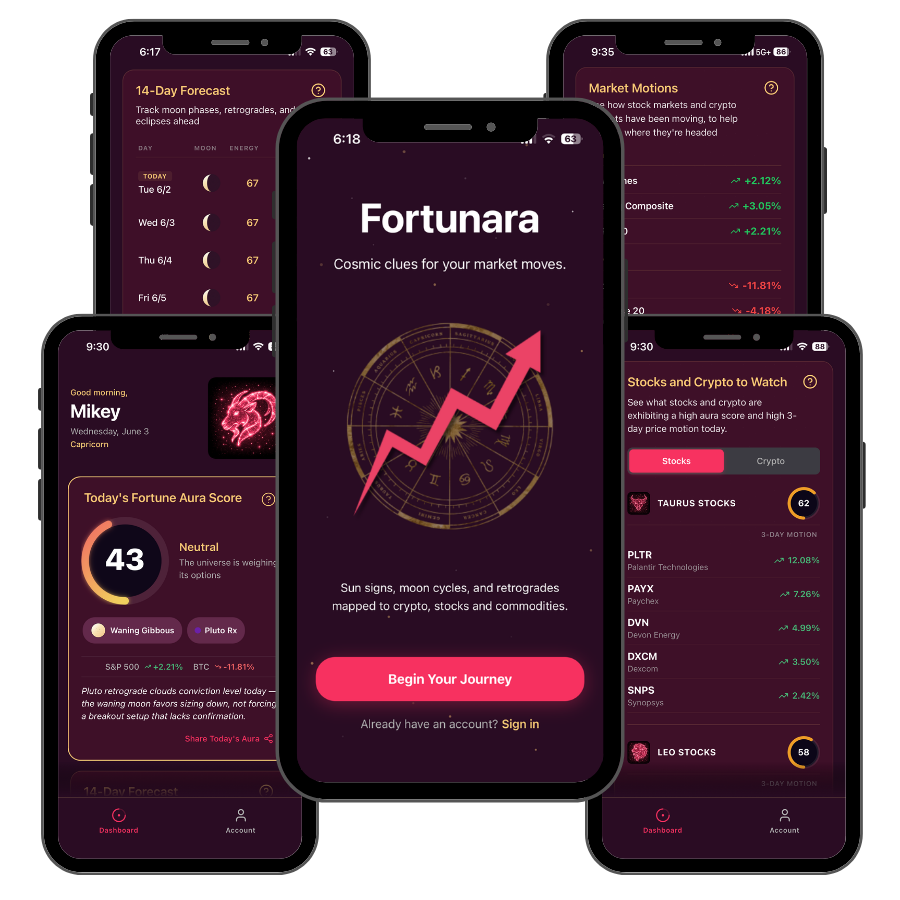
Get cosmic clues for your market moves.
Daily planetary signals mapped to your watchlist. Personalized to your sign.
Get Early AccessFor entertainment only. Not financial advice.
Henry Weingarten: Background and Credentials
Henry Weingarten has been a practicing astrologer for over fifty years. He founded the New York School of Astrology and the NY Astrology Center before establishing the Astrologers Fund. He is the author of Investing by the Stars: Using Astrology in the Financial Markets, published by McGraw-Hill, and a former editor of The Aquarian Agent and Astrology magazines.
He has lectured at astrological and financial conferences worldwide and has been a frequent guest on television and radio programs including Fox News, CNBC, and WABC Radio New York, where he continues to make market commentary appearances as recently as 2025.
Unlike some figures in financial astrology whose Wall Street credentials are indirect, Weingarten built his career at the specific intersection of institutional money management and astrological research. The Astrologers Fund is not a side project or a newsletter service. It is a registered investment operation that has managed real institutional capital since 1988.
The Methodology: How Weingarten Uses Astrology for Institutions
Weingarten’s analytical approach synthesizes several layers of astrological analysis with conventional market inputs.
Saturn-Neptune configurations: One of Weingarten’s most documented analytical frameworks. When Saturn and Neptune form significant aspects — conjunctions, squares, oppositions — Weingarten identifies what he calls a “reality strikes” configuration: a period when bull markets built on incorrect assumptions face a reckoning.
Eclipse analysis: Like Arch Crawford’s 1987 crash prediction and Bill Meridian, Weingarten tracks eclipse windows as significant market inflection points. He has been specific about the distinction between solar eclipse effects (longer-duration, macro-level) and lunar eclipse effects (shorter-duration, higher volatility).
Jupiter and Venus cycles for global equity selection: Weingarten uses planetary configurations to identify which geographic markets are likely to outperform or underperform in a given period. When Jupiter or Venus aspects a country’s “national chart” — the astrological chart cast for the date of the country’s founding — it can signal a period of economic expansion or contraction.
Long-term outer-planet cycles for macro positioning: Pluto, Neptune, and Uranus transits form the backdrop for Weingarten’s longer-duration macro views. His analyses of Pluto cycles and their historical correlation with financial system restructuring have been part of his framework for anticipating decade-scale market regime changes.
The Forecasting Record: Decades of Documented Calls
The Astrologers Fund’s performance record predates the 2022 Forbes notice by decades. Weingarten has made specific, documented, and verifiable calls across multiple market cycles since 1988.
1990 Tokyo Stock Market Crash: Weingarten predicted the collapse of the Tokyo stock market, which fell approximately 48% from its peak in December 1989 to its trough in 1990.
1997 Hong Kong and Asian Market Crises: Weingarten forecasted the Asian financial contagion that devastated equity markets across the region in 1997–1998.
2000 Nasdaq Correction: Barron’s reported that had investors listened to Weingarten in 2000, they would have cashed out of stocks when the Nasdaq hit 5,000. His model portfolio was up 17% for the year; the Nasdaq fell nearly 40%.
2008 Commodity Calls: In summer 2008, Weingarten published specific targets: sell oil at 147 (it peaked at 147.27), sell gold from 990 to less than 832, buy the U.S. dollar to 85. His biography notes these calls were “perfect to within one day.”
2022 Market Crash: Documented by Forbes as the only institutional forecast that correctly called the 2022 crash among the organizations whose outlooks Carrel reviewed.
This is the kind of multi-decade forecasting record — across different market conditions, different asset classes, different geographic markets — that makes casual dismissal difficult. Like Arch Crawford’s 1987 crash prediction, the calls are specific enough to be verifiable and the track record is long enough to rule out luck.
The 2022 Call: When Forbes Took Notice
The 2022 Forbes notice deserves elaboration because it illustrates something important about how financial astrology is perceived at the institutional level.
Carrel was reviewing market outlooks — documents produced by major financial institutions for their clients and the public, representing the collective forecasting capacity of organizations with thousands of analysts, economists, and quants. These are the resources that move institutional capital.
Against this field, the Astrologers Fund stood alone in correctly calling the crash. Carrel noted it. Forbes published it.
This does not mean the Astrologers Fund is always right. Weingarten himself acknowledges that no forecaster is consistently accurate across all calls. But the 2022 episode adds to a multi-decade pattern that is documented and citable: at key moments, when conventional institutional analysis has failed, the Astrologers Fund’s planetary cycle framework has succeeded.
Investing by the Stars: The Book
Weingarten’s Investing by the Stars: Using Astrology in the Financial Markets, published by McGraw-Hill, is the most accessible introduction to his analytical framework and remains one of the most widely referenced books in financial astrology.
The book details how to use astrological frameworks for stock selection, market timing, and global market analysis. It includes analysis of the NYSE’s own natal chart, insights into the horoscopes of major companies, and practical frameworks for applying planetary cycles to investment decisions.
The back cover of the original edition opens with a striking observation: “Even financier J.P. Morgan kept an astrologer on staff — and scores of today’s analysts, brokers, and traders quietly rely on planetary data to help guide their investment decisions.”
The “quietly” is intentional and telling. Weingarten’s experience — and the experience of every practitioner in this field — is that institutional use of financial astrology is far more widespread than public acknowledgment would suggest.
Why an Institutional Fund Using Astrology Matters
The Astrologers Fund’s significance goes beyond any individual call or multi-year track record. It matters because it exists at all.
Financial astrology is routinely dismissed as incompatible with professional investment management. An institutional fund openly using astrology as its primary tool — managing real money for real institutional clients for over 35 years — directly challenges that presumption.
The fund’s existence also makes a specific argument about financial markets: that collective human belief, psychological cycles, and the narrative power of widely-shared symbolic frameworks are legitimate inputs to investment analysis. Whether the planets cause anything or simply mark the timing of collective behavioral shifts, the track record suggests that tracking them is useful. For a deeper look at the evidence, see Is Financial Astrology Real? →
This is the behavioral finance argument that underpins the history of financial astrology on Wall Street: markets are human systems, and human systems follow cycles that planetary analysis can, in experienced hands, help identify.
The Astrologers Fund Today
Henry Weingarten continues to operate the Astrologers Fund from New York. He publishes a weekly email newsletter, Wall Street, Next Week, and makes regular appearances on financial media. The fund’s website, afund.com, maintains a record of forecasts and market commentary.
Weingarten continues to lecture at international financial and astrological conferences and manages institutional capital using the same planetary cycle methodology he has refined since 1988.
After more than 35 years, the Astrologers Fund remains the most prominent example of institutional financial astrology in practice — and the Forbes citation from 2023 suggests that at the moments that matter most, it continues to deliver.
Frequently Asked Questions
What is the Astrologers Fund?
The Astrologers Fund, Inc. is an institutional investment fund founded and managed by Henry Weingarten since May 2, 1988. It uses astrology as its primary analytical tool to oversee investment funds and advise institutional investors and money managers worldwide. It is based in New York.
Who is Henry Weingarten?
Henry Weingarten is the Managing Director of the Astrologers Fund, a practicing astrologer for over fifty years, founder of the New York School of Astrology, and author of Investing by the Stars. He has advised institutional investors and money managers globally since 1988 using planetary cycle analysis.
Did the Astrologers Fund predict the 2022 market crash?
According to Lawrence Carrel writing in Forbes, when reviewing the global outlooks of multiple investment banks and fund companies for 2022, the only organization that predicted the 2022 market crash was the Astrologers Fund.
Does the Astrologers Fund manage institutional money?
Yes. The Astrologers Fund is an institutional fund that manages money for high-net-worth individuals and institutions. It is not a retail mutual fund. Weingarten has advised institutional investors and money managers worldwide for over thirty-five years.
Fortunara brings the analytical tradition of the Astrologers Fund to everyday investors.
Planetary cycle awareness, updated daily.
For entertainment only. Not financial advice.