
Bill Meridian: The Wall Street MBA Who Beat the Market Using Astrology for 40 Years
19.9% annually vs. the S&P’s 5.6%, over 17 years, tracked by Timer Digest. The methodology: planetary cycles.
The Numbers That Stop a Skeptic Cold
Before discussing methodology, it is worth stating the performance record plainly.
According to Timer Digest — an independent service that monitors more than 100 leading market timing models worldwide — Bill Meridian’s Cycles Research model portfolio returned 19.9% annually from 1996 through 2013.
The S&P 500, rebalanced quarterly over the same period, returned 5.6% annually.
The portfolio outperformed the benchmark in 51 of 68 quarters — a 75% hit rate over 17 years.
Meridian has been ranked #1 in stock market timing by Timer Digest three times, #1 in bond market timing once, and #1 in gold market timing once.
His methodology is financial astrology — planetary cycle analysis. He has been practicing it since 1972, the year he graduated from New York University with an MBA in finance.
Background: Wall Street Training, Astrological Curiosity
Meridian entered Wall Street immediately after completing his MBA at NYU in 1972. He was not, by training, an astrologer. He was a finance professional with formal credentials in banking and investment analysis.
The astrological turn came simultaneously with his entry into markets. In the same year he received his MBA, he began studying astrology — initially out of intellectual curiosity, then with increasing conviction as he found that planetary cycles appeared to correlate meaningfully with market behavior.
This dual background — rigorous financial training on one track, astrological research on another — shaped everything about how Meridian approached the work. He was not an astrologer who decided to look at markets. He was a trained financial analyst who decided to look at planets.
By the early 1980s, Meridian had begun applying computers to financial astrology — one of the first researchers in the field to do so. The results of that computational work would define his career.
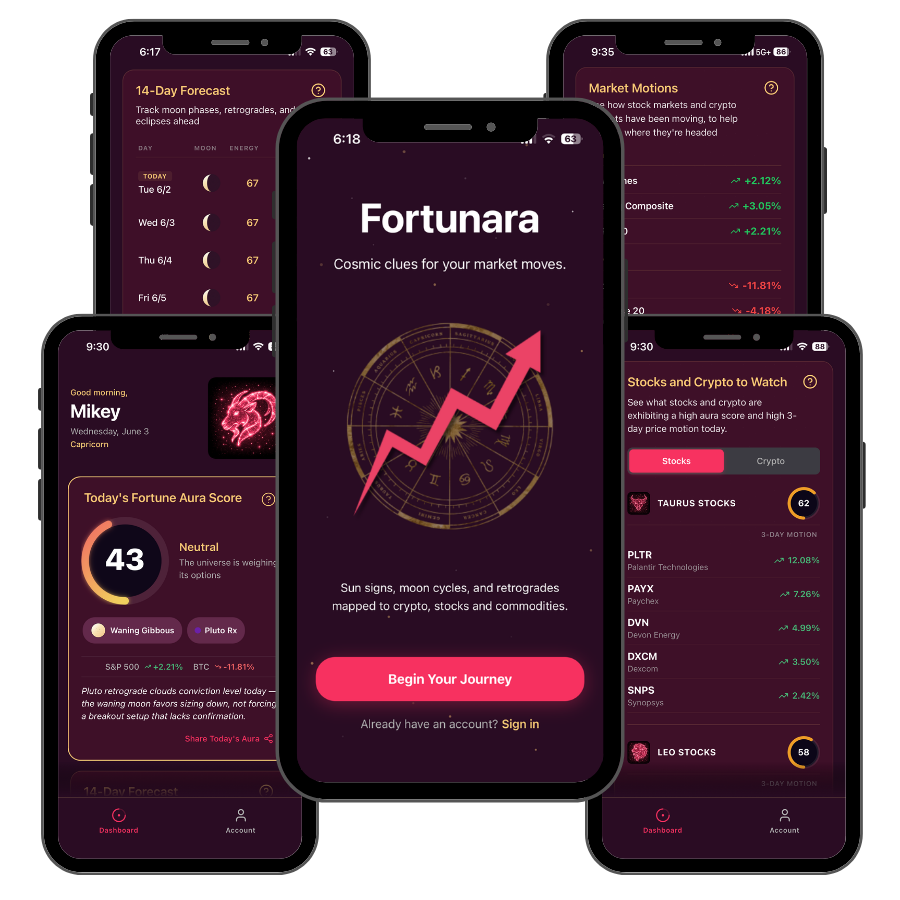
Get cosmic clues for your market moves.
Daily planetary signals mapped to your watchlist. Personalized to your sign.
Get Early AccessFor entertainment only. Not financial advice.
The Breakthrough: Computers and First-Trade Charts
In 1983, Meridian designed the AstroAnalyst — what researchers believe was the first software program built specifically to analyze the relationship between planetary cycles and price series data. The program introduced several analytical concepts that are now standard in financial astrology: composite cycles, efficiency tests, and systematic first-trade chart analysis.
First-trade charts are the core of Meridian’s stock selection methodology. The concept draws on W.D. Gann’s methodology — Gann was among the first analysts to cast astrological charts for the dates when stocks first began trading, treating each company’s market debut as its “birth” moment. Meridian systematized and computerized this approach on a scale Gann could never have achieved manually.
Meridian built a database of hundreds of first-trade charts and back-tested the methodology against actual price history. The results were strong enough that he continued developing and refining the approach for the next four decades.
He contributed the efficiency test, composite cycles analysis, and first-trade chart frameworks to the Market Trader and Timing Solutions programs — two of the most widely used professional financial astrology platforms in existence today.
The Core Methodology: What Meridian Actually Does
Meridian’s investment process combines several layers of analysis.
Planetary cycle timing: Meridian tracks major outer-planet transits — Jupiter, Saturn, Uranus, Neptune, Pluto — and their aspects to each other and to key zodiac points. Long-cycle configurations identify macro regimes; shorter-cycle transits identify specific windows for entering or exiting positions.
Eclipse path analysis: Meridian has written extensively on what he calls the Predictive Power of Eclipse Paths — his finding that regions of the world directly under the path of a solar eclipse tend to experience significant economic and political disruption in the months following. Countries directly under eclipse paths have, in his research, shown measurable correlations with subsequent stock market underperformance.
First-trade chart overlays: For stock selection, Meridian identifies which companies have favorable upcoming planetary transits to their first-trade charts. A company with Jupiter about to conjunct its natal Venus might be flagged as a candidate for outperformance in the coming period.
The 3.8-year cycle: One of Meridian’s most cited contributions to mainstream technical analysis. He identified a recurring 3.8-year cycle in market behavior that Robert W. Colby — described by his publisher McGraw-Hill as America’s foremost expert on technical analysis — considered significant enough to include in his authoritative Encyclopedia of Technical Indicators. This is not an astrology publication; it is a standard reference work in conventional technical analysis. Meridian’s planetary cycle research appears in it on its merits.
The Track Record in Detail
The performance numbers cited at the opening of this article come from a Timer Digest summary published by the Astrology News Service in 2016, when Meridian was named Timer Digest’s Stock Market Timer of the Year.
The specific figures: a 19.9% annual return for the Cycles Research model portfolio versus 5.6% for the S&P 500, rebalanced quarterly, from 1996 through 2013. The portfolio outperformed the benchmark in 51 of 68 quarters.
To put this in context: a 19.9% annualized return over 17 years, compounded, turns $10,000 into approximately $234,000. The same $10,000 compounded at the S&P’s 5.6% becomes approximately $25,000. The difference in terminal wealth is roughly ten-to-one.
This is not one good year. It is a 17-year track record verified by an independent service that tracks over 100 advisors using multiple methodologies. The methodology that generated it is planetary cycle analysis.
Planetary Stock Trading: The Book That Defined a Field
Meridian’s Planetary Stock Trading — now in its fourth edition — is widely considered the foundational reference text for the first-trade chart approach to stock selection.
His second book, Planetary Economic Forecasting, examines the relationship between planetary cycles and industrial production data across 220 years of economic history. It is the most historically comprehensive study of the correlation between planetary cycles and macroeconomic output available in English.
His third book, The Predictive Power of Eclipse Paths, documents the eclipse path methodology and its applications to geographic market selection.
What Robert Colby and the McGraw-Hill Encyclopedia Said
Perhaps the most striking external validation of Meridian’s work comes not from an astrology publisher but from a mainstream technical analysis reference.
Robert W. Colby, described by McGraw-Hill as America’s foremost expert on technical analysis, found Meridian’s work on planetary cycles significant enough to include his 3.8-year cycle in the Encyclopedia of Technical Indicators — published by McGraw-Hill, the same publisher that produces standard financial reference texts used by professional analysts worldwide.
Colby described Meridian as “an internationally renowned financial researcher, fund manager, and designer of analytical software, including the first program developed for researching the correlation between time series data and cycles.”
This is a mainstream financial analysis publisher citing a financial astrologer’s work as worthy of inclusion in a standard reference text. It is one of the clearest examples of financial astrology earning recognition on strictly analytical merits.
Meridian Today: Institutional Fund Management
Bill Meridian currently divides his time between Vienna, New York, and Abu Dhabi, where he provides investment management and advisory services to institutional clients. He continues to publish research through billmeridian.com, has written the mundane astrology column for Dell Horoscope magazine since 1990, and remains one of the most active researchers in the financial astrology field.
At the institutional level — managing money for high-net-worth individuals and institutions — Meridian is doing what the field’s skeptics often claim is impossible: using planetary cycles to generate verified, tracked, outperforming investment returns, at scale, over multiple decades.
What Meridian’s Story Tells Us
Bill Meridian is, in many respects, the most rigorous case study available for evaluating financial astrology on strictly empirical terms. He has the formal finance credentials (NYU MBA). He has the independent performance verification (Timer Digest, Hulbert). He has the published research record (three books, McGraw-Hill inclusion). He has the institutional client base. And he has done it all using planetary cycles as his primary analytical framework, for over forty years.
His story sits squarely within the history of financial astrology on Wall Street — a tradition that includes J.P. Morgan’s personal astrologer, W.D. Gann’s 1929 crash prediction, and Arch Crawford’s 1987 call. What Meridian adds to that tradition is something it previously lacked: a continuously audited, independently verified, four-decade performance record.
The planets, in Meridian’s hands, are not a belief system. They are a timing tool — and the returns speak for themselves.
Frequently Asked Questions
Who is Bill Meridian?
Bill Meridian is a financial astrologer and fund manager with an MBA in finance from NYU. He began applying astrology to markets in 1972 and has been ranked the #1 stock market timer by Timer Digest three times, most recently in 2016. He currently manages institutional funds and advisory from offices in Vienna and New York.
What is Planetary Stock Trading?
Planetary Stock Trading is Bill Meridian's book series — now in its fourth edition — that details how to use company first-trade charts (the astrological chart of a stock's first day of trading) to forecast price performance. The methodology draws on W.D. Gann's first-trade chart work and is one of the most widely referenced texts in financial astrology.
What is Meridian's track record?
According to Timer Digest, Meridian's Cycles Research model portfolio returned 19.9% annually versus the S&P 500's 5.6% from 1996 through 2013, outperforming the benchmark in 51 of 68 quarters. He has been ranked #1 in stock market timing, bond market timing, and gold market timing by Timer Digest at various points across his career.
Fortunara applies the planetary cycle methodology that professionals like Bill Meridian have used for decades.
Accessible for everyday investors.
For entertainment only. Not financial advice.