
Astrological Market Timing: A Practical Framework
Quick Answer
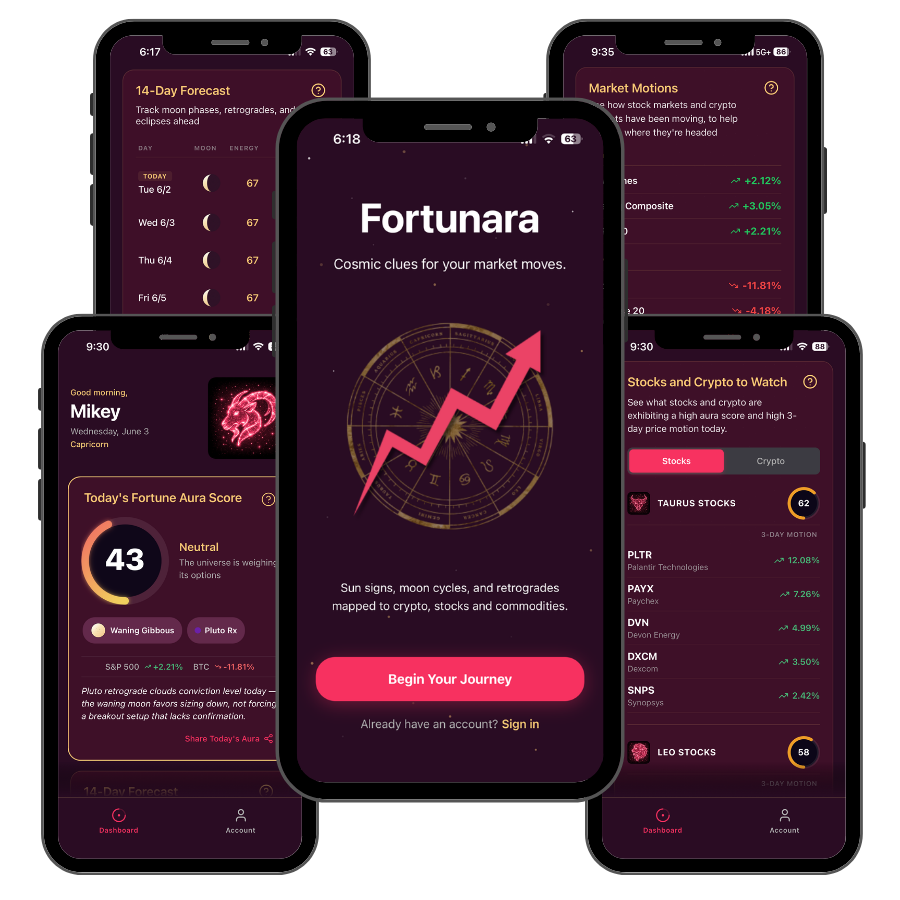
Get cosmic clues for your market moves.
Daily planetary signals mapped to your watchlist. Personalized to your sign.
Get Early AccessFor entertainment only. Not financial advice.
The Three-Timescale Architecture
The single most important structural concept in financial astrology is the three-timescale architecture. Getting this right is what separates practitioners who find the framework useful from practitioners who find it contradictory and confusing.
Financial astrology produces signals at three distinct speeds. Each speed occupies a different role in the investment process. The failure mode is to apply a short-timescale signal without properly checking whether the long-timescale context supports it.
The three timescales:
Long-cycle context (months to years): Jupiter and Saturn transits set the broad macro environment. Jupiter transits through a sign last approximately 12 months; Saturn transits last 2–3 years. These positions establish whether the background environment favors expansion or contraction, risk appetite or risk aversion.
Medium-cycle conditions (weeks to months): Mercury retrograde, Venus retrograde, Mars retrograde, and major planetary aspects create the medium-cycle context. These are specific windows with specific characteristics — elevated caution during Mercury retrograde, valuation pressure during Venus retrograde — that modify how aggressively you should act on favorable short-cycle signals.
Short-cycle timing (days to weeks): Lunar phases provide the finest timing layer. New moons as preferred initiation windows, full moons as preferred review windows, quarter phases as adjustment points. This is the layer that most practitioners interact with most frequently.
Layer One: Reading the Macro Environment
Before applying any short-cycle timing signal, the macro layer deserves attention. Jupiter’s current sign position tells you something about the broad market environment. Saturn’s position tells you something about structural constraints and long-cycle pressures.
Jupiter in growth-oriented signs (Aries, Leo, Sagittarius, Aquarius) tends to correlate with elevated risk appetite and broader equity market expansion. These are the environments where short-cycle buy signals are most reliable and medium-cycle caution periods tend to be corrective rather than catastrophic. Jupiter transits guide →
Saturn in structurally challenging positions — particularly in signs where it has traditionally been associated with restriction (Cancer, Aries) or making difficult aspects to other outer planets — provides a macro headwind that should moderate how aggressively you pursue short-cycle bullish signals.
The macro layer doesn’t generate frequent trade signals. It sets the posture: how much aggression is appropriate in this environment, how much defensive positioning makes sense, what risk levels fit the background conditions.
Layer Two: Active Planetary Conditions
The medium-cycle layer tracks active retrograde periods and significant planetary aspects. These are time-bounded windows with specific investment implications.
Mercury retrograde is the most frequently applicable medium-cycle signal. It occurs three to four times per year, lasts approximately three weeks, and has a consistent application: elevated caution in technology and communication sectors, higher scrutiny of contracts and agreements, skepticism about information received during the retrograde window. The shadow periods before and after retrograde carry some of the same energy. Mercury retrograde guide →
Venus retrograde occurs every 18 months. Venus governs value, money, and financial relationships. Venus retrograde windows have historically correlated with valuation corrections in financial markets and complications in mergers and acquisitions activity.
Major planetary aspects — conjunctions, oppositions, and squares between outer planets — are lower-frequency but higher-significance events. Jupiter-Saturn conjunctions, which occur every 20 years, have historically coincided with significant market structural shifts. Saturn-Pluto conjunctions have preceded major systemic stress events.
At the medium-cycle layer, the key question is: are there active conditions that should raise the threshold for action? Mercury retrograde doesn’t mean no trades — it means trades require more justification and tighter risk management.
Layer Three: Lunar Phase Timing
With the macro context and medium-cycle conditions established, the lunar phase provides the finest timing layer for execution decisions.
The core application is straightforward. New moon periods are preferred windows for initiating positions — deploying capital that has been researched and is ready for entry. Full moon periods are preferred windows for reviewing and assessing existing positions. This rhythm repeats every 29.5 days and requires no calculation beyond knowing the lunar calendar. Lunar phases and markets →
The lunar phase signal is a tiebreaker for discretionary decisions, not an override for non-discretionary ones. When you have flexibility about when to enter a position that you’ve already decided to take, the lunar phase is a relevant factor. When a time-sensitive opportunity arises regardless of phase, the lunar calendar is secondary to the opportunity.
Eclipse seasons — which occur twice a year — amplify the lunar signal significantly. Solar eclipses amplify new moons; lunar eclipses amplify full moons. Eclipse windows merit elevated attention regardless of whether the direction is bullish or bearish.
Reading the Three Layers Together
The practical decision process works from top down:
Step 1 — Macro check: What is Jupiter doing? What is Saturn doing? Is the background environment expansionary or contractionary? This sets the aggression level for the period.
Step 2 — Active conditions check: Is Mercury retrograde? Venus retrograde? Are there major planetary aspects in orb? Any active condition raises the threshold for action.
Step 3 — Lunar timing check: Where is the lunar cycle? Is a new moon approaching (favors initiation)? Is a full moon approaching (favors review)? Is this an eclipse window (elevated significance)?
Step 4 — Fundamental check: Does the investment thesis support this action independent of astrological timing? Astrology modifies timing; it doesn’t create theses. If the fundamental case isn’t there, no astrological signal justifies entry.
When all four checks align — supportive macro, no active complications, favorable lunar timing, strong fundamental thesis — practitioners treat this as the highest- confidence configuration. When they conflict, position size and risk management adjust accordingly.
Common Mistakes in Application
The most common mistake is applying short-cycle signals without checking long-cycle context. A favorable new moon in a Saturn-dominated market environment is a much weaker signal than the same new moon in a Jupiter-dominated environment. The lunar phase calendar doesn’t exist in isolation.
The second most common mistake is treating astrological timing as a replacement for fundamental analysis. No planetary configuration makes a bad investment good. The framework adjusts timing probabilities; it doesn’t create investment quality where none exists.
The third mistake is over-applying the framework — checking astrological signals so frequently that every decision becomes dependent on them. Financial astrology works best as a periodic check-in, not as a real-time trading signal. The three-timescale architecture provides a natural review cadence: monthly (lunar phases), periodic (retrograde windows), and quarterly (Jupiter transit review).
For investors new to the framework, starting with just the lunar phase calendar and Mercury retrograde dates — the two most practically applicable signals — is the recommended entry point. The two signals together provide most of the practical benefit of the full framework without requiring mastery of all three layers at once.
The full discipline overview, including the history and evidence base for each signal type, is covered in What is Financial Astrology? →
Common Questions
How do I know which timescale to prioritize when signals conflict?
How much does astrological timing improve returns in practice?
Can I use astrological timing without knowing my birth chart?
Fortunara is for entertainment only. Nothing on this page constitutes financial advice.
Fortunara handles the three-timescale synthesis automatically — the Cosmic Forecast integrates long-cycle planetary context, medium-cycle retrograde and aspect signals, and the daily lunar phase into a single morning read.
One synthesized signal. No calculation required.
For entertainment only. Not financial advice.