
Financial Astrology Explained: The Complete Practitioner's Guide
Quick Answer
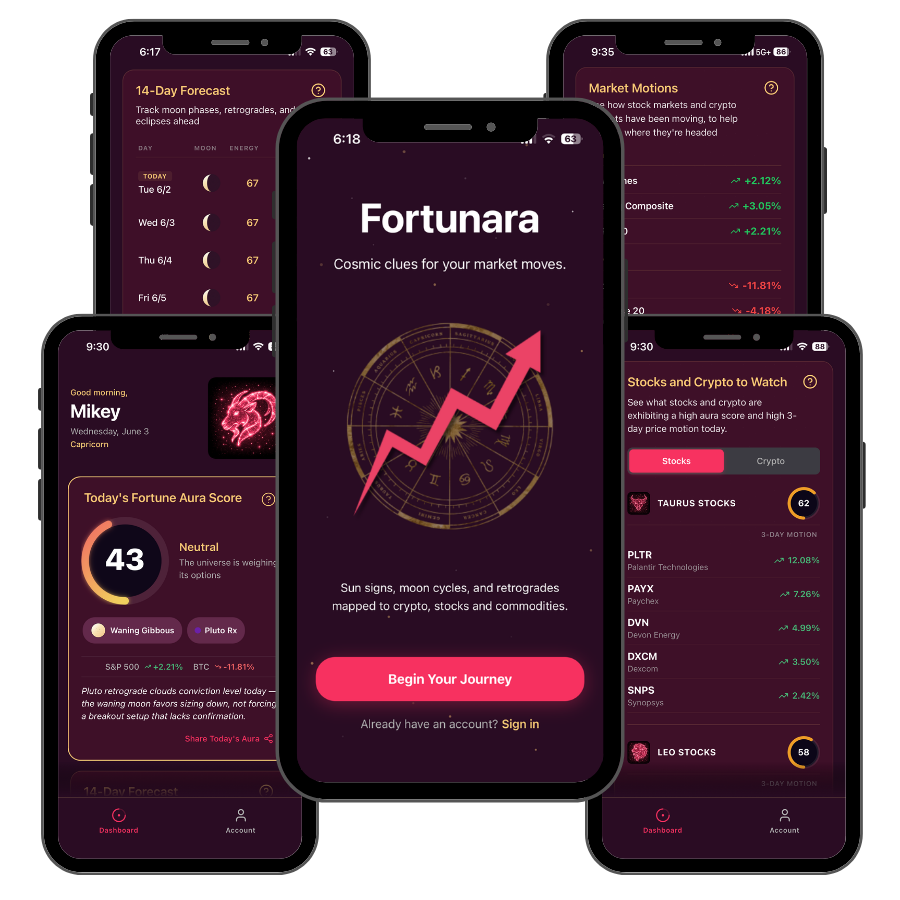
Get cosmic clues for your market moves.
Daily planetary signals mapped to your watchlist. Personalized to your sign.
Get Early AccessFor entertainment only. Not financial advice.
The Core Premise
Financial astrology rests on a single foundational claim: planetary cycles correlate with collective human behavior, and collective human behavior moves markets.
This isn’t a mystical claim. It’s a behavioral one. Markets are made of human beings making decisions about risk, value, and timing. Those decisions are influenced by mood, confidence, and psychological state. If planetary cycles affect human psychology at a population level — and there is evidence from the clinical literature that they do, at least for lunar cycles — then they should leave a traceable signature in collective investor behavior.
The behavioral finance revolution of the last three decades has established that markets are not populated by perfectly rational agents. They are populated by human beings with cognitive biases, emotional states, and psychological patterns that show up in systematic, predictable ways. Financial astrology is, at its core, an ancient framework for tracking one particular source of collective psychological variation.
Whether the mechanism is direct (planetary positions causing physiological effects) or indirect (enough investors acting on astrological signals to create self-fulfilling patterns) is a question practitioners debate. The practical implication is the same: the patterns are real enough to be useful.
What Financial Astrology Is Not
Before going further, it’s worth being explicit about what financial astrology doesn’t claim to do.
It does not predict specific price levels. No planetary configuration tells you that a stock will hit $150. It provides timing context — windows of elevated opportunity or elevated risk — not price targets.
It does not replace fundamental analysis. A company with deteriorating earnings and a failing business model won’t be saved by a favorable Jupiter transit. The fundamental analysis has to be right first. Astrology modifies timing, not thesis.
It does not guarantee outcomes. Every astrological signal is probabilistic. Favorable windows produce better average outcomes — they don’t produce guaranteed outcomes. Unfavorable windows increase the probability of complications — they don’t make every trade in them wrong.
It is not a trading system in isolation. The practitioners who get the most from financial astrology use it as a layer on top of their existing analytical process, not as a replacement for it.
The Three Main Signal Types
Financial astrology operates with three primary categories of planetary signal, each operating on a different timescale.
Planetary transits are the movements of planets through zodiac signs. They operate on timescales of weeks to years, depending on the planet’s orbital speed. Jupiter transits last roughly a year per sign; Saturn transits last two to three years. These long-cycle transits create the broad macro context for market conditions — the backdrop against which shorter-term signals play out.
Planetary aspects are geometric relationships between planets — conjunctions, trines, squares, oppositions — that occur as planets move relative to each other. They operate on timescales of days to weeks and represent the medium-cycle signal layer. A Jupiter-Saturn conjunction, for instance, has historically correlated with significant market turning points.
Lunar phases represent the fastest-moving signal layer, cycling every 29.5 days. The new moon and full moon framework has the strongest academic support of any signal in financial astrology — the Dichev and Janes (2003) Journal of Finance study documented an 8.3 percentage point annualized return differential between new moon and full moon periods across 25 countries. Full lunar cycle analysis →
Retrograde Periods: A Special Case
When a planet appears to move backward in the sky relative to Earth — an optical illusion caused by orbital mechanics — it is said to be in retrograde. Retrograde periods are associated with complications in the planetary domain that planet governs.
Mercury rules communication, technology, and contracts. Mercury retrograde — which occurs three to four times per year, lasting three weeks each time — is associated with delays, miscommunications, technology failures, and complications with contracts and agreements. In the markets, this maps onto elevated volatility in tech and communication sectors, higher rates of deal failure, and a general increase in information errors. Mercury retrograde guide →
Venus retrograde, which occurs every 18 months, affects financial markets more broadly because Venus governs value, money, and luxury goods. Venus retrograde periods have historically correlated with valuation corrections in financial markets.
Mars retrograde affects energy, aggression, and forward momentum. In markets, Mars retrograde periods tend to see a dampening of the risk-on sentiment that normally drives equity markets higher.
Retrograde periods are among the most practically applicable signals in financial astrology because they are fixed, predictable windows that can be planned around months in advance.
The Academic Evidence Base
Financial astrology occupies an unusual position in the landscape of market analysis: it has genuine academic evidence supporting specific claims, alongside a much larger body of practitioner knowledge that has not been subjected to rigorous empirical testing.
The strongest academic evidence covers lunar cycles. The Dichev and Janes (2003) Journal of Finance study is the most rigorous piece of research in the field — a peer-reviewed paper in one of the most selective economics journals, documenting a consistent return differential across 25 countries and several decades. It is not fringe research.
There is also academic work on Mercury retrograde and stock market returns, on Saturn transits and economic contractions, and on Jupiter transits and market optimism. The quality and rigor of this research varies considerably. The lunar cycle work is the most methodologically sound.
For claims that lack academic validation, financial astrology relies on practitioner observation: patterns documented over decades of market analysis by practitioners who track both planetary positions and market behavior. This is a weaker form of evidence than peer-reviewed research, but it is evidence. The patterns have been observed and re-observed across different market environments.
Serious practitioners distinguish between these two evidence tiers. The lunar cycle claims should be weighted heavily; the practitioner-derived claims should be weighted as contextual factors rather than high-confidence signals. Is financial astrology real? →
The History of the Discipline
Financial astrology did not emerge in the 20th century. It has roots in ancient Mesopotamia, where temple astronomers tracked planetary cycles alongside agricultural and market conditions. The connection between celestial observation and economic timing was established before modern astronomy existed.
In the modern era, W.D. Gann is the most famous practitioner — a trader and market theorist of the early 20th century whose methods incorporated planetary cycles and geometric time analysis. Gann’s records suggest consistent profitability over decades; his methods remain studied and debated.
The Astrologers’ Fund, founded by Henry Weingarten in New York, is the most prominent contemporary institutional practitioner of financial astrology. Bill Meridian has applied financial astrology to corporate charts and market timing with documented methods. Arch Crawford’s Crawford Perspectives newsletter provided financial astrology market commentary for decades.
These practitioners were not on the fringes of the financial world. They operated in the center of it, and their work was taken seriously by professionals who cared about performance.
The full history of the discipline is covered in the financial astrology overview, with detailed profiles of W.D. Gann and Bill Meridian.
How to Start Using Financial Astrology
The practical entry point for most investors is the lunar cycle. It has the strongest academic support, the simplest application (new moon for initiation, full moon for review), and a clear mechanism that doesn’t require belief in anything beyond behavioral finance.
From there, adding Mercury retrograde awareness is the logical next step. Mercury retrograde happens three to four times a year, lasts three weeks each time, and has a consistent application: elevated caution in technology and communication sectors, more careful review of contracts and agreements, and skepticism about information received during the retrograde window.
The macro context of Jupiter and Saturn transits can then provide longer-cycle awareness of whether the broad market environment is in an expansion or contraction phase — background knowledge that modifies how aggressively to act on shorter-cycle signals.
The more advanced applications — aspect analysis, natal chart correlations for individual stocks, eclipse timing — build on this foundation. The sequential approach is much more effective than trying to apply the full framework at once.
For the practical framework that organizes these layers, see the astrological market timing guide →
Common Questions
Is financial astrology the same as regular astrology?
Do I need to know astrology to use financial astrology tools?
How is financial astrology different from technical analysis?
Fortunara is for entertainment only. Nothing on this page constitutes financial advice.
Fortunara synthesizes the planetary, lunar, and sign-based signals covered in this guide into a single daily Cosmic Forecast — so you get the timing context without managing the calculation.
The complete framework, delivered automatically.
For entertainment only. Not financial advice.