
Full Moon & the Stock Market
Quick Answer
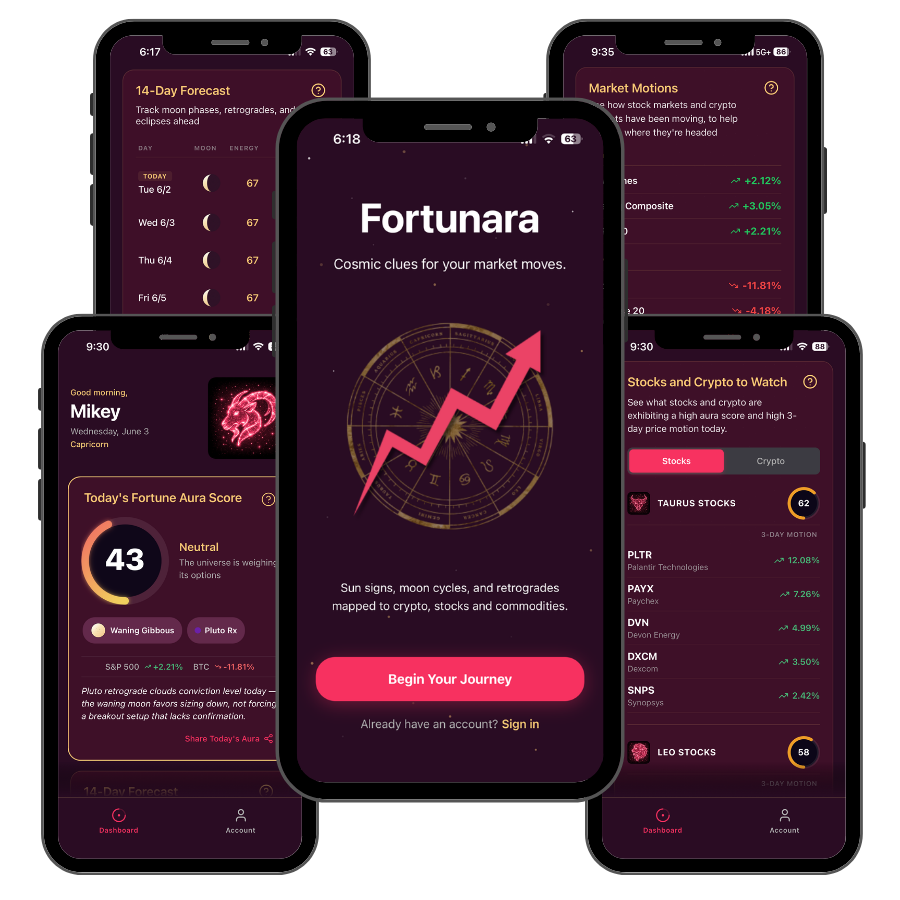
Get cosmic clues for your market moves.
Daily planetary signals mapped to your watchlist. Personalized to your sign.
Get Early AccessFor entertainment only. Not financial advice.
What the Full Moon Represents
The full moon is the peak of the lunar cycle. The moon is fully illuminated, reaching maximum brightness before beginning its retreat into darkness. In the astrological tradition, this peak is associated with culmination, revelation, and the surfacing of what has been developing in the dark.
In market terms, the full moon carries a distinct character:
Completion rather than initiation. Where the new moon favors beginning, the full moon favors completing, assessing, and preparing for what comes next. Positions that have been building through the waxing phase often reach a natural assessment point at the full moon.
Revelation and disclosure. The full moon is associated with things coming to light. In markets, this manifests as earnings surprises — both positive and negative — news that surfaces unexpectedly, and information that was previously obscured becoming visible. Full moon periods tend to see more dramatic information events than the average day.
Emotional intensity. Full moon periods are associated with heightened emotional states in the traditional literature — and the connection between emotional intensity and investor behavior is well-documented in behavioral finance. Sentiment extremes, both bullish and bearish, tend to cluster around full moon periods.
The Dichev and Janes Data on Full Moons
The Dichev and Janes finding is most precisely described as a new moon advantage rather than a full moon disadvantage. But the practical implication is the same: the 15 days around full moons underperform the 15 days around new moons by approximately 8.3 percentage points annualized.
This is not a signal to exit all positions at every full moon. It’s a signal to modify behavior at the margin:
- Be more conservative about initiating new positions
- Be more attentive to reviewing and potentially trimming existing positions
- Apply elevated skepticism to euphoric sentiment signals
- Watch for surprising information events more carefully
The full moon is a natural review window, not a sell signal. The distinction matters.
Full Moon Sign Context
Like new moons, full moons occur in different zodiac signs each month. The sign context modifies what themes are “illuminated” during that full moon period.
Full moon in Scorpio highlights financial secrets, M&A activity, deep-value situations, and anything involving shared resources or debt. Earnings calls under a Scorpio full moon tend to surface more surprises — positive and negative — than average.
Full moon in Sagittarius highlights international markets, legal and regulatory situations, and speculative themes. Geopolitical news tends to land harder during Sagittarius full moons.
Full moon in Capricorn highlights institutional structures, corporate governance, and the performance of established companies against long-term targets. Quarter-end full moons in Capricorn tend to coincide with institutional portfolio rebalancing activity.
Full moon in Aries highlights impulsive market behavior, risk-taking, and aggressive positioning. These full moons can see sharp, fast moves as the Aries energy meets the full moon’s culmination quality.
Full moon in Taurus highlights material values, commodity prices, and the valuation of tangible assets. Real estate news and commodity price movements are often more significant during Taurus full moons.
Practitioners use the sign context to anticipate what kinds of news or market events are most likely to surface — and to position their risk management accordingly.
Lunar Eclipses: The Amplified Full Moon
Just as solar eclipses amplify new moons, lunar eclipses amplify full moons. A lunar eclipse occurs when Earth passes between the Sun and Moon, casting its shadow on the moon.
In financial astrology, a lunar eclipse is a full moon whose revelation qualities are dramatically intensified. What comes to light during a lunar eclipse full moon tends to be more significant, more surprising, and more lasting in its market impact than a standard full moon disclosure.
Eclipse-season full moons have historically coincided with some of the more dramatic market moves. The revelation that characterizes all full moons is amplified to a degree that can produce outsized volatility. Practitioners treat lunar eclipse windows as elevated risk periods requiring careful position management.
Eclipse seasons occur approximately twice a year. Each season contains a solar eclipse (amplified new moon) and a lunar eclipse (amplified full moon). Fortunara’s Cosmic Forecast flags both types specifically.
The Practical Review Discipline
The most useful application of the full moon framework isn’t market timing — it’s portfolio discipline. Treating the full moon as a mandatory monthly portfolio review creates a structured cadence that benefits investment decision-making regardless of the astrological signal.
The questions to ask during each full moon review:
- Which positions have developed as expected since the last new moon?
- Which positions have surprised me — positively or negatively?
- What information has surfaced about my holdings in the past two weeks?
- Are there positions I should trim, exit, or add to?
- What am I watching for in the next two weeks before the next new moon?
This discipline — monthly review at the full moon, new initiations around the new moon — creates a natural investment rhythm that many practitioners describe as one of the most practical benefits of working with the lunar calendar.
Common Questions
Should I sell everything before the full moon?
Does the full moon signal apply to all asset classes equally?
What happens in months with two full moons (blue moon)?
Fortunara is for entertainment only. Nothing on this page constitutes financial advice.
Fortunara flags each full moon in the Cosmic Forecast with its sign context and any eclipse designation — so you know whether you're heading into a standard review window or an amplified revelation period.
The signal before the event, not after.
For entertainment only. Not financial advice.