
Waxing & Waning Moon: The Investor's Monthly Calendar
Quick Answer
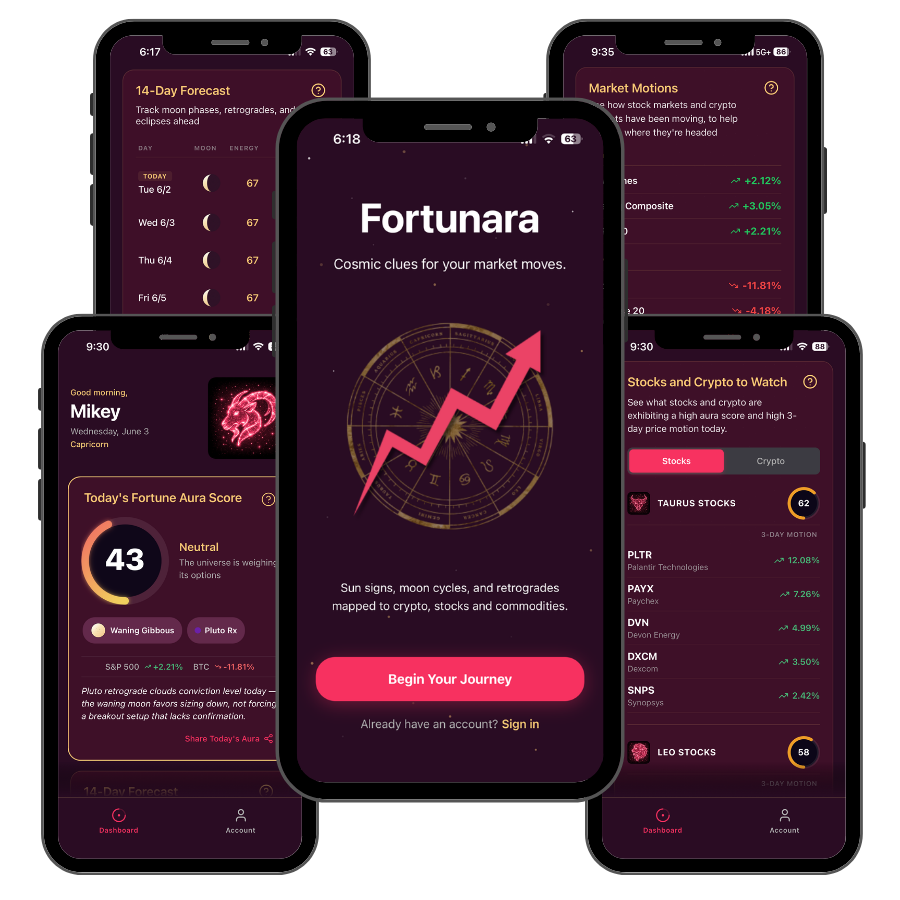
Get cosmic clues for your market moves.
Daily planetary signals mapped to your watchlist. Personalized to your sign.
Get Early AccessFor entertainment only. Not financial advice.
The Eight Phases as a Portfolio Calendar
Most investors know two phases of the lunar cycle: new moon and full moon. The discipline of financial astrology works with all eight, and the granularity is useful.
New Moon (Day 1–2): The opening. Darkness before the light. Traditional practice: initiate new positions, begin new research processes, deploy capital that has been waiting. The Dichev and Janes data supports this as the higher-returning phase of the cycle.
Waxing Crescent (Days 3–6): The moon’s light is beginning to build. Traditional practice: continue building positions initiated at the new moon, begin active monitoring, let new ideas develop without forcing premature conclusions.
First Quarter (Days 7–9): The moon is half-lit, at the 90-degree square to the Sun. Traditional practice: review and adjust. This phase often surfaces the first real test of positions initiated at the new moon. Is the thesis playing out? Are there complications that weren’t visible at initiation? The first quarter is a decision point: continue, adjust, or reconsider.
Waxing Gibbous (Days 10–13): The moon is more than half-lit and approaching full. Traditional practice: consolidate positions that are working, do final preparation for the full moon review. This is the phase where momentum positions tend to be most extended. The approach to the full moon is a time to tighten stops and prepare for the cycle’s culmination.
Full Moon (Days 14–15): The peak. Traditional practice: review everything, assess what has worked and what hasn’t, consider reducing positions that have reached targets. Be cautious about new initiations. The Dichev and Janes data marks this as the lower-returning half of the cycle.
Waning Gibbous (Days 16–19): The moon’s light is beginning to recede. Traditional practice: gradual distribution of positions that are complete, profit-taking where targets have been reached. The momentum that built through the waxing phase begins to slow.
Last Quarter (Days 21–23): The moon is half-lit again, at the 90-degree square to the Sun but on the waning side. Traditional practice: exit positions that aren’t working, defend key holdings, prepare cash for the next new moon cycle. The last quarter square often surfaces the final test of whether to hold or fold.
Waning Crescent (Days 24–28): The moon is nearly dark again. Traditional practice: preparation and research for what comes next. Review the universe of positions you want to initiate at the next new moon. Build the list, do the due diligence, prepare to act when the cycle resets.
The Waxing Phase as the Growth Half
From new moon to full moon, the traditional framework maps onto a general bias toward accumulation, expansion, and forward momentum. The light is building. The energy is constructive.
This doesn’t mean selling is wrong during the waxing phase or that every waxing period produces positive returns. Markets don’t follow a 29.5-day schedule. The waxing bias is a gentle contextual tilt, not a rule.
What practitioners observe: positions initiated during the waxing phase tend to develop more cleanly, with fewer complications and reversals in the early stages. The energy of the building moon provides a supportive backdrop for new ideas. Positions that immediately reverse after initiation are more common during the waning phase.
The Waning Phase as the Harvest Half
From full moon to new moon, the framework maps onto a general bias toward completion, distribution, and the clearing of what isn’t working. The light is receding. The energy favors finishing rather than beginning.
Again: this is a tilt, not a rule. Strong secular uptrends continue right through full moons and waning phases. Jupiter transits override lunar waning signals routinely. The waning phase provides a context for reviewing and harvesting, not for wholesale selling.
The discipline’s most practical application of the waning phase: use it for portfolio maintenance that gets neglected when markets are moving fast. Clear out positions that have been sitting with no thesis. Take profits that are justified by the analysis. Do the administrative work of portfolio management. The waning phase is a natural time for this kind of housekeeping.
Why This Works Even If You’re a Skeptic
Here is the pragmatic case for the lunar investment calendar, offered entirely without metaphysical commitment:
Investors consistently benefit from structured review rhythms. Monthly portfolio reviews outperform ad-hoc reviews in the professional management literature. The discipline of having a regular cadence — when to initiate, when to review, when to harvest — is itself valuable, regardless of the underlying rationale.
The lunar calendar provides one such cadence. It’s consistent, predictable, and requires no subjective judgment about when to do what. The new moon is the new moon. The full moon is the full moon. You don’t have to decide whether “now feels like a review time” — the calendar tells you.
If the astrological signal behind the calendar is real, you get the signal plus the discipline. If it isn’t, you still get the discipline. The monthly rhythm has value either way.
This is an honest argument that serious practitioners make, and it’s worth making explicitly.
Integrating the Lunar Calendar With Standard Practice
The cleanest integration: map your existing investment process onto the lunar calendar without changing the underlying analysis.
Use the new moon window for: executing positions you’ve already decided to take based on your regular analysis. When the analysis says yes and the timing is flexible, favor the new moon window. New moon guide →
Use the full moon window for: the monthly portfolio review you probably already do, or should be doing. Review every position: thesis intact? Expected performance? Anything changed? Full moon guide →
Use the last quarter for: clearing the portfolio of anything that isn’t working. The waning phase supports completion and release.
Use the waning crescent for: building the next cycle’s watch list. Research rather than execution.
The structure doesn’t require abandoning fundamental analysis. It provides a timing layer on top of that analysis.
Common Questions
Do I need to track all eight phases, or just new and full?
What happens when the lunar calendar conflicts with other signals?
Is there a simple way to track the lunar calendar alongside regular market research?
Fortunara is for entertainment only. Nothing on this page constitutes financial advice.
Fortunara's Cosmic Forecast shows the current lunar phase, days to the next transition, and how the phase interacts with your sign's Fortune Aura — all in the daily morning read.
The monthly rhythm, delivered automatically.
For entertainment only. Not financial advice.