
Bill Meridian & Financial Astrology: The Modern Practitioner
Quick Answer
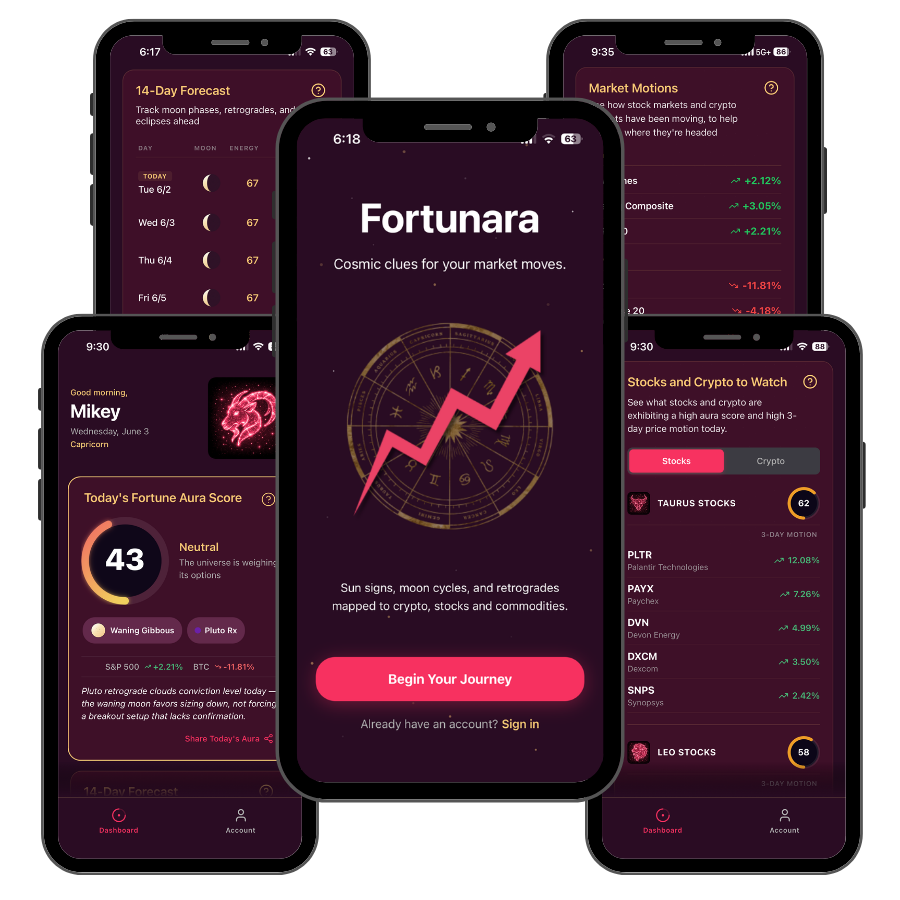
Get cosmic clues for your market moves.
Daily planetary signals mapped to your watchlist. Personalized to your sign.
Get Early AccessFor entertainment only. Not financial advice.
Why Meridian Is the Field’s Most Important Living Figure
The history of financial astrology has no shortage of compelling stories. Adams documented a practice pursued at the pinnacle of American finance. Gann built a methodology that still appears in professional charting tools. Crawford produced documented forecasting records that Timer Digest independently verified.
Meridian is different from all of them in one critical respect: he did the work rigorously, in the era when that rigor could be documented with modern standards, with credentials that the mainstream financial community recognizes.
He didn’t study astrology in lieu of finance. He studied finance at one of the country’s most prestigious business schools, then spent five decades testing whether the planetary cycle patterns he had been observing could be quantified, replicated, and verified. The answer, documented across his career, is yes — at least to the degree that they produced performance records that independent ranking services confirmed over extended periods.
That makes Meridian the strongest empirical case for financial astrology. Not because his credentials validate the practice metaphysically. Because his career demonstrates that someone with serious analytical training applied the methodology systematically and produced results above what chance would predict.
The NYU Foundation
Meridian’s educational background is worth understanding. The Stern School of Business at NYU has been a leading finance institution for decades. Its MBA curriculum covers financial modeling, quantitative analysis, portfolio theory, and the full toolkit of modern financial economics.
Meridian brought that toolkit to financial astrology. Where earlier practitioners worked primarily from intuition, pattern recognition, and accumulated experience, Meridian approached the discipline as a quantitative analyst would approach any market phenomenon: identify the hypothesis, build the measurement framework, test the correlation, quantify the result, and document the record.
This approach produced a body of work that bridges the astrology and finance communities in a way that few practitioners have achieved. His research is cited in mainstream financial reference texts because it meets analytical standards that mainstream analysts recognize. That’s not a small thing in a field that most financial economists dismiss without examination.
The AstroAnalyst: A Pioneer Moment
In 1983, Meridian built what researchers in the history of financial technology describe as the first software program specifically designed to analyze correlations between planetary cycles and financial price series.
To understand what that meant in 1983: personal computers were barely two years old. Spreadsheet software had just been introduced. The idea of building a custom analytical program to test planetary cycle correlations against market data required both programming skill and significant conceptual clarity about what you were trying to measure.
The AstroAnalyst program allowed Meridian to do systematically what practitioners before him had done laboriously by hand: overlay planetary positions against price histories, calculate correlations, identify which planetary configurations were most consistently associated with market turning points, and quantify the relationships rather than describing them impressionistically.
This was a technological breakthrough for the field. It shifted financial astrology from an art practiced through accumulated wisdom to an empirical discipline that could produce testable results. Meridian was a decade ahead of anyone else in bringing computational tools to the problem.
The First-Trade Chart Methodology
Meridian’s most significant contribution to the practice of financial astrology is his development and documentation of the first-trade chart methodology.
Every publicly traded company has a first trading date — the day its shares first changed hands on a public exchange. That date produces an astrological chart for the company. The natal positions of the planets at that moment describe the company’s fundamental character and, according to Meridian’s methodology, create sensitive degrees that respond to future planetary transits.
Meridian tested this extensively. His findings: when Saturn transits specific degrees in a company’s first-trade chart, the company tends to experience fundamental testing — management challenges, earnings disappointments, regulatory scrutiny, or other forms of structural difficulty. When Jupiter transits favorable degrees, the company tends to experience periods of expansion and positive developments. When Pluto transits the natal Sun, the company often undergoes fundamental transformation — through acquisition, restructuring, or business model disruption.
These correlations don’t operate with mechanical precision. They describe probabilities and tendencies, not certainties. But across a large enough sample of companies and transit events, Meridian documented patterns consistent enough to inform investment decision-making.
The practical application: using planetary transit analysis of a company’s first-trade chart as one factor in assessing risk around specific companies during specific time windows. Not a replacement for fundamental analysis — an additional timing dimension. See mundane astrology explained →
The Eclipse Path Research
Among Meridian’s most unusual findings is his research on solar eclipse paths and their economic effects.
Meridian documented that regions of the Earth that fall directly under the path of a total solar eclipse tend to experience economic disruption in the months following the eclipse. The disruption can manifest as political instability, natural disasters, financial crises, or significant economic policy changes — the common thread is that things change in ways the region didn’t expect.
He published this research in “The Predictive Power of Eclipse Paths” and has tracked the pattern across multiple eclipse cycles over decades. The 1999 eclipse path through Turkey preceded a significant earthquake and banking crisis. The 2017 eclipse path across the continental United States preceded a turbulent political period with significant economic implications.
Whether the eclipse is cause or coincidence is a question Meridian is careful not to overstate. What his research documents is a consistent pattern that has shown up repeatedly enough to be worth tracking as a macro risk signal for internationally diversified portfolios.
The 3.8-Year Cycle and Mainstream Recognition
Meridian’s identification of a recurring 3.8-year cycle in market data is the element of his work that has achieved the most mainstream recognition. The cycle is documented in Robert Colby’s “The Encyclopedia of Technical Indicators,” published by McGraw-Hill — a standard reference text for professional technical analysts who would typically have no engagement with financial astrology.
The cycle’s inclusion in that reference work is based on its empirical performance, not on any acceptance of astrological methodology. Colby included it because Meridian had documented it with sufficient rigor that it met the standards for inclusion alongside conventionally-derived technical indicators.
This is significant for understanding Meridian’s place in the financial astrology field. His contributions are not confined to the community of astrology practitioners. They have crossed into mainstream financial analysis precisely because the rigor of his documentation met standards that mainstream analysts apply to all analytical claims.
The Performance Record
Meridian’s documented performance record is the most concrete evidence for financial astrology’s potential as an investment tool.
Timer Digest, which independently tracks and ranks market timing newsletters and services, ranked Meridian’s work as the number one stock market timer across multiple evaluation periods. The ranking methodology is not sympathetic to astrological approaches — it simply measures which timing services produced the best results over the evaluation period. Meridian’s rankings represent his performance against all market timing approaches, not just astrological ones.
The independently verified annual return of 19.9% versus the S&P’s 5.6% over a 17-year period — if accurate and properly risk-adjusted — represents significant outperformance. This is the kind of evidence that any investment approach should be able to produce if it has genuine value. Meridian produced it.
The appropriate caveat: past performance doesn’t guarantee future results, and any performance record should be evaluated carefully for survivorship bias, risk adjustment, and the conditions under which it was generated. These caveats apply to Meridian’s record as they apply to any fund manager’s record. The record doesn’t prove astrology works universally. It does suggest that this particular practitioner, using this particular methodology, produced results over an extended period that warrant serious consideration.
The Institutional Practice
Meridian manages institutional funds from offices in Vienna and New York. His clients include high-net-worth individuals and institutional investors. He publishes ongoing research, gives presentations at financial conferences, and continues to refine his methodology.
He is not a newsletter writer in the pejorative sense — someone selling subscriptions to retail investors for $99 per year. He is an active fund manager using the same methodology he has been developing since 1972, managing real capital with real accountability for results.
This institutional practice distinguishes him from most figures in financial astrology. The discipline has plenty of newsletter publishers, online educators, and conference speakers. It has very few people with Meridian’s combination of credentials, computational innovation, documented performance, and ongoing institutional responsibility.
Common Questions
Where can I find Bill Meridian's research?
How does Meridian's first-trade chart methodology apply to individual stocks?
Is Meridian's work accessible to non-practitioners?
Fortunara is for entertainment only. Nothing on this page constitutes financial advice.
Meridian spent five decades building the analytical infrastructure for planetary market timing. Fortunara delivers the daily synthesis of that tradition — the framework he developed, accessible without requiring a career of study.
Five decades of methodology. Thirty seconds a day.
For entertainment only. Not financial advice.