
W.D. Gann & Financial Astrology: The Methodology Behind the Legend
Quick Answer
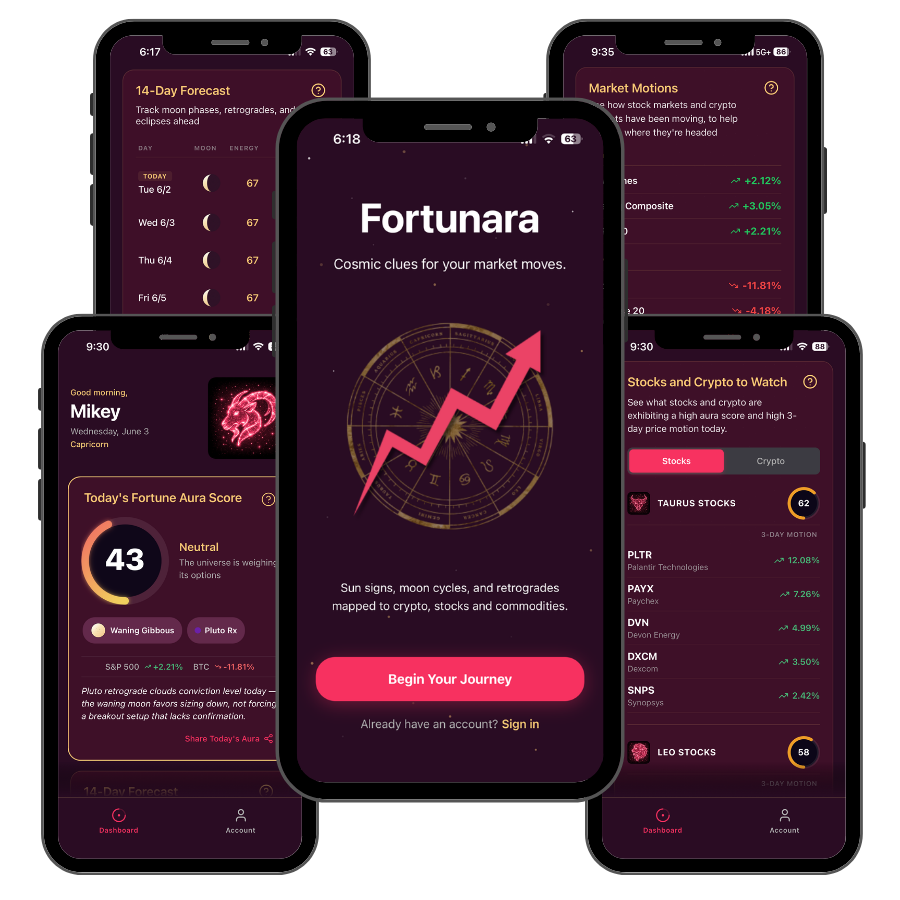
Get cosmic clues for your market moves.
Daily planetary signals mapped to your watchlist. Personalized to your sign.
Get Early AccessFor entertainment only. Not financial advice.
Why Gann Is Different From Every Other Market Figure
Most famous traders are known for one brilliant call or one successful period. Gann is known for a system. A methodology. A framework for understanding why markets move when they move that he spent decades refining and that remains in active use nearly 70 years after his death.
He published extensively — “The Truth of the Stock Tape,” “45 Years in Wall Street,” “How to Make Profits in Commodities,” among others. He developed proprietary tools. He trained students. He built a body of analytical work that practitioners still debate, study, and apply today.
What sets him apart from other market legends isn’t the 1929 call, though that’s remarkable enough on its own. It’s that he left a replicable system. Not a black box. A methodology with internal logic, documented principles, and tools that can be learned and applied. The fact that those tools have astrological foundations — which most modern practitioners using them don’t fully understand — is the deeper story.
The 1929 Prediction
In November 1928, Gann published his annual market forecast. The forecast was specific. It called for a major market top and subsequent crash in the fall of 1929.
The Dow Jones Industrial Average peaked on September 3, 1929. Black Thursday arrived on October 24, 1929. The crash that followed became the defining financial catastrophe of the 20th century.
Gann had called it eleven months in advance.
Was it astrological analysis that produced the forecast? The evidence suggests it was a significant component. Gann’s surviving notes and the structure of his forecasting methodology indicate that planetary cycle analysis — particularly the positions and aspects of Saturn, Jupiter, and the outer planets relative to the NYSE natal chart — was central to his timing work.
This doesn’t mean astrology “caused” him to make the call. It means that within his analytical framework, the 1929 planetary configuration looked like a major turning point, and he said so in writing before it happened. Full FAQ on Gann →
The Law of Vibration
Gann’s core theoretical framework was what he called the Law of Vibration. Markets, he believed, moved according to natural mathematical and cosmic law — the same principles that governed the movement of planets, the growth of plants, and the cycles of nature.
This is not a mystical claim in the way it might first appear. Gann was trained in mathematics and geometry. His framework was systematic, not intuitive. The Law of Vibration, as he applied it, meant that market prices moved in geometric relationships that could be mapped and predicted — and that those geometric relationships had correspondences with planetary geometry.
Angular relationships between planets — conjunctions, squares, trines, oppositions — translated, in Gann’s system, into angular relationships on price charts and time cycles. A Saturn-Jupiter square in the sky corresponded to a 90-degree angular relationship in price/time space. The planetary geometry was a macro template for the market’s geometric behavior.
This is the intellectual foundation under all of Gann’s tools. It explains why the Square of Nine is structured as it is, why Gann Angles use specific geometric divisions, and why his time cycle work involves intervals derived from planetary orbital periods.
The Tools He Left Behind
Gann’s tools are the most lasting evidence of his influence. They appear in standard technical analysis curricula, in charting software used by professional traders, and in the analysis published by major financial institutions.
Gann Angles are trend lines drawn at specific geometric angles from price and time pivots. The most famous is the 1x1 line — 45 degrees on a properly scaled chart — which Gann considered the most significant trend indicator. The angle relationships derive from his geometric/planetary framework.
The Square of Nine is a spiral numerical grid that Gann used to calculate price support, resistance, and time targets. Its mathematical structure reflects the same spiral geometry found in planetary orbital mechanics and in natural growth patterns. Traders who use it as a mechanical calculation tool often don’t know that Gann designed it as an expression of cosmic geometric principles.
The Wheel of 24 maps price and time in a circular format that reflects zodiacal structure. Gann was explicit in his private correspondence that this tool was astrologically derived, though his published writings obscured this.
Time cycles were central to Gann’s analysis. He identified recurring intervals — 90 days, 144 days, 360 days, and multiples and fractions of these — that he mapped to planetary orbital periods. The 144-day cycle corresponds to the angular relationship of specific planetary positions. The 360-day cycle mirrors the zodiacal degree count.
The Deliberate Obscurity
One of the most discussed features of Gann’s work is its intentional opacity. His books are famously difficult. His explanations are often oblique. His most important insights seem to be encoded rather than stated directly.
There is documented evidence that this was deliberate. Gann believed that if his most powerful methods became widely known, they would be arbitraged away. The edge came precisely from their exclusivity. Practitioners who have studied his private correspondence and the notes of his students report that the astrological foundations of his work were far more explicit in private than in published form.
The result is that most traders who use Gann tools today are applying the output of a planetary geometry framework without knowing that’s what they’re using. Gann Angles in a charting platform don’t come with a notation explaining their derivation from the Law of Vibration and planetary geometry. They’re presented as empirical technical tools — which they are, but their logic goes considerably deeper.
The Controversy, Addressed Honestly
No account of W.D. Gann would be complete without acknowledging the documented criticism of his work.
Alexander Elder, whose trading books remain widely read, documented that Gann’s son reportedly said his father earned his living primarily from selling courses rather than trading. The estate Gann left at his death in 1955 was modest — not the fortune one might expect from a trader whose returns matched his reputation.
This is worth noting honestly. It’s possible that Gann was a better analyst than trader — that his framework identified patterns correctly without translating those identifications into consistent trading profits. Many practitioners who follow the discipline make exactly this observation: analytical accuracy doesn’t automatically produce trading performance.
The methodology’s validity and Gann’s personal financial success are separate questions. The tools he developed produce results for practitioners who use them, whether or not Gann himself lived as proof of their efficacy. The 1929 forecast stands regardless of how much money Gann made.
The Lineage He Created
The modern financial astrology field owes more to W.D. Gann than to any other single figure. Bill Meridian traces his methodology explicitly to Gann’s framework, having spent years studying Gann’s tools before developing his own quantitative approach. Arch Crawford’s cycle analysis incorporates Gann-derived time cycle work. The computational tools that Meridian pioneered in the 1980s were designed specifically to test and extend the planetary geometry principles Gann identified manually. Read Bill Meridian’s story →
Gann spent his career building, by hand, the analytical infrastructure for tracking planetary market signals. The calculation work that took him a career to develop, modern financial astrology platforms handle in real time. The methodology is his. The access is new. See planetary aspects explained →
Common Questions
Are Gann's methods still valid today?
Where can I learn Gann's methods properly?
What's the connection between Gann and the NYSE natal chart?
Fortunara is for entertainment only. Nothing on this page constitutes financial advice.
Gann spent his career building tools to track the planetary signals he believed governed markets. Fortunara delivers the same analysis — without requiring you to manually calculate a Square of Nine.
The methodology, without the calculation overhead.
For entertainment only. Not financial advice.