
Evangeline Adams & J.P. Morgan: The Founding Story of American Financial Astrology
Quick Answer
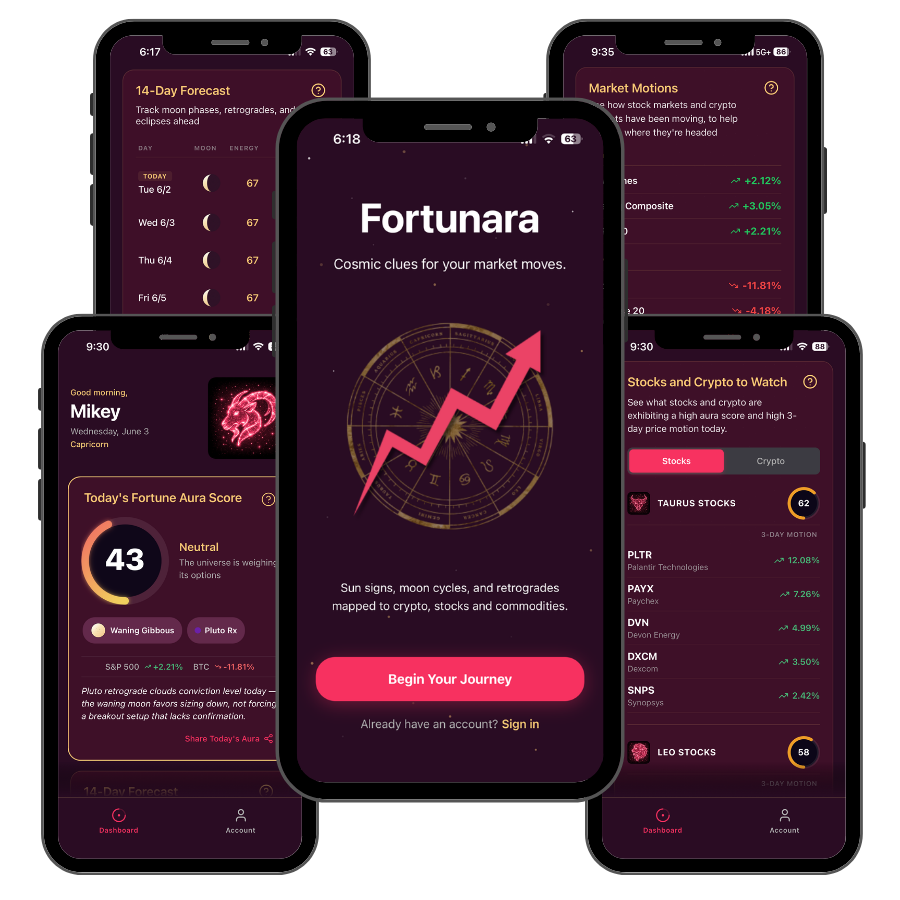
Get cosmic clues for your market moves.
Daily planetary signals mapped to your watchlist. Personalized to your sign.
Get Early AccessFor entertainment only. Not financial advice.
The Woman Who Legitimized Astrology in America
When Evangeline Adams arrived in New York in 1899, she was a 31-year-old astrologer from a Boston family with a complicated reputation. Astrology was practiced widely but quietly, associated with immigrant communities and working-class fortune-telling parlors rather than with the business establishment. She changed that.
Within a decade, Adams had built a client list that read like a register of the Gilded Age’s most powerful people. She commanded a waiting list for consultations. She published books that went through multiple editions. She eventually hosted a radio program that reached an audience of millions. When she died in 1932, she was the most famous astrologer in American history — and the practice she helped legitimize has never entirely left the boardroom.
Her significance to financial astrology isn’t just biographical. She represents the first documented case of mainstream financial power actively seeking and relying on astrological counsel. Everything that came after — Gann’s planetary methodology, Meridian’s quantitative work, the entire modern discipline — exists in a tradition she helped establish.
The J.P. Morgan Relationship
Adams documented her advisory relationship with J.P. Morgan directly in her autobiography, “The Bowl of Heaven,” published in 1926. The relationship was not a casual consultation. Morgan engaged her services regularly, particularly during the final years of his life. She provided astrological counsel that he incorporated alongside his financial analysis when making significant decisions.
The nature of that counsel was timing. Adams was not predicting specific stock prices or telling Morgan which companies to acquire. She was reading the quality of conditions — favorable or unfavorable — for major financial decisions at specific moments. This is the same application that serious practitioners use today: not prediction of outcomes, but assessment of the timing quality around high-stakes decisions.
The famous observation attributed to Morgan — “millionaires don’t use astrology; billionaires do” — circulates in various forms and the exact wording is uncertain. What Adams’s autobiography and Morgan’s documented engagement with her services confirm is that the sentiment captured in that phrase was real. The most powerful banker of his era found astrological timing counsel worth maintaining over years. Full FAQ answer →
The Client List
Morgan was not Adams’s only client from the financial and social elite of the era. Her client list included figures whose names still appear in American financial history.
Andrew Carnegie, the steel magnate who became one of America’s first billionaires, was among her clients. The King of Greece sought her counsel. Enrico Caruso, the most celebrated opera singer of the early 20th century, visited her. Mary Pickford, the first major film star, was a regular client. Newspaper publishers, Wall Street figures, politicians, and artists populated her waiting room.
What this breadth of clientele demonstrates is that Adams was not serving a niche market of believers. She was serving the most powerful people in America across every field. These were not credulous individuals — they were the era’s decision-makers, and they found her analysis useful enough to return repeatedly.
The 1914 Trial
In 1914, Adams was arrested in New York City for fortune-telling, then illegal under the city’s disorderly persons law. The charge was the same used against street-corner palm readers and traveling carnival operators. Her arrest was meant to put her in the same category.
The trial became a landmark event. Adams requested the opportunity to demonstrate the validity of her work. The presiding magistrate agreed, and handed her information about an anonymous individual — later revealed to be his own son — without providing the name or any identifying details. Adams cast a horoscope based on the birth information provided and delivered her analysis.
The magistrate’s ruling was unequivocal. He declared that her reading was so specific, so accurate in its characterization of the individual, that he could not classify her work as fortune-telling in the legal sense. She was acquitted. The New York Times covered the proceedings.
The significance of the ruling extended beyond Adams’s personal case. It established, in a New York court of record, that astrological analysis constituted a form of analytical practice rather than fraud or charlatanism. It was a legal distinction that shaped how the practice was regulated — and perceived — for decades afterward.
The Radio Years
Adams’s cultural influence extended beyond her private practice. In the late 1920s and early 1930s, she hosted a radio program that reached millions of listeners weekly. She brought astrological analysis into American living rooms on a scale that had not been possible before broadcasting.
The program covered general astrological themes, current planetary conditions, and their implications for everyday life. Financial themes were a consistent thread — not specific investment advice, but the broader question of whether the current sky favored or cautioned against risk-taking, expansion, or consolidation.
The audience Adams built through radio was the precursor to what we now recognize as the mass astrology market. She demonstrated, decades before the internet made it universal, that a significant proportion of the general population was interested in astrology as a practical tool for navigating uncertainty. The market she identified is the same market Fortunara serves — just available now at mobile scale.
Her Books and Legacy
Adams wrote several books on astrology that remained in print for decades after her death. “The Bowl of Heaven” (1926), her autobiography, provides the primary source documentation for her relationship with Morgan and the other details of her career. “Astrology: Your Place in the Sun” and “Astrology: Your Place Among the Stars” extended her reach to general audiences who couldn’t book consultations.
Her writing was notable for its accessibility. She wrote for readers who were curious but not initiated — the same audience that financial astrology practitioners today are trying to serve. She explained the system, its rationale, and its applications in plain language rather than technical jargon.
The tradition Adams helped establish — serious astrology applied to serious financial decision-making by serious people — is the lineage that runs through W.D. Gann, Arch Crawford, Bill Meridian, and into the current generation of financial astrology practitioners. Read the Gann story →
Why This History Matters for Modern Investors
The Adams-Morgan story is often treated as a piece of colorful historical trivia. It’s more significant than that.
It establishes that financial astrology has been practiced at the highest levels of American finance for more than a century. It was not invented for the internet. It did not emerge from retail trading communities in the 1990s. It was present at the creation of the modern American financial system, used by the man who twice stepped in to prevent national financial panics.
That history doesn’t prove astrology works. Morgan made mistakes. He was also wrong about plenty of things. But it relocates the conversation about financial astrology from the fringe to the mainstream — and that relocation matters for how investors evaluate whether the practice merits serious consideration.
Adams was doing manually, with laborious chart calculation and decades of accumulated pattern recognition, what modern financial astrology platforms synthesize automatically. The question she was answering — what are the timing conditions for this major financial decision? — is the same question Fortunara’s daily read is designed to address.
Common Questions
Did J.P. Morgan really say "millionaires don't use astrology; billionaires do"?
Is Evangeline Adams's autobiography available today?
How did Adams's approach compare to modern financial astrology?
Fortunara is for entertainment only. Nothing on this page constitutes financial advice.
The tradition Adams practiced — synthesizing planetary timing for high-stakes financial decisions — is what Fortunara delivers daily. The calculation overhead she spent years mastering takes about thirty seconds on a modern platform.
The tradition, made accessible.
For entertainment only. Not financial advice.